Our solicitor in the UK emailed to say that he's been in touch with the council about our house. They say that because we did the alterations before 1988 (and, presumably, because they were all internal) they don't require planning permission.
On the other hand, our buyer's solicitor might insist that we go through the process of drawing up plans and getting permission granted, which would be expensive and also very time-consuming. Even if they insist on a certificate that says we don't need permssion, that could apparently take six weeks.
So if either of those scenarios occur, we'll have to withdraw on the house sale here. At least it would force the decision.
Meanwhile, the lawyer here has been doing the legal searches on the house we hope to buy. He had some questions for one of the architects, and on Monday is meeting with the vendor (who is acting as his own lawyer rather than employing one) to check a few more details. The solicitor doesn't think they're going to cause problems, but wants to ensure he has all the pertinent information.
Which is fine, as far as we're concerned. This is what we pay lawyers to do, after all! If there is any problem beyond what we already know, we'd like to be aware of it. And the solicitor will be drawing up the contract, so he wants to be certain he knows all the facts before going ahead.
However, the estate agent is not happy. She rang Richard yesterday, shortly after he spoke to the lawyer, and said it was ridiculous how slowly things are going. She wants the contracts signed on Monday, she says that her lawyers could have pushed it through without all this fuss. She says the lawyer is too young (?!) - and 'unprofessional'.
Richard told her that he's doing what we want, and that in the UK we expect lawyers to be careful, rather than rushing things. They're supposed to protect the interests of the client, and that's what he seems to be doing. The agent said that's not what happens here. Richard reminded her that Cyprus is now in Europe, and that increasingly they're going to find that lawyers expect to follow European principles, and that buyers will want them too. She insisted, again, that it's 'unprofessional'.
Then we remembered that we've heard this strange usage of the word before - someone we know wanted to employ a musician for various events. The musician said she wanted to set her fees and hours in advance, and also let him know that she would not be available for a possible event six months ahead. The person wanting to employ her got angry, and insisted that she was ' unprofessional'... which seemed very odd, since she was in fact behaving as one would expect a professional musician to do, even though it's not usual here. Or hasn't been. More normal in Cyprus would be to agree to everything happily, then have a shouting match over the fees at some point in the future, and call in sick at the last moment for the event she knew she could not attend.
We thought it was just a mis-use of English by this particular person, but after the estate agent used it in the same incorrect way, we realised that they don't mean 'unprofessional' at all. They mean 'un-Cypriot'. If 'professional' means 'the way it's always been done in Cyprus, which works well most of the time' then naturally anything like a careful lawyer, or forward-thinking musician, will seem 'unprofessional'.
Saturday, February 11, 2006


Friday, February 10, 2006
Vanishing dustbins
For eight years, we've had two black plastic dustbins. They're old - one of them had quite a crack in the bottom - and fairly grubby, but they did their job. Every couple of days I emptied our inside bins into a black sack and put it outside in a dustbin. The dustmen come early in the mornings on Tuesdays, Thursdays and Saturdays (excellent service!) and empty them.
They were definitely here a week ago when I took a load of quick photos around the house and outside to put on a CD for Daniel.

See... right by the front of the car, in this little piece of one of the pictures of our front garden. (Uh, full of weeds... but the geranium is doing well). In fact, they were there Wednesday night when I put a sack of rubbish out.
But this morning, when we were getting in the car to do our weekly supermarket visit, Richard noticed that they had vanished.
It was quite a windy night, so we thought perhaps they had blown out into the street. But no, we couldn't see them anywhere. So maybe the dustmen had put them in our neighbour's front yard? Nope - no sign. Could they have been stolen?? Um... Theft is pretty rare in Cyprus anyway, but who on EARTH would steal two rather ancient, extremely tatty, partly broken dustbins?
So maybe they were so bad that the dustmen decided to throw them away along with the rubbish. I don't suppose we'll ever know.
Since we hope to be moving soon, we'll just put out the black sacks for now, rather than going to the trouble of buying a new dustbin. I don't even know where they can be bought from.
But it's very odd.
They were definitely here a week ago when I took a load of quick photos around the house and outside to put on a CD for Daniel.
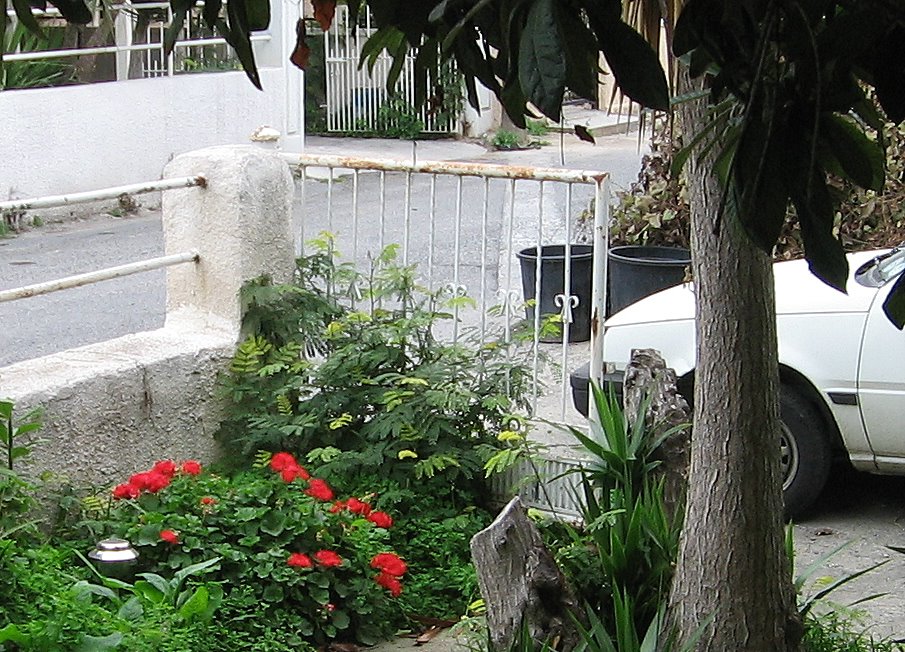
See... right by the front of the car, in this little piece of one of the pictures of our front garden. (Uh, full of weeds... but the geranium is doing well). In fact, they were there Wednesday night when I put a sack of rubbish out.
But this morning, when we were getting in the car to do our weekly supermarket visit, Richard noticed that they had vanished.
It was quite a windy night, so we thought perhaps they had blown out into the street. But no, we couldn't see them anywhere. So maybe the dustmen had put them in our neighbour's front yard? Nope - no sign. Could they have been stolen?? Um... Theft is pretty rare in Cyprus anyway, but who on EARTH would steal two rather ancient, extremely tatty, partly broken dustbins?
So maybe they were so bad that the dustmen decided to throw them away along with the rubbish. I don't suppose we'll ever know.
Since we hope to be moving soon, we'll just put out the black sacks for now, rather than going to the trouble of buying a new dustbin. I don't even know where they can be bought from.
But it's very odd.
Thursday, February 09, 2006
Good news, and another possible worry
The good news is, I had an email from Daniel. Yes, they're safely on the Doulos, doing yet more training. His phone is flat, and he hasn't yet had a chance to get the charger checked for safety, hence why he hasn't replied to text messages.
But the house situation seems to grow ever more complicated. This time it's about our house in the UK. We signed the contract and deed transfer document on Monday and they're now safely at our solicitor's office back in Birmingham. So far so good.
But a query has come up from the buyer's solicitor, for which we have to delve into history.
When we bought the house in Birmingham, way back in 1982, it had been used as a rental property and was converted to two separate apartments. A downstairs flat, with access via the back door only, and an upstairs two-storey one, with access via the main staircase near the front door. Rather like the place we're hoping to buy here, but with the staircase inside rather than outside.
The house was also in need of considerable repairs - new roof, damp-proof course, plaster renovation, rewiring, and various other things. So when we received our mortgage offer, it was on condition that we did the necessary renovation and conversion. We even managed to find the initial paperwork. The initial mortgage valuation includes the sentences:
"We have assumed, for the purpose of our Valuation, that the property will be converted back to a single dwellinghouse."
and:
"An entrance doorway requires forming between the ground and first floor flats, and the sink unit should be removed from the rear bedroom."
Since we wanted it as one house, this was no problem. When we received the actual mortgage offer, it said that it was subject to various legal things, and:
"Subject to the property to be reconverted to a single dwelling."
On the original document from the estate agent (yes, we even still have that!) there's the phrase:
"if required, relatively minor works of adaptation could be carried out to reconvert the property to a spacious private residence."
And yes, it was relatively minor. We did it ourselves on the day we moved in - knocked through an old doorway, and removed some of the blocking-in of the staircase. It took us several years to complete the renovations - we did a lot more than was required by the mortgage, and of course redecorated throughout - but the actual reconversion back to one house was the work of about an hour.
Well.
The solicitor of the lady buying the house has been doing the standard searches, and has uncovered something which we did not know: some years before we bought the house, the previous owner applied for planning permission to convert it into two flats. Perhaps because he wanted to rent it out, and rules for rental properties are quite strict.
However since the modifications were all internal, it never occurred to us that planning permission would be relevant. It didn't come up in the searches our solicitor did, as far as we know, and was never mentioned by the mortgage company, the estate agent, or indeed anyone else.
We HOPE that since it was so long ago, and didn't involve any changes to the look or structure of the house, that there will not be any problems. But we heard from our UK solicitor today (not the one we used 23 years ago) that he's been asked to check with the local planning office, to confirm that planning permission and/or building regs would not have been required.
Ironical, really. Our concerns about the house we want to buy here are that it may be difficult to sell again, since it doesn't have full planning permission for everything on the site. And now we find that our house in the UK is in a similar state.
Sigh.
But the house situation seems to grow ever more complicated. This time it's about our house in the UK. We signed the contract and deed transfer document on Monday and they're now safely at our solicitor's office back in Birmingham. So far so good.
But a query has come up from the buyer's solicitor, for which we have to delve into history.
When we bought the house in Birmingham, way back in 1982, it had been used as a rental property and was converted to two separate apartments. A downstairs flat, with access via the back door only, and an upstairs two-storey one, with access via the main staircase near the front door. Rather like the place we're hoping to buy here, but with the staircase inside rather than outside.
The house was also in need of considerable repairs - new roof, damp-proof course, plaster renovation, rewiring, and various other things. So when we received our mortgage offer, it was on condition that we did the necessary renovation and conversion. We even managed to find the initial paperwork. The initial mortgage valuation includes the sentences:
"We have assumed, for the purpose of our Valuation, that the property will be converted back to a single dwellinghouse."
and:
"An entrance doorway requires forming between the ground and first floor flats, and the sink unit should be removed from the rear bedroom."
Since we wanted it as one house, this was no problem. When we received the actual mortgage offer, it said that it was subject to various legal things, and:
"Subject to the property to be reconverted to a single dwelling."
On the original document from the estate agent (yes, we even still have that!) there's the phrase:
"if required, relatively minor works of adaptation could be carried out to reconvert the property to a spacious private residence."
And yes, it was relatively minor. We did it ourselves on the day we moved in - knocked through an old doorway, and removed some of the blocking-in of the staircase. It took us several years to complete the renovations - we did a lot more than was required by the mortgage, and of course redecorated throughout - but the actual reconversion back to one house was the work of about an hour.
Well.
The solicitor of the lady buying the house has been doing the standard searches, and has uncovered something which we did not know: some years before we bought the house, the previous owner applied for planning permission to convert it into two flats. Perhaps because he wanted to rent it out, and rules for rental properties are quite strict.
However since the modifications were all internal, it never occurred to us that planning permission would be relevant. It didn't come up in the searches our solicitor did, as far as we know, and was never mentioned by the mortgage company, the estate agent, or indeed anyone else.
We HOPE that since it was so long ago, and didn't involve any changes to the look or structure of the house, that there will not be any problems. But we heard from our UK solicitor today (not the one we used 23 years ago) that he's been asked to check with the local planning office, to confirm that planning permission and/or building regs would not have been required.
Ironical, really. Our concerns about the house we want to buy here are that it may be difficult to sell again, since it doesn't have full planning permission for everything on the site. And now we find that our house in the UK is in a similar state.
Sigh.
Wednesday, February 08, 2006
Surreal....
I know this is Cyprus, and things sometimes happen in an almost Discworldian style, but even so...
Yesterday, Richard asked the lawyer to proceed with searches on the house we want to buy.
Today he received an email from the lawyer, quoting his fees, and saying what he would be doing - drafting and negotiating the contract, stamping the contract, filing with the land registry. So far so good. Then it went on to say:
5. Look after the payments on your behalf (payments are done in stages according to work progress by the developers).
6. Apply to the Council of Ministers for the necessary permission to register the property on your name and of course Mr B.......'s.
Uh... but the house is already built so it's not in progress. And we have NO idea who the Mr B mentioned might be. Moreover, the subject-line in the email referred to 'property at L.......... Street' whereas we had understood the address to be 4, C........... Street.
Richard wrote back, asking if we had been sent an incorrect message.
The lawyer replied that the email was indeed intended for someone else, and apologised.
But then he went on to say that he referred to L.......... Street because the title sent from the estate agent concerns a propery at 4, L.................. Street!
I looked at the photocopy of the title deeds we were given. The map showing the plot is clearly marked (in English) as C........... Street. The text (in Greek) appears to have two addresses: one is the Greek equivalent (K................ Street) but there's also an address at L................. Street mentioned on the document.
Then I looked at the copy of planning permission for the upper two storeys, which we also had a copy of. It's not easy to read handwritten Greek, and the photocopy isn't very clear, but it does indeed look as though the address given is L............... Street.
Strange.
Richard phoned the agent. She said that streets in Larnaka are being renamed, so perhaps this was formerly C.............. Street, now L............... Street.
Hmmmm.
Well that might make sense - who knows what they might do? - except that the plans are dated 20 years ago, and the deed was most recently altered in 2005. Or so we think. Not being fluent in Greek (or in Cypriot culture, despite over 8 years living here) we're not quite sure what it means. And we certainly don't want to sign a contract for the wrong property!!
The agent will apparently phone tomorrow morning and confirm either way.
Sigh.
Still no news from Daniel, either. But we hope that 'no news is good news'. He's probably very busy. Or perhaps the email system isn't working properly, and messages are taking several days to arrive (as happened last summer). If the port is also out of range for mobile phones (unlikely, but I suppose possible) then he might not even have received our text messages.
Yesterday, Richard asked the lawyer to proceed with searches on the house we want to buy.
Today he received an email from the lawyer, quoting his fees, and saying what he would be doing - drafting and negotiating the contract, stamping the contract, filing with the land registry. So far so good. Then it went on to say:
5. Look after the payments on your behalf (payments are done in stages according to work progress by the developers).
6. Apply to the Council of Ministers for the necessary permission to register the property on your name and of course Mr B.......'s.
Uh... but the house is already built so it's not in progress. And we have NO idea who the Mr B mentioned might be. Moreover, the subject-line in the email referred to 'property at L.......... Street' whereas we had understood the address to be 4, C........... Street.
Richard wrote back, asking if we had been sent an incorrect message.
The lawyer replied that the email was indeed intended for someone else, and apologised.
But then he went on to say that he referred to L.......... Street because the title sent from the estate agent concerns a propery at 4, L.................. Street!
I looked at the photocopy of the title deeds we were given. The map showing the plot is clearly marked (in English) as C........... Street. The text (in Greek) appears to have two addresses: one is the Greek equivalent (K................ Street) but there's also an address at L................. Street mentioned on the document.
Then I looked at the copy of planning permission for the upper two storeys, which we also had a copy of. It's not easy to read handwritten Greek, and the photocopy isn't very clear, but it does indeed look as though the address given is L............... Street.
Strange.
Richard phoned the agent. She said that streets in Larnaka are being renamed, so perhaps this was formerly C.............. Street, now L............... Street.
Hmmmm.
Well that might make sense - who knows what they might do? - except that the plans are dated 20 years ago, and the deed was most recently altered in 2005. Or so we think. Not being fluent in Greek (or in Cypriot culture, despite over 8 years living here) we're not quite sure what it means. And we certainly don't want to sign a contract for the wrong property!!
The agent will apparently phone tomorrow morning and confirm either way.
Sigh.
Still no news from Daniel, either. But we hope that 'no news is good news'. He's probably very busy. Or perhaps the email system isn't working properly, and messages are taking several days to arrive (as happened last summer). If the port is also out of range for mobile phones (unlikely, but I suppose possible) then he might not even have received our text messages.
Tuesday, February 07, 2006
Stress....
Daniel should have joined the Doulos on Sunday. However we have not heard anything from him since Saturday night, and the Doulos site has just posted some 'news' dated today (7th Feb) saying that the new recruits 'are coming'... does that mean they aren't there yet, we wonder, or was this written a few days ago but only just published? Emails sent to the address he should have on the Doulos are bouncing straight back. Tim and Richard have both sent text messages on their mobile phones, but have had no response.
I'm sure if anything had gone wrong, or he was ill or anything, we'd have been told; but it's still a bit odd and beginning to worry me a little.
Added to that, we don't know what's happening with the house we hope to buy, or how soon our house in the UK will be sold. On Friday our solicitor in the UK told us he was sending a contract to sign via FedEx. Great, we thought. At least that means the sale is going through. However when the package arrived, it became clear that contract exchange isn't going to happen at once; all SHOULD be all right, and the solicitor needed our signatures on both the contract and the deed transfer document, so that when the time comes he'll have them ready. But he doesn't know if it will be by the end of February.
As for the house here... it still seems ideal in many ways. But the estate agent phoned on Saturday trying to persuade us to pull out, and look at some other properties. Which got us wondering why. We wondered if perhaps she had now seen the house, and realised it's probably worth more than the asking price. Or whether someone else has offered to buy it, who is willing to move more quickly.
Yesterday we instructed the solictor here to do the searches, and let the estate agent know that we do want to go ahead, assuming no further problems crop up.
Today she rang again, and said that the vendor now wants to make the house officially into two properties, with two sets of title deeds, and that his architect says it's perfectly possible (perhaps he'll draw boundaries where they don't exist, as on the plans for the upstairs two storeys!). Then he apparently wants to sell them separately, so he can get more money. The agent says she's told him he has to go ahead with the sale price as agreed while we're still interested... but who knows what will happen. We know from experience that the law is often ignored completely, and that as foreigners there's nothing we can do about it. We are also aware that some Cypriots are convinced that foreigners are wealthy, so perhaps the vendor thinks we would be prepared to pay more if he got the house somehow legalised.
So that all creates yet more stress. Relationships are all-important here, and we really don't want to antagonise the family selling the house, or get a bad reputation with the neighbours. If any more problems crop up, we probably will pull out. We certainly won't pay more for this house than the asking price, even though it's very good value and we might have paid more had a slightly higher price been given in the first place.
I do believe God's in control and that if we're not supposed to have this house, then something as good - or better - will come up. It's been suggested that we buy a plot and have a house built to our own specifications, ensuring it's fully legal and compliant. So we may consider that option if this one falls through. But in the meantime, it's hard to get anything much done as the whole process is so stressful...
I'm sure if anything had gone wrong, or he was ill or anything, we'd have been told; but it's still a bit odd and beginning to worry me a little.
Added to that, we don't know what's happening with the house we hope to buy, or how soon our house in the UK will be sold. On Friday our solicitor in the UK told us he was sending a contract to sign via FedEx. Great, we thought. At least that means the sale is going through. However when the package arrived, it became clear that contract exchange isn't going to happen at once; all SHOULD be all right, and the solicitor needed our signatures on both the contract and the deed transfer document, so that when the time comes he'll have them ready. But he doesn't know if it will be by the end of February.
As for the house here... it still seems ideal in many ways. But the estate agent phoned on Saturday trying to persuade us to pull out, and look at some other properties. Which got us wondering why. We wondered if perhaps she had now seen the house, and realised it's probably worth more than the asking price. Or whether someone else has offered to buy it, who is willing to move more quickly.
Yesterday we instructed the solictor here to do the searches, and let the estate agent know that we do want to go ahead, assuming no further problems crop up.
Today she rang again, and said that the vendor now wants to make the house officially into two properties, with two sets of title deeds, and that his architect says it's perfectly possible (perhaps he'll draw boundaries where they don't exist, as on the plans for the upstairs two storeys!). Then he apparently wants to sell them separately, so he can get more money. The agent says she's told him he has to go ahead with the sale price as agreed while we're still interested... but who knows what will happen. We know from experience that the law is often ignored completely, and that as foreigners there's nothing we can do about it. We are also aware that some Cypriots are convinced that foreigners are wealthy, so perhaps the vendor thinks we would be prepared to pay more if he got the house somehow legalised.
So that all creates yet more stress. Relationships are all-important here, and we really don't want to antagonise the family selling the house, or get a bad reputation with the neighbours. If any more problems crop up, we probably will pull out. We certainly won't pay more for this house than the asking price, even though it's very good value and we might have paid more had a slightly higher price been given in the first place.
I do believe God's in control and that if we're not supposed to have this house, then something as good - or better - will come up. It's been suggested that we buy a plot and have a house built to our own specifications, ensuring it's fully legal and compliant. So we may consider that option if this one falls through. But in the meantime, it's hard to get anything much done as the whole process is so stressful...
Thursday, February 02, 2006
Alongside the house saga....
... Life goes on. It's been chilly, grey and windy (though no rain) for a couple of days now. Rather miserable. I did a couple of loads of laundry this morning and hung them out, but will leave them overnight; that usually works best. I suppose a tumble drier would be a good idea for the rainier times of year (as suggested in a comment a while ago) but they're expensive to run, they use a lot of energy, and they're not particularly good for clothes. About half our clothes can't be tumble-dried anyway (they would either shrink or grow!) and of course if things get left in a drier for more than about ten minutes after it's finished, they crease and then need ironing.
So I much prefer hanging out in the fresh air where possible ... inside out, so they can just be folded and put straight away when they're dry. I iron about twice a year, and that's usually when Tim's playing in a concert needing a white cotton shirt, and it wasn't hung up properly so looks crumpled.
About ten o'clock this morning we went to the bank, to try to open a savings account. Since significant amounts of money will be transferred here while we're in process of buying a house, we thought we might as well get a bit of interest (current accounts don't give any here). There were lots of options but we chose one with instant access. Should have been easy, but there were computer problems at the bank, and it seemed to take ages before the printer produced the forms to sign (about six times each) to set up the account.
This afternoon Richard went with a friend who's in the building trade, and an architect, to look at the house we're still hoping to buy...details in the post below.
Shortly after they left a friend from Limassol arrived to collect some things his family left here when we last saw them, and we chatted a while. He mentioned that someone he knows, who's in Larnaka tonight, flying out tomorrow, will be visiting the Doulos at the weekend - and is going to make a point of saying hello to Daniel!
Tim took a look at our friend's laptop - he was asking some technical questions which I didn't understand - and then, after checking Dan's downloads and starting some more (thank goodness for Broadband!) he rushed off to his singing lesson. After that he had half an hour to eat before rushing out again to the 'Christianity Explored' course that his church is running. When he got back - with some doughnuts from the bakery - he started copying Dan's stuff onto CD.
While he was out, some more friends popped over for an hour to chat. Then Richard phoned the guy at the hotel who's going to see Daniel, and discovered that he has lots of luggage space! Wonderful... that means we can send the software CDs directly rather than having to put them in a package to Germany to be forwarded via air freight. We can also send out some more thin trousers and shorts, which he wanted (I've sent some but they probably won't arrive for several more weeks), and all the chocolate he had at Christmas but didn't have room for... and Richard's sending him a text message to ask if there's anything else he'd like while we have this opportunity. Apparently he'll actually join the Doulos on Sunday; we're not quite sure how the group will get there, but assume there won't be any more flights, so no more limits of luggage weight.
So I much prefer hanging out in the fresh air where possible ... inside out, so they can just be folded and put straight away when they're dry. I iron about twice a year, and that's usually when Tim's playing in a concert needing a white cotton shirt, and it wasn't hung up properly so looks crumpled.
About ten o'clock this morning we went to the bank, to try to open a savings account. Since significant amounts of money will be transferred here while we're in process of buying a house, we thought we might as well get a bit of interest (current accounts don't give any here). There were lots of options but we chose one with instant access. Should have been easy, but there were computer problems at the bank, and it seemed to take ages before the printer produced the forms to sign (about six times each) to set up the account.
This afternoon Richard went with a friend who's in the building trade, and an architect, to look at the house we're still hoping to buy...details in the post below.
Shortly after they left a friend from Limassol arrived to collect some things his family left here when we last saw them, and we chatted a while. He mentioned that someone he knows, who's in Larnaka tonight, flying out tomorrow, will be visiting the Doulos at the weekend - and is going to make a point of saying hello to Daniel!
Tim took a look at our friend's laptop - he was asking some technical questions which I didn't understand - and then, after checking Dan's downloads and starting some more (thank goodness for Broadband!) he rushed off to his singing lesson. After that he had half an hour to eat before rushing out again to the 'Christianity Explored' course that his church is running. When he got back - with some doughnuts from the bakery - he started copying Dan's stuff onto CD.
While he was out, some more friends popped over for an hour to chat. Then Richard phoned the guy at the hotel who's going to see Daniel, and discovered that he has lots of luggage space! Wonderful... that means we can send the software CDs directly rather than having to put them in a package to Germany to be forwarded via air freight. We can also send out some more thin trousers and shorts, which he wanted (I've sent some but they probably won't arrive for several more weeks), and all the chocolate he had at Christmas but didn't have room for... and Richard's sending him a text message to ask if there's anything else he'd like while we have this opportunity. Apparently he'll actually join the Doulos on Sunday; we're not quite sure how the group will get there, but assume there won't be any more flights, so no more limits of luggage weight.
House update
Today, Richard went with a friend who's in the building trade locally, and his recommended architect, to look at the house we're thinking of buying. They were armed with the plans which - we're told - were used for constructing the top to storeys, and a tape measure.
The good news:
The house appears to be structurally sound. There's a support shown on the plans which doesn't exist in the house, but it wasn't load-bearing. There's no sign of sagging, or recent repainting, and the architect is pretty sure there's no problem as far as that goes.
The plan showed a balcony which is now part of the living room on the middle floor. However Cyprus rules seem to revolve around whether a balcony is 'covered' or not. Since the top storey would have been over the balcony, it would have been covered according to the plan; so that too isn't likely to be a problem.
The not-so-good news:
Unfortunately, the plans show a plot which is slightly larger than the actual plot, assuming the fences are in the correct places. There's a regulation which says that properties should be at least three metres away from the boundaries, other than where attached to other buildings. The original downstairs flat was built exactly to specificiations, but the plans show two alterations to it: the outside staircase which leads up to the other part of the house, and a porch extension outside the kitchen which is then built over upstairs. Both of these come to within two-and-a-half metres of the boundary. There's also a small front porch downstairs, which eats into the three metres away from the street: apparently even this isn't allowed, despite the porch making the house considerably more attractive.
Because of these things, the house cannot receive a certificate of approval. If pushed, the planning office would say it can only be done if the front porch is ripped out, the staircase is removed, and the side of the house over the kitchen porch is taken out. In other words, it's not possible to draw up legitimate plans for the house as it is at present, which is what we had hoped.
It's also not possible to put an inside staircase between the ground floor and the middle storey. Houses like this aren't constructed to take stairs, so it would be a major undertaking requiring signifiant reconstruction.
The slightly worrying news:
Apparently this is not at all unusual. Our friend estimated that at least 80% of homes in Larnaka (indeed, perhaps the whole island) are similarly not officially approved. It's not a crime to build a house which doesn't meet the regulations, and most Cypriots don't care. Brits who want totally legal houses with approval certificates find that the only way to do so is to buy land out in one of the villages, and be involved right from the start in every aspect. That's the only way of ensuring that the building matches the plans, and the boundaries are far enough away.
But even that isn't a guarantee of anything, since plans can unfortunately be forged. We know of two families who bought new houses, having checked - as they thought - every aspect, only to find months later that the planning permission was actually for somewhere else, and the land they're living on wasn't supposed to have houses at all. They're in the middle of horrible legal battles, since the developer has vanished.
In other words - if we decide not to go ahead with this house, we may well find that we simply can't find anywhere that's fully legitimate, in the area we want. And indeed, we don't think any of the houses we've seen so far fulful the requirement to be more than 3 metres away from all their boundaries. There are many, many houses locally which go right up to the street with no gap at all. I'm not even sure our current rental house could get a certificate...
The interesting rumour:
A friend has heard that the government may be announcing a temporary window of time in which any houses like this can be given certificates, simply because it's too big a problem to solve. If this is true, future houses will be more strictly monitored, but older ones that are basically sound (like this one) will be made legitimate.
The bottom line:
We don't want to sign a contract until contracts have been exchanged on our UK house, so having this one slow down isn't a bad thing from our point of view.
Deeds can be transferred without the final certificate of approval - they'll just have the slightly strange comment that there are buildings which aren't registered. It wouldn't be a problem so long as we live there.
Even if there isn't an official window for registering, the planning office will sometimes go ahead and approve houses like this which almost meet the regulations, simply to get them off their files. If they don't, we can just apply again a few years later.
It might be difficult to sell, but then again most Cypriots aren't worried by such things, and if the worst came to the worst, we'd still own the land, and that's the main cost of houses here. Buildings are basically very inexpensive. It's a nice area, and house/land price are set to rise in the next few years.
The conclusion:
This house meets all our needs and wishes, and more.
So, we'll ask our solicitor to do whatever searches are necessary, and draw up a contract - but not hurry about it. We'll also try to check the plans at the planning office, just to ensure that there really was permission given for the two extra storeys to be built.
So at present, I think we're going to go ahead unless some major new problem occurs...
The good news:
The house appears to be structurally sound. There's a support shown on the plans which doesn't exist in the house, but it wasn't load-bearing. There's no sign of sagging, or recent repainting, and the architect is pretty sure there's no problem as far as that goes.
The plan showed a balcony which is now part of the living room on the middle floor. However Cyprus rules seem to revolve around whether a balcony is 'covered' or not. Since the top storey would have been over the balcony, it would have been covered according to the plan; so that too isn't likely to be a problem.
The not-so-good news:
Unfortunately, the plans show a plot which is slightly larger than the actual plot, assuming the fences are in the correct places. There's a regulation which says that properties should be at least three metres away from the boundaries, other than where attached to other buildings. The original downstairs flat was built exactly to specificiations, but the plans show two alterations to it: the outside staircase which leads up to the other part of the house, and a porch extension outside the kitchen which is then built over upstairs. Both of these come to within two-and-a-half metres of the boundary. There's also a small front porch downstairs, which eats into the three metres away from the street: apparently even this isn't allowed, despite the porch making the house considerably more attractive.
Because of these things, the house cannot receive a certificate of approval. If pushed, the planning office would say it can only be done if the front porch is ripped out, the staircase is removed, and the side of the house over the kitchen porch is taken out. In other words, it's not possible to draw up legitimate plans for the house as it is at present, which is what we had hoped.
It's also not possible to put an inside staircase between the ground floor and the middle storey. Houses like this aren't constructed to take stairs, so it would be a major undertaking requiring signifiant reconstruction.
The slightly worrying news:
Apparently this is not at all unusual. Our friend estimated that at least 80% of homes in Larnaka (indeed, perhaps the whole island) are similarly not officially approved. It's not a crime to build a house which doesn't meet the regulations, and most Cypriots don't care. Brits who want totally legal houses with approval certificates find that the only way to do so is to buy land out in one of the villages, and be involved right from the start in every aspect. That's the only way of ensuring that the building matches the plans, and the boundaries are far enough away.
But even that isn't a guarantee of anything, since plans can unfortunately be forged. We know of two families who bought new houses, having checked - as they thought - every aspect, only to find months later that the planning permission was actually for somewhere else, and the land they're living on wasn't supposed to have houses at all. They're in the middle of horrible legal battles, since the developer has vanished.
In other words - if we decide not to go ahead with this house, we may well find that we simply can't find anywhere that's fully legitimate, in the area we want. And indeed, we don't think any of the houses we've seen so far fulful the requirement to be more than 3 metres away from all their boundaries. There are many, many houses locally which go right up to the street with no gap at all. I'm not even sure our current rental house could get a certificate...
The interesting rumour:
A friend has heard that the government may be announcing a temporary window of time in which any houses like this can be given certificates, simply because it's too big a problem to solve. If this is true, future houses will be more strictly monitored, but older ones that are basically sound (like this one) will be made legitimate.
The bottom line:
We don't want to sign a contract until contracts have been exchanged on our UK house, so having this one slow down isn't a bad thing from our point of view.
Deeds can be transferred without the final certificate of approval - they'll just have the slightly strange comment that there are buildings which aren't registered. It wouldn't be a problem so long as we live there.
Even if there isn't an official window for registering, the planning office will sometimes go ahead and approve houses like this which almost meet the regulations, simply to get them off their files. If they don't, we can just apply again a few years later.
It might be difficult to sell, but then again most Cypriots aren't worried by such things, and if the worst came to the worst, we'd still own the land, and that's the main cost of houses here. Buildings are basically very inexpensive. It's a nice area, and house/land price are set to rise in the next few years.
The conclusion:
This house meets all our needs and wishes, and more.
So, we'll ask our solicitor to do whatever searches are necessary, and draw up a contract - but not hurry about it. We'll also try to check the plans at the planning office, just to ensure that there really was permission given for the two extra storeys to be built.
So at present, I think we're going to go ahead unless some major new problem occurs...
Tuesday, January 31, 2006
The house saga continues
This morning we met the solicitor. Nice chap, excellent English, and in typical lawyer-ese, proceded to tell us several 'worst case' scenarios that might apply to the house we want to buy. For instance: that the upper two storeys might never have had planning permission, so might need to be pulled down. He did say that a more likely scenario was that planning permission was applied for, and perhaps obtained: however as the deeds mention buildings that aren't registered, he suspected that either they had never officially been inspected and completed, or perhaps the builder had deviated from the plans and so couldn't get a completion certificate.
He then went on to say that of course it's Cyprus, and hardly anybody does anything by the book. He said that most people build extra parts to their homes without permission, or draw up official plans and then build something different. But people don't buy and sell frequently like they do in the UK; he inherited his home from his parents, and will pass it on to his children, and yes, he too has built extra parts which aren't legalised. However, he said that if he ever did have to sell, he would get retrospective permission and a final document before putting it on the market. If we go ahead and buy, and find later that there's a problem, it may be impossible to prove that we didn't put the building up ourselves.
So, he told us that what he needs is the certificate of completion. He also needs to speak to the vendor's solicitor, or the vendor himself if he doesn't have a solicitor. But he doesn't want to deal with the estate agent, who will have mixed motives.
After that, we went to speak to the estate agent, who seemed rather frazzled. She did produce some plans for the house showing the top two storeys, and said that the vendor had 'found' his planning permission, which he had previously said was lost. She said that he admits he's made a few minor alterations to what was planned, including covering over a verandah but she didn't think it was a problem. We looked at the plans carefully, and there seemed to be more differences than that, although as we've only seen the house twice (and didn't take any measurements) it's hard to tell exactly. We think the verandah hasn't just been covered over, it's been included as part of an extension to make a dining room. We also think there's another balcony been built (the utility area outside the kitchen) that's not shown on the plans, and - possibly more worrying still - an interior wall removed which includes a load-bearing support. Cyprus houses aren't built of bricks, but of concrete pillars and steel posts, so it's not quite like the UK.
The agent insisted it's not a big deal. She said that yes, the vendor could apply for inspection and certificate, but he'd have to remove all the structures that aren't in the plans to do so - which would be quite a major undertaking, and rather a nuisance too as we like what he's done. She said that as we want to turn the building back into one house, putting internal stairs between the ground floor and middle floor, we'd have to employ an architect to do that and apply for planning permission anyway - and so it would be better to get him to draw up plans for the house as it is now, plus what we want changed, and go from there. That does make sense: there's no point getting rid of the improvements, having that made official, then applying for them and re-doing them. Equally it would be a bit silly for the vendor to employ an architect to make plans for the house as it is now, and us to employ one separately to make plans for the change we want.
But what to do? That's the problem. We chatted with a British friend who's a civil engineer and understands house structures. He said the missing pillar may not be a problem, since some supporting structures in Cyprus aren't necessary - they're just there as corners of rooms. Or it may be vital, in which case it should certainly be put back. He also said it's possible that the plans we've seen aren't the latest ones; we should go to the town planning office and ask to see the most recent ones, to see if they match what we've seen or how the house is now. We should also take an architect to the house, to look at the structure, to discuss what we want, and to find out what would work and what wouldn't.
Richard also chatted with another friend who's in the building trade, who said he knows an excellent architect who might be prepared to work for us and help sort out this problem.
It does sound as if it's not as bad as the worst-case scenario, but it's still more complicated than we had hoped. No surprises, really; we know several people who have bought houses or flats here, and none of them have had a totally straightforward purchase. It's a bit strange in a country where there's almost no violent crime or burglary, that so many people think nothing of cheating on their taxes, changing houses without plans, and generally ignoring or deceiving large agencies such as insurance companies!
We do still want to go ahead on this house. Lots of people are praying, and it does seem exactly right for us. I don't like not knowing what path is ahead, or even what step we should take next, but am trying to be confident that it's all in God's hands.
He then went on to say that of course it's Cyprus, and hardly anybody does anything by the book. He said that most people build extra parts to their homes without permission, or draw up official plans and then build something different. But people don't buy and sell frequently like they do in the UK; he inherited his home from his parents, and will pass it on to his children, and yes, he too has built extra parts which aren't legalised. However, he said that if he ever did have to sell, he would get retrospective permission and a final document before putting it on the market. If we go ahead and buy, and find later that there's a problem, it may be impossible to prove that we didn't put the building up ourselves.
So, he told us that what he needs is the certificate of completion. He also needs to speak to the vendor's solicitor, or the vendor himself if he doesn't have a solicitor. But he doesn't want to deal with the estate agent, who will have mixed motives.
After that, we went to speak to the estate agent, who seemed rather frazzled. She did produce some plans for the house showing the top two storeys, and said that the vendor had 'found' his planning permission, which he had previously said was lost. She said that he admits he's made a few minor alterations to what was planned, including covering over a verandah but she didn't think it was a problem. We looked at the plans carefully, and there seemed to be more differences than that, although as we've only seen the house twice (and didn't take any measurements) it's hard to tell exactly. We think the verandah hasn't just been covered over, it's been included as part of an extension to make a dining room. We also think there's another balcony been built (the utility area outside the kitchen) that's not shown on the plans, and - possibly more worrying still - an interior wall removed which includes a load-bearing support. Cyprus houses aren't built of bricks, but of concrete pillars and steel posts, so it's not quite like the UK.
The agent insisted it's not a big deal. She said that yes, the vendor could apply for inspection and certificate, but he'd have to remove all the structures that aren't in the plans to do so - which would be quite a major undertaking, and rather a nuisance too as we like what he's done. She said that as we want to turn the building back into one house, putting internal stairs between the ground floor and middle floor, we'd have to employ an architect to do that and apply for planning permission anyway - and so it would be better to get him to draw up plans for the house as it is now, plus what we want changed, and go from there. That does make sense: there's no point getting rid of the improvements, having that made official, then applying for them and re-doing them. Equally it would be a bit silly for the vendor to employ an architect to make plans for the house as it is now, and us to employ one separately to make plans for the change we want.
But what to do? That's the problem. We chatted with a British friend who's a civil engineer and understands house structures. He said the missing pillar may not be a problem, since some supporting structures in Cyprus aren't necessary - they're just there as corners of rooms. Or it may be vital, in which case it should certainly be put back. He also said it's possible that the plans we've seen aren't the latest ones; we should go to the town planning office and ask to see the most recent ones, to see if they match what we've seen or how the house is now. We should also take an architect to the house, to look at the structure, to discuss what we want, and to find out what would work and what wouldn't.
Richard also chatted with another friend who's in the building trade, who said he knows an excellent architect who might be prepared to work for us and help sort out this problem.
It does sound as if it's not as bad as the worst-case scenario, but it's still more complicated than we had hoped. No surprises, really; we know several people who have bought houses or flats here, and none of them have had a totally straightforward purchase. It's a bit strange in a country where there's almost no violent crime or burglary, that so many people think nothing of cheating on their taxes, changing houses without plans, and generally ignoring or deceiving large agencies such as insurance companies!
We do still want to go ahead on this house. Lots of people are praying, and it does seem exactly right for us. I don't like not knowing what path is ahead, or even what step we should take next, but am trying to be confident that it's all in God's hands.
Subscribe to:
Posts (Atom)