Showing posts with label play. Show all posts

Sunday, November 08, 2020

The Benefits of Board Games

 I grew up in a family that played both board and card games. One of my grandmothers played bridge at a very high level, even (so family legend has it, anyway) playing for Scotland at times. She taught us to play Whist, and Hearts, and Rummy, and - eventually - Bridge. My other grandparents taught us to play Crazy Eights, another card game which, as I later learned, is the same idea as Uno. 

At home, my siblings and I would sometimes play Canasta, a card game that didn't necessarily require four players. We also played a lot of mah-jong, a bit of Scrabble, and various other games that we acquired, some better than others. Monopoly was popular with some of my siblings, although I found it a bit stressful. I have lots of memories of family board games on Christmas Day, or on holidays, or - as young adults - Sunday afternoons. 

I played board games with school and church friends too; I had quite a collection of two-player games. Mastermind was a favourite, as was Quandary. And I helped to run the Chess Club at my secondary school, although I was no expert at the game. But I couldn't remember a time when I didn't know the rules, or those of draughts (also known as checkers).  Then there were pencil-and-paper games for the car, or the back of class in a dull physics lesson...

It never occurred to me that there were people who didn't play games growing up, any more than it occurred to me that there were people who didn't like reading. And so, when our sons were born, we introduced them to games as early as possible, starting with Snakes and Ladders, Misfits and Pelmanism (Pairs), moving on to more interesting games as they got older. 

When we moved to Cyprus, we didn't take many games with us other than small packs of cards and travel games, so we were very pleased to discover that the Thrift Shop had quite a selection of games.  We learned, from colleagues, to play Rummikub and acquired a set of our own.  As the boys turned into teenagers, computer games became more interesting to them, but we still tried to play a family board game at least once a week. 

By the time we moved from our rental house to the one where we live now, we had sufficient different games to fill a biggish box - and since our cat Cleo insisted on sleeping in the packed game box, I even have a photo of it:

black cat sleeping in a box of board games

All too quickly the sad day came when both our sons had left home, and we were 'empty-nesters' for the first time. Amidst the adjustments, and the sadness that was sometimes overwhelming, I had the sudden awful thought: that we would no longer have the opportunity to play board games. Richard doesn't like games involving playing cards, and two-player Rummikub isn't all that interesting. He's not much of a fan of Scrabble, or other word games... and besides, we couldn't see ourselves sitting down to play a board game with just the two of us.

Within six months, we had made new friends; one couple who were happy to play Scrabble with us, and then other games, some of which they bought and brought back to Cyprus from their visits to their home country. And the family who were keen game-players, who introduced us properly to Settlers of Catan. 

Fourteen years later, we can't imagine life without playing games regularly. During lockdown, we played games over the internet; not ideal, but better than nothing. 

Playing Settlers of Catan online during lockdown


And now, at least for the time being, since we're allowed to have up to ten people (including us) in our house, we're back to our normal schedule of regular board games. Many years ago we established that every other Sunday afternoon our friends would come over for the afternoon and evening. The under-18s watch a film while the over-18s play a Catan game, usually Cities and Knights. There's something about Catan games that makes them eminently re-playable, and we're so familiar with them now that we carry on conversations while playing. 

Today we finished our game in under an hour, though it wasn't a creaming: we were all quite evenly matched right up to the end. So as the girls were still watching a DVD, we played a couple of rounds of Kingdominoes, a game one of our sons gave us for Christmas a couple of years ago, which advertised itself as the kind of game you play when you've finished something else and have half an hour or so available. It's a simple game that can be played by quite young children, but has some interesting strategies too, and each game is somewhat different. 

Scoring a game of Kingdominoes

If you look carefully, you'll see Alex, our large white cat, asleep in the Settlers game box, where he had established himself an hour and a half earlier. Our cats are very keen on game box lids. 

We also established, about six years ago, that my friend and her daughters come over on Tuesday mornings. When they were little we read them books, and they coloured, and played with Lego. Now the youngest is ten, we play board games every week.  Sometimes Settlers, sometimes Probe, sometimes Mastermind, Probe, Rummikub... as well as regular games of Ligretto, a fast card game that I like very much, despite not being particularly good at it. 

A few years ago we also got into the routine of playing Cities and Knights with our adult friends one mid-week evening every week, and nearly three years ago we decided to play a non-Settlers game every Saturday evening. We had been given several excellent board games, but didn't seem to find the time to play them sufficiently to think about any kind of strategy. Our games cupboard was filling up, and there were some games which we played so rarely that we felt almost as if we had to learn them from scratch every time we played them. 

games cupboard, organised by category

So we played, in turn, Agricola, Above and Below, Puerto Rico and Grand Austria Hotel, once a month each for a year, then in 2019 introduced a few others to the mix as we became familiar, at last, with these diverse games.  

I keep the games roughly organised, as seen in that photo, with the 'party' type games at the top right, and the ones we like playing the most, the strategy games with tangible pieces and boards, on the bottom right. At the top left are the two-player games, and at the bottom left are the others - the card-based games, variations on Carcassonne, Rummikub, Upwords and so on.

I learned recently that the ones I categorised as strategy games are known as Euro-style games, or German board games. Most of them originated in Germany, which apparently is an excellent country for creating coherent, interesting board games. 

Occasionally someone who hears that we play games regularly raises their eyebrows, or looks confused. 'We used to play Monopoly with the children...' they might mutter. Or 'I suppose the occasional game of chess whiles away the time.'  But there's so much more to it than just entertainment. For one thing, playing games is a great way to socialise, to build up and establish friendships. 

Of course, board games are important for young children, to help them understand the importance of taking turns, of being patient, of low-key competition in a friendly way, where it doesn't matter if one wins or loses. Some children are naturally gracious losers, others find it more difficult; but by playing a variety of games, where each child will succeed at times (even if, at first, subtly helped by the parent) they should gradually learn to accept that other people will sometimes win too, and that concentration and developing skills can help them improve. 

For older people like us, playing board games helps to keep our minds active. It also encourages us to exercise our strategic, tactical, logistical and diplomatic skills - the four different 'intelligences' connected with the four temperaments as identified by Keirsey. A board game is an excellent way to develop our least preferred intelligences, and to see their usage in a non-threatening environment. 

Since someone else has written a useful article, I'll link to this interesting page about the benefits of board games as it explains some of what I've mentioned, in a bit more depth.

Of course, computer games have some of these advantages too - and when they're social, played on Facebook with friends, just taking one or two turns each day, they're a nice way of staying in touch and another exercise of strategy, fast thinking or whatever is needed.  I play Lexulous - similar to Scrabble - online, and usually have about eight or nine games ongoing. I play one or maybe two moves per game per day - it's hardly time-consuming.  Another social game I play with three different people, at present, is Word Blitz; it's essentially a quick version of Boggle, with Scrabble-style scoring. 

But there's nothing to beat a group of friends or relatives around a board game, and we're very thankful that, so far, we're still allowed to do this in Cyprus. 

Tuesday, October 28, 2014

Misfits

 When my sons were small - over twenty-five years ago - I looked for simple board games that they could play, to introduce the ideas of taking turns and of observing specific ‘rules’ for the course of a game. One of our favourites was called ‘Misfits’. I gave it away when my sons outgrew it, but a couple of years ago I managed to find an updated edition inexpensively, and bought it to play with a friend’s young children. It was an instant success.


COMPONENTS OF MISFITS

Inside the box, if it’s bought new, are cartoon depictions of twelve differently costumed ‘people’. These include, a ballet dancer in a pink tutu, an astronaut dressed to walk on the moon, a cheerful clown, a warty witch and a white-garbed chef. They’re caricatured, of course, so instantly recognisable by adults and older children; it’s not hard for little ones of two or three to learn what they are if they don’t know. 


There is also a single sheet with instructions, explaining that this game is for 3-6 players, aged three and above.


AIM OF MISFITS


Each of the twelve caricatured people is made up of five thick pieces of card that are easily separated: a ‘hat’ (or other headgear) of some kind, a face, a body, and two individual legs. The aim of the game is to create individuals with the correct number of body parts - but as ‘misfits’. So, for instance, a pirate’s hat can be on a witch’s head, with a chef’s body and a pair of ballerina legs.  And there’s the catch: the legs must be in a matching pair. 


PLAYING MISFITS

The cards are placed face down on the table or floor, and muddled together in a pile. Each player takes seven of the cards and looks at them. With little children, of course, it’s easier just to lay them out on the table in front so older players can help them, but they’re supposed to be kept private.  


Misfits


The first person to find a hat card places it on the table, and play then continue clockwise. The person on the left of the starting player can either play another hat, if they have one, or they can play a face card directly underneath the hat that has been played. The person to their left can then play a hat, or (if the second player placed a hat) a face, or (if the second player placed a face) a body. It takes longer to type than to explain; the idea is that each ‘misfit’ is built up a piece at a time, starting at the top. 


At the end of the round each player draws another card from the pile, and play continues until all cards are used up. If a player cannot play a card, they pass their turn and do not draw an extra piece from the pile.


Whoever finishes a misfit creation (by playing the second leg) takes it, and it counts as one point.  Thus the only ‘strategy’ to the game is to avoid playing a leg when there are other options, in the hope that someone else plays the matching one first. Of course, if a player has a matching pair of legs, then winning that misfit creation is guaranteed. 


CHILDREN’S OPINIONS

My sons, and more recently my friends’ children (three girls) all liked this game when it was first introduced to them, and understood the rules quickly. It’s actually suitable for children younger than three so long as they don’t put the pieces in their mouths; I assume the 3+ recommendation is for safety reasons. My sons would have been about four and two when they first played it; the youngest of my friend’s daughters was nearly three. Even at two the idea of taking turns was familiar to them, although there were a few complaints, now and again: ‘But I want to play two pieces!’ or ‘He’s taking too long!’


I thought at first that having only twelve characters would make the game too quick, but in fact it’s about the right length; there are 60 pieces in all, so with four players that’s fifteen rounds - more than enough for a small child. Occasionally they’ve got bored part-way through and we’ve then just put the pieces away; other times (particularly with the girls) they want to make up the ‘real’ characters with the correct body parts, so that’s usually another five minutes of entertainment at the end.


ADULTS’ OPINIONS

This is not a very interesting game for anybody over the age of about six, although I’ve had children of eight or nine play it with younger children. However, played once or twice per month it’s not too irritating, and since part of the fun is making silly characters, nobody seems to mind who wins. 


Since there is no reading involved, and no counting, it’s playable by any child who is able to take turns and who has some idea of how bodies go together. It’s a great way to introduce the concept of following specific rules in a game - useful in helping children understand the concept that different people have different ‘house rules’. It’s also easy enough for an adult to manipulate the winnings slightly - by choosing when to play or withhold a leg - and since it’s mostly luck, a very small child has just as much chance of winning as an adult. 


The pieces are big enough that they’re unlikely to get lost, and since we don’t allow food with games, and always have hands washed before playing, the cards have remained in good condition. 


POLITICAL INCORRECTNESS

Misfits is, of course, not a game to be taken seriously. In the version my sons had, there were slightly different characters including a kilted Scotsman and a South Sea island girl in a grass skirt. These do not feature in our current edition, so I can only assume that they were withdrawn due to perceived problems with racial stereotyping. Fair enough, I suppose, although small children are unlikely to be prejudiced. However there are now only three female characters amongst the twelve, and since the evil-looking witch and mermaid are not real, I feel that the danger of sexism is possibly worse; the only ‘real’ woman is the skinny ballerina.


Friday, December 06, 2013

Alice's Wonderland (in Cyprus)

A long overdue review... 

It's almost four weeks since the premiere of 'Alice's Wonderland', at Scala Theatre in Larnaka. Our friend Catherine was the creator of this amazing stage show for children; formerly with Theatre Antidote, she now runs 'Little Muse Youth Theatre', and this is her first professional production under that banner. The show is loosely based on Lewis Carrol's classic 'Alice in Wonderland', with a nod to the 1999 film adaptation, which begins with a moody Alice refusing to sing for her rather harsh and pushy parents. 

In the Little Muse version, Alice is played by Catherine, and all the other parts are performed by Lefteris, a musician who specialises in using recycled materials.  As we entered the theatre, about twenty minutes before the play began, Lefteris was giving us a wonderful demonstration of his talents on the drums, with occasional calls of 'Alice!'  


In Cyprus it's normal for people to arrive late, so it's quite a tribute to Catherine's advertising and charisma that the first members of the audience had waited for more than half an hour before they could go in. Invited guests had been allocated seats, but for everyone else it was 'first come first seated' - although in Scala Theatre pretty much every seat is a good one. And with ten minutes to go before the opening, most of the seats were filled: 


Lefteris plays Alice's father at the start of the show. He's a travelling musician who really wants his only daughter to sing.. but she can't. Her early attempts at music are really quite painful:


However she's more than willing to announce her father when he performs: 


He won't give up. He dresses Alice up, and is determined to make her sing:


In desperation, she runs away. And suddenly she finds herself meeting the oddest of characters... 

Those familiar with the classic book will recognise them, but it's not necessary to know the original story. I was so engrossed I forgot to take many more photos. 


Lefteris is a natural comedian as well as a musician, and manages to play the March Hare, the Queen of Hearts, and also the Mad Hatter: 


The backdrop works like the pages of a book, something I had never seen before, moving back and forth to show us the different scenes - and it all works flawlessly.  Naturally Alice learns to sing in the course of the show, and becomes more confident, encouraging the audience to follow their dreams. It's a message that might be thought most appropriate for older children and teens, yet there were children as young as two and three who were absolutely engrossed by the story.  

This fifty-something adult was also captivated.  The pace is perfect, with no scene too long, and just enough humour to ensure a little laughter without breaking the flow.

All in all, it was magical. 

For those in Cyprus who would like to see this show, the 'Alice's Wonderland' Facebook page has details of all performances.

Sunday, April 28, 2013

Outing to Stratford while not in Cyprus

On Thursday, we had a day out.  One of my birthday presents was tickets to see 'As you Like it', in the new theatre in Stratford, by the Royal Shakespeare company.  Tim decided to treat us, and also himself; he's been to see plays a couple of times since living in the UK, but had not been to the new main theatre.

It was a matinee performance, starting at 1.00pm. We allowed plenty of time to get to Stratford, taking lunch with us to eat beforehand. We had no idea where to park, but then Richard spotted one that appealed to him:


It wasn't even too horribly expensive, by UK standards. 

The 'marina' nearby was just for narrowboats: 


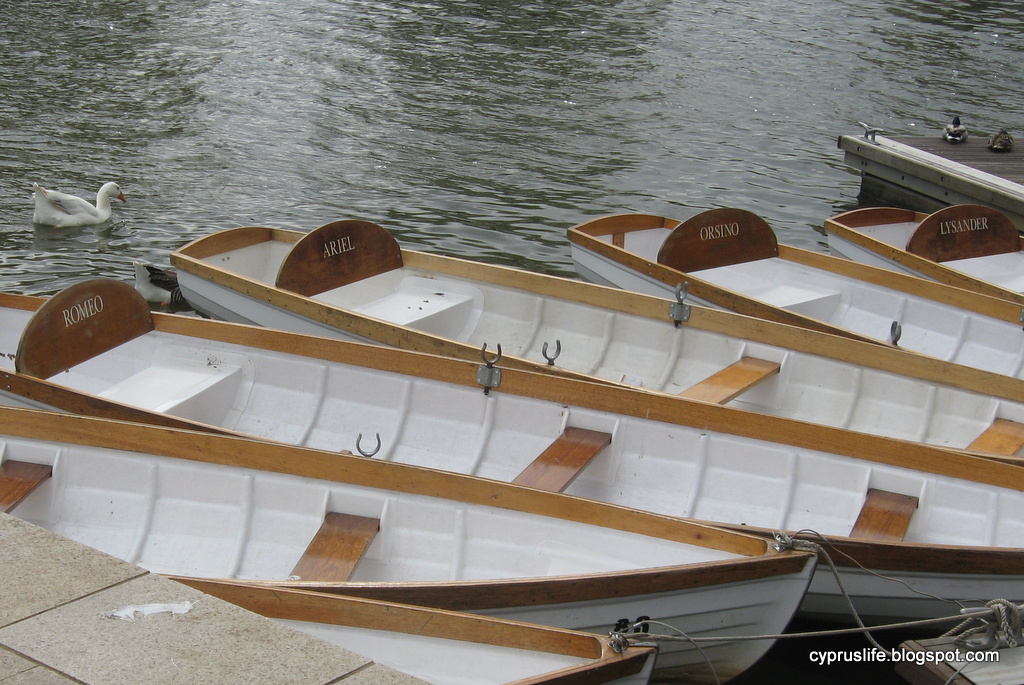
We were amused that the small rowing boats available for hire were named after Shakespearean characters: 


We were very close to the big park which contains the theatre, and it was even reasonably sunny:


I wasn't so impressed with this statue, which (at this angle) looked as if it was picking its nose (ugh):


We saw lots of swans in the river, probably hoping for pickings from tourists (though I do know that one isn't actually supposed to feed bread to birds as it's not good for them). 


The new theatre is attached to the side of the old one, which looks very scruffy now, even with some broken windows:


We went for a walk, then sat in the park to eat our lunch.  Around 12.30 we went into the theatre, had some coffee, and then went to find our seats.  Photos aren't allowed during the performances, but I did take one beforehand showing the stage and the layout of the seats: 


'As you Like it' was amazing - it started with two of the main characters in modern dress coming out to sweep the stage... minimalist scenery, and a revolving part of the stage made it work beautifully, and the main actors were excellent. There was some great music too, and one piece in the second half which earned a round of applause on its own.

The RSC are renowned for not doing 'traditional' Shakespeare... and yet, watching this, with the men in modern suits and some decidedly bawdy humour and gestures, I realised that it was probably closer to the original concept which was, after all, contemporary as far as Shakespeare was concerned.  Here are some of the official production photos on the RSC website.

If I have a single complaint about the production, it would be the number of cigarettes smoked by actors and actresses! The air conditioning was good enough that we didn't smell anything, but it seemed like a very odd idea, which added nothing to the show, and was a terrible example to the many school groups watching.

I'm not a huge Shakespeare buff, but I do enjoy his comedies... and, as usually happens, I found that after the first half hour or so the language started to feel quite natural.  Out of curiosity I looked back to see which other plays we had seen in recent years; it really isn't many.  In 2010 we saw 'The Merchant of Venice' in Kurium (in Cyprus), which was excellent, albeit fairly 'traditional' in the way it was done.  The time before that was as long ago as 2006 when we saw 'A Midsummer Night's Dream', also in Kurium, with some very ingenious scenery.  We also saw 'Twelfth Night' in Kurium back in 1999.

We could remember, too, that we saw a visiting company doing something in a cultural centre in Nicosia, the same year that we saw 'Midsummer Night's Dream', but had no recollection at all of what it was.  Just as well I keep these records in this blog: it was the work of a moment to search through and find the event.  But I was very surprised to discover, on reading the relevant post, that in our cultural afternoon in Nicosia we saw, as we did on Thursday, 'As you Like it'.  We evidently liked it very much, but I had completely forgotten and was convinced I had never seen it before....