Showing posts with label renovation. Show all posts

Tuesday, June 21, 2022

Restoration of Bathroom Renovation

 In my previous blog post, I mentioned that we were having some work done upstairs, and that I would write about it when it was complete. 

To introduce it, I need to backtrack six years, when we employed a local builder to remove the old-fashioned bathroom from our house and instal a new one, with an extractor fan, better lighting, and an altogether more modern appearance. We were very pleased with the result. 

Anyone who is curious to read more about it can check the lengthy post I wrote at the time about our bathroom renovation

However, about a week after we had been using the new shower regularly, I realised that a couple of the tiles around the tap didn't look quite the same as the rest. I thought I was imagining it at first. Then I wondered if we had somehow bought a box of tiles in a slightly different shade but hadn't noticed at the time. This theory was disproved when a third tile started changing colour. And we found some water on the floor. It wasn't just shower water that had splashed over; this was behind the bath, where there shouldn't have been any water.

And then we noticed some of the paint starting to bubble on one of the walls. We contacted the builder - I don't recall the time-frame, but it was probably some months after the renovation. He came back, and said that the bubbly paint was possibly due to the plaster not having dried out fully before it was painted. He was more concerned about the water and the different shades on the tiles, and he managed to find a joint that wasn't quite right. 

He said he had employed a plumber who rushed his work and had made some other mistakes. So he fixed this leaky pipe joint, and said he would talk to his brother - who is a plasterer - about getting the bubbly paintwork dealt with. 

Time passed. Not months but years.  If we were away for more than about a week, we returned to find that all the tiles were the same colour, but a couple of days later, with regular shower use, the ones around the taps turned back to the different shade.  And the patches with bubbly paintwork turned into large patches of bare wall, including one in the wall outside the bathroom which seemed to be getting worse and worse. 

The builder and his brother did come and look at the bathroom a couple of times, where the walls were getting worse, and said they would come back some time. But they're very busy with other work, and it didn't happen... and we didn't know anyone else who would be able to do the work. Word of mouth is the best way to find skilled handymen here, but unfortunately most of the people we knew with experience of this kind of thing had been disappointed (or worse). The people we used were some of the best locally. 

A young friend who had done some other work for us suggested that perhaps the sealant around the bath was causing the tile problems, and added some more. It looked good, but didn't seem to make any difference to the colour of the tiles. 

More years passed, with the pandemic stopping everything from happening, and finally we talked to another young friend, whom I will refer to as L, the son of some close friends who has worked with a builder in the UK, and did some excellent plastering for us downstairs. He doesn't particularly like working inside - his passion is horticulture - but he said he thought he could fix our problems working just an hour or two per day for a couple of weeks. 

This is what the wall outside the bathroom looked like when L had removed the radiator, and chipped away the loose plaster. He said the wall was very damp, so clearly there was a problem inside the wall, one which he could only tackle from the bathroom side. 


This was what the wall inside looked like: 

And this is the wall opposite, where plaster had fallen away but it was no longer damp, and it had stopped getting worse. The problem that caused this was that the exterior wall had been sucking in water; a year or so ago L had painted the outside wall, which stopped any more damp getting in.

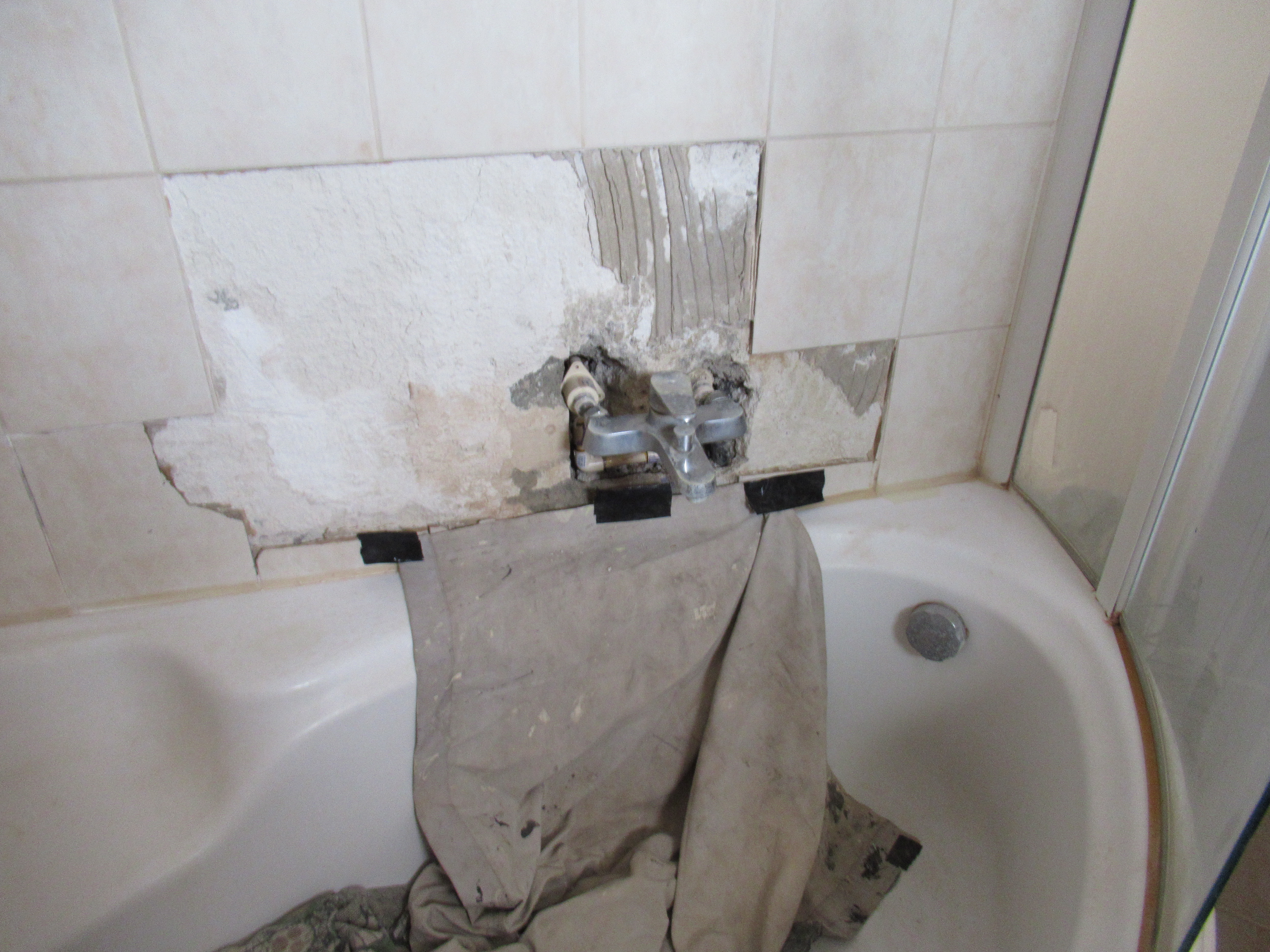
A couple of days later, the tiles around the taps looked like this:


In pulling away the worst of the tiles, L discovered others that almost fell off the wall. 

The timing worked well, as there were no visitors in our guest flat during May, so we were able to go downstairs to shower. Not ideal, as the guest flat stairs are outside, but we were thankful to have that option while the bathroom was unusable. 

We were also very thankful to have discovered an almost-full box of the tiles. That meant we didn't need to try to find matching tiles, or - worse! - replace all the tiles. And in feeling around the plumbing, L found a place that was wet - a joint that had never properly been made, which was the cause of the leaking. At least, he hoped that was the only cause. He managed to fix it, and then we had to wait for everything to dry out. 

All seemed to be dry a week or so later, so he started plastering. First he used the mixture commonly used in Cyprus that looks to us more like concrete:


He plastered the other walls too, and then we had to wait for those to dry out. May was a good time for this to happen; it was warm but not yet humid, and we were able to use a small upright fan to help the process. 

Over the course of the next few days, further plastering happened. Then there was a big leap forward in terms of appearance ,when L called in his brother J to help with the tiling. 


Alex, who appears sporadically in this blog, assumed that the dust sheet was put there for his comfort, and tried to persuade us to turn on the taps to give him a drink. He was rather annoyed when we refused, not wanting any excess water until everything was complete. 

The walls opposite and outside were also being plastered, and sanded, and skimmed, and looked better than they had in years.


Since we were having all this done, and since our previous shower fittings had become quite corroded, we decided to splash out (so to speak) on new fittings, which improved the appearance significantly: 


I wouldn't have minded too much if we had had to change the colour of the bathroom walls, as the orange used six years ago was rather more vivid than I had anticipated. But when we found a half-full pot of the paint, it was an easy decision to use that rather than embarking on a complete re-paint. Richard and I did the painting (mostly Richard) and at last, over a month since it was started, our bathroom was back to how it was after the first renovation six years ago:


It was very good to be able to take a shower in our bathroom again after more than three weeks of having to go down two flights of stairs (one of them outside). We know we're very blessed to have options like this, but guests were expected for our flat early in June. 

Here's the wall next to the bath:


And here's the one opposite:


The only thing remaining was for L to cut some more skirting board pieces and fit them, which he did a few days later. 

We've been using the shower for nearly four weeks now, and are delighted - and relieved - that none of the tiles is showing any indication of changing colour, nor is any of the plaster bubbling or crumbling. And, as mentioned in the previous post, our Roomba has worked hard at eliminating the last of the plaster dust. L did an excellent job tidying and sweeping every day he came, after finishing, but inevitably there was fine dust that kept falling. 

We hope that this bathroom renovation will last considerably longer than six years, and appreciate it all the more after having been unable to use it for most of May.

Tuesday, March 22, 2016

A Cyprus style damp proof course

When we first moved to Cyprus, someone explained to us that the older houses - and some of the newer ones - suffer from rising damp. Because of their construction, the kind of damp proof treatment that we knew of in the UK was not possible. However, we were assured, it wasn't a huge problem. With the long hot summers, everything dries out nicely, and it's easy enough either to rub down and repaint each year when damp showed in the walls, or to have a kind of hardboard layer in front of the walls to stop it showing.

That was all very well in the house we rented, which we knew would eventually be pulled down. And those were the drought years in Cyprus. But then we bought our own house ten years ago, and there has been more rain. Moreover, since we use our downstairs floor as a guest flat rather than living in it all the time, a musty smell developed in several cupboards. Guests in the warmer months have opened windows and doors and let fresh air in, but those staying in the winter have experienced problems with mould growing on walls of one of the bedrooms, and the bathroom ceiling. It was fairly easy to wash off with some vinegar, but we started talking about what we could do to decrease the damp and condensation.

Doing some research online, we both came across the site of 'Dr Damp'. This is a company who claim to do the only reputable damp-proofing in Cyprus, and to have gained a good reputation across Europe. So, at the end of January, we arranged for them to come and do a survey. Richard went around the guest flat with the guy who came, watching the damp meter and learning about the method they use. We were told that we did have a damp problem: not yet a serious one, but it could become one in the next few decades. The system is guaranteed for twenty years and it sounded entirely reputable, if rather expensive.

Since it's Cyprus we wanted a personal recommendation rather than just affirmations on the website, and a friend remembered that some other friends had had a damp-proof system installed a year or two previously. I got in touch, and we were assured that the Dr Damp team do a great job, and are friendly and professional. It all seemed like a good thing to get done, and we inherited money from my mother a couple of years ago... so we booked the treatment for the second week of February, knowing that the flat was going to be empty from then until almost the end of the month.

Despite the company being based in Paphos, the men arrived fairly early on the Monday morning, and the house reverberated with power tools for several hours as they drilled out the rectangular holes that form the first part of the process for all the external walls.  These are what we saw, all around the outside of the house, by the end of the first day:


They don't go right through to the inside so it's not going to create draughts.

By the end of the second day, the special system was in place - here's a different part of the wall, showing how they had to cut away some of the paintwork to install each one.


The men were indeed very friendly - even helping to rescue our cat Alexander when he got stuck up a neighbour's tree - and cleaned up all the mess they had made, roughly plastering over the worst of the bits of wall they had hacked away.

There were some internal walls that were damp too, and they had to be treated with chemicals, so we had to move everything out of the way so they could do that:


If you think that really doesn't look too bad, this is what the guest flat kitchen/dining room looked like by the time furniture and various other things had been moved to enable the damp proofing:


After three days the Dr Damp guys left, and we paid our teenage friend Jacob to do the plastering and repainting, and some other painting that was long overdue.

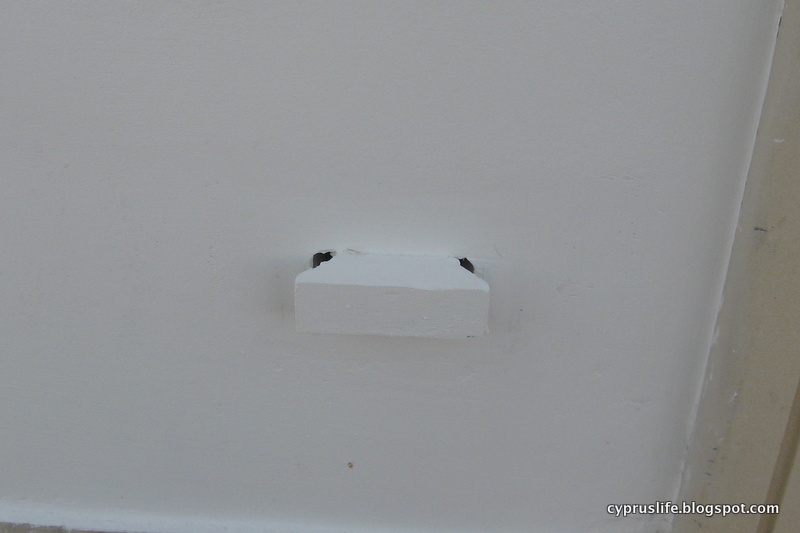
Here's the first stage, around the new system. Of course it was important not to fill in the holes around the triangular stone things: that's where the airflow, in and out, removes damp from the walls.


Unfortunately, in rubbing down and sanding some of the exterior paintwork and plaster, more pieces fell off, showing that the damp had indeed taken a hold in places. So Jacob worked rather more hours than we had anticipated, but did an excellent job.  By the time he had finished, the damp proof system looked more like this:


Once the sanding and necessary inside painting was complete, we had quite a job to clean the guest flat, which by that stage was covered with a fine layer of dust. So we removed and dusted all the books (only about a thousand of them, but still... quite a task), and I washed every single piece of bedding that I could find, and all the towels and curtains too.  The washing machine was in use at least a couple of times every day - thankfully it was good drying weather - and I also used our carpet shampooing machine to clean all the mattresses.

We swept and dusted and mopped several times, and I also sorted some of the kitchen cupboards, cleaning away any mould that had grown, washing all the things inside, and getting rid of some bits and pieces that had evidently never been used.

And, at last, the living room was back to its usual self, albeit rather cleaner than it has been for a while, in preparation for our end-of-February visitors:


The kitchen, too, was clean and sparkling, the windows freshly washed, the floor reflecting the sunlight:


We were told that it could take two or three months before the damp smells vanished entirely, but the bathroom cupboard - which was very bad - smelled fresher within about a week, and the kitchen cupboards are a great deal less musty than they were, although not yet perfect.

This won't entirely solve the condensation problem: however, Richard is going to install an extractor fan in the bathroom, and we hope that the reduction of damp in general will make the master bedroom less likely to grow mould on the walls too.