Showing posts with label leaking. Show all posts

Tuesday, June 21, 2022

Restoration of Bathroom Renovation

 In my previous blog post, I mentioned that we were having some work done upstairs, and that I would write about it when it was complete. 

To introduce it, I need to backtrack six years, when we employed a local builder to remove the old-fashioned bathroom from our house and instal a new one, with an extractor fan, better lighting, and an altogether more modern appearance. We were very pleased with the result. 

Anyone who is curious to read more about it can check the lengthy post I wrote at the time about our bathroom renovation

However, about a week after we had been using the new shower regularly, I realised that a couple of the tiles around the tap didn't look quite the same as the rest. I thought I was imagining it at first. Then I wondered if we had somehow bought a box of tiles in a slightly different shade but hadn't noticed at the time. This theory was disproved when a third tile started changing colour. And we found some water on the floor. It wasn't just shower water that had splashed over; this was behind the bath, where there shouldn't have been any water.

And then we noticed some of the paint starting to bubble on one of the walls. We contacted the builder - I don't recall the time-frame, but it was probably some months after the renovation. He came back, and said that the bubbly paint was possibly due to the plaster not having dried out fully before it was painted. He was more concerned about the water and the different shades on the tiles, and he managed to find a joint that wasn't quite right. 

He said he had employed a plumber who rushed his work and had made some other mistakes. So he fixed this leaky pipe joint, and said he would talk to his brother - who is a plasterer - about getting the bubbly paintwork dealt with. 

Time passed. Not months but years.  If we were away for more than about a week, we returned to find that all the tiles were the same colour, but a couple of days later, with regular shower use, the ones around the taps turned back to the different shade.  And the patches with bubbly paintwork turned into large patches of bare wall, including one in the wall outside the bathroom which seemed to be getting worse and worse. 

The builder and his brother did come and look at the bathroom a couple of times, where the walls were getting worse, and said they would come back some time. But they're very busy with other work, and it didn't happen... and we didn't know anyone else who would be able to do the work. Word of mouth is the best way to find skilled handymen here, but unfortunately most of the people we knew with experience of this kind of thing had been disappointed (or worse). The people we used were some of the best locally. 

A young friend who had done some other work for us suggested that perhaps the sealant around the bath was causing the tile problems, and added some more. It looked good, but didn't seem to make any difference to the colour of the tiles. 

More years passed, with the pandemic stopping everything from happening, and finally we talked to another young friend, whom I will refer to as L, the son of some close friends who has worked with a builder in the UK, and did some excellent plastering for us downstairs. He doesn't particularly like working inside - his passion is horticulture - but he said he thought he could fix our problems working just an hour or two per day for a couple of weeks. 

This is what the wall outside the bathroom looked like when L had removed the radiator, and chipped away the loose plaster. He said the wall was very damp, so clearly there was a problem inside the wall, one which he could only tackle from the bathroom side. 


This was what the wall inside looked like: 

And this is the wall opposite, where plaster had fallen away but it was no longer damp, and it had stopped getting worse. The problem that caused this was that the exterior wall had been sucking in water; a year or so ago L had painted the outside wall, which stopped any more damp getting in.

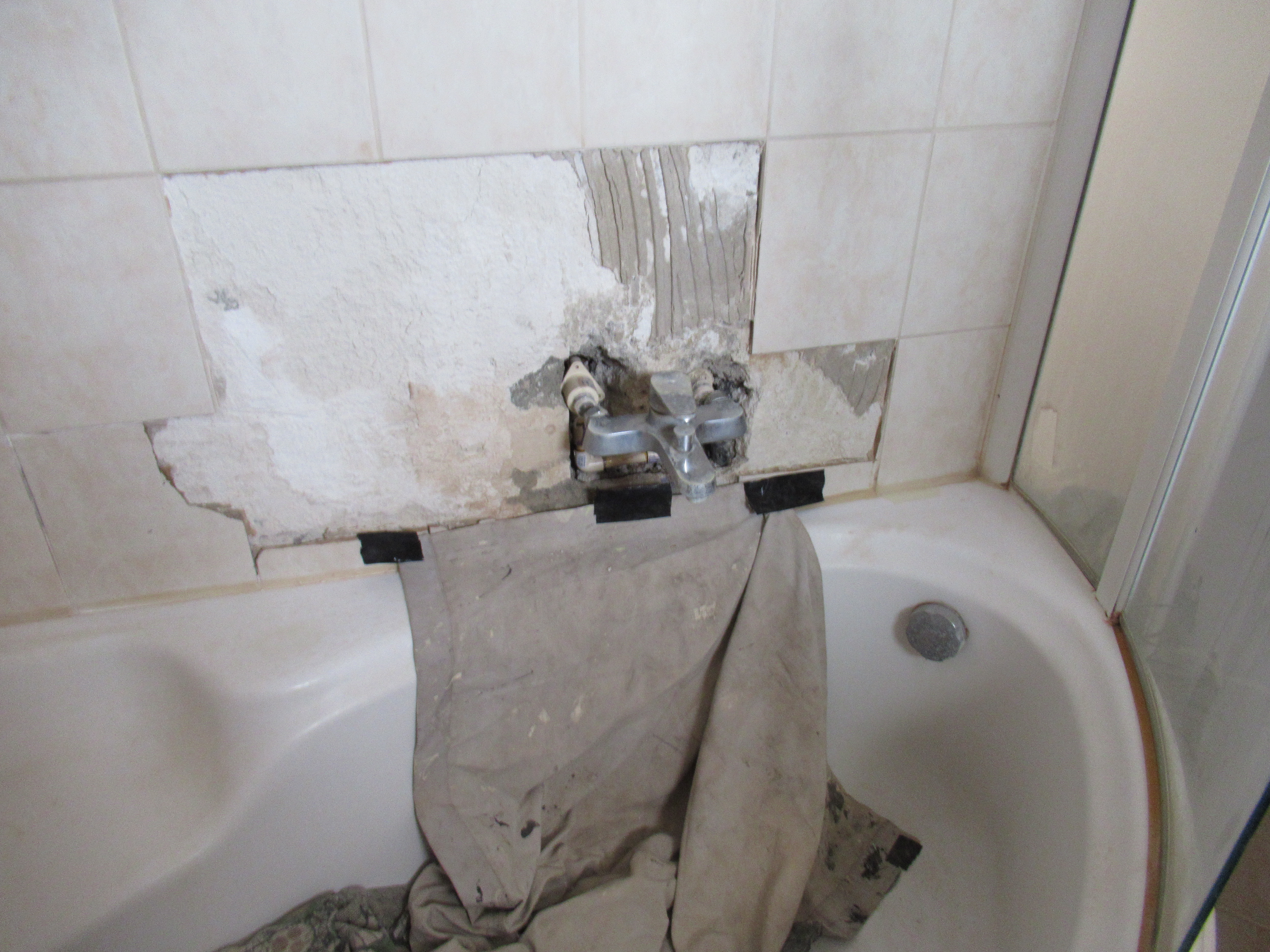
A couple of days later, the tiles around the taps looked like this:


In pulling away the worst of the tiles, L discovered others that almost fell off the wall. 

The timing worked well, as there were no visitors in our guest flat during May, so we were able to go downstairs to shower. Not ideal, as the guest flat stairs are outside, but we were thankful to have that option while the bathroom was unusable. 

We were also very thankful to have discovered an almost-full box of the tiles. That meant we didn't need to try to find matching tiles, or - worse! - replace all the tiles. And in feeling around the plumbing, L found a place that was wet - a joint that had never properly been made, which was the cause of the leaking. At least, he hoped that was the only cause. He managed to fix it, and then we had to wait for everything to dry out. 

All seemed to be dry a week or so later, so he started plastering. First he used the mixture commonly used in Cyprus that looks to us more like concrete:


He plastered the other walls too, and then we had to wait for those to dry out. May was a good time for this to happen; it was warm but not yet humid, and we were able to use a small upright fan to help the process. 

Over the course of the next few days, further plastering happened. Then there was a big leap forward in terms of appearance ,when L called in his brother J to help with the tiling. 


Alex, who appears sporadically in this blog, assumed that the dust sheet was put there for his comfort, and tried to persuade us to turn on the taps to give him a drink. He was rather annoyed when we refused, not wanting any excess water until everything was complete. 

The walls opposite and outside were also being plastered, and sanded, and skimmed, and looked better than they had in years.


Since we were having all this done, and since our previous shower fittings had become quite corroded, we decided to splash out (so to speak) on new fittings, which improved the appearance significantly: 


I wouldn't have minded too much if we had had to change the colour of the bathroom walls, as the orange used six years ago was rather more vivid than I had anticipated. But when we found a half-full pot of the paint, it was an easy decision to use that rather than embarking on a complete re-paint. Richard and I did the painting (mostly Richard) and at last, over a month since it was started, our bathroom was back to how it was after the first renovation six years ago:


It was very good to be able to take a shower in our bathroom again after more than three weeks of having to go down two flights of stairs (one of them outside). We know we're very blessed to have options like this, but guests were expected for our flat early in June. 

Here's the wall next to the bath:


And here's the one opposite:


The only thing remaining was for L to cut some more skirting board pieces and fit them, which he did a few days later. 

We've been using the shower for nearly four weeks now, and are delighted - and relieved - that none of the tiles is showing any indication of changing colour, nor is any of the plaster bubbling or crumbling. And, as mentioned in the previous post, our Roomba has worked hard at eliminating the last of the plaster dust. L did an excellent job tidying and sweeping every day he came, after finishing, but inevitably there was fine dust that kept falling. 

We hope that this bathroom renovation will last considerably longer than six years, and appreciate it all the more after having been unable to use it for most of May.

Tuesday, November 24, 2020

Repairing the Roof

Anyone who has followed or popped into this blog over the course of the past decade and a half will probably have come across mention of our roof leaking. It's not uncommon in Cyprus to have areas where heavy rain leads to dripping through the roof, and we're thankful that it's only ever been above the stairs. Since stairs don't generally have carpets here, it's annoying but it doesn't take long to mop it up afterwards.

And if you haven't come across any of those posts, and/or are interested in seeing some, this post from 2009 was all about rain, with a photo at the end of our cool box and a yellow bucket strategically placed to catch the drips. In our first few years here, we had two or three people come to look at the roof.  One or two broken tiles got fixed, and suggestions were made, but in the end the regular response was along the lines of, 'This is Cyprus. Roofs leak.' 

The problem was that it got worse each year, or so it seemed. Then in 2010, a couple of Richard's sailing friends took a look at the roof, and discovered a hole, and also a large amount of pigeon mess which was making the rain bounce in an odd direction. I wrote in this post about how they cleaned the mess away, and sealed the hole. And it definitely helped the problem that winter.  

But a year later, there was more torrential rain, and once again our roof leaked. I wrote this post, illustrated again with a photo, except that by then we had moved from a yellow bucket to a blue one. In 2014, we had some loft insulation installed, and another hole in the roof was fixed. And so it went on... each year, we expected rain through the roof when the wind was high and the rain was heavy.

So it wasn't any surprise that it happened this year, when it rained - except that it seemed considerably worse than last year's. Out came the cool box again, although this time it was accompanied by a large empty paint pot. 

containers for catching water from leaking roof

But I had to remove photos from the walls, something I hadn't had to do for some years. And it seemed that the rain was coming through in more places than previously. We realised it had been a while since the roof was last cleaned, and we knew there was a lot of bird mess up there. So we called our friendly roofing guy, who eventually came at the end of last week, with another guy, to check the roof and fix whatever problems they could find.

It was important that they came on Friday, as heavy rain was predicted for last weekend, and our roofing friend told us he'd been asked, urgently, to look at two other roofs as well that morning. 

It turned out that there were more problems than just an excess of bird mess. Richard had asked if something could be done to make the problem less severe in future, possibly by moving some of the pipes on the roof. Since I didn't go up there (and have no wish to do so) I didn't entirely understand, but it all sounded like a good idea. 

roof in Cyprus with water tanks

However, when they moved the pipes, they discovered an entire area of the roof that had never been sealed, with some wood that was rotting away. 

And when they'd replaced the wood and sealed the area, they went over the whole roof carefully. They discovered a couple of broken tiles which they removed and replaced. Here are the broken ones:

broken roof tiles

I think the roofing guys expected to be here for about an hour, but in the end it was nearly three hours. Thankfully it hadn't started raining, so after cleaning up they hurried off to the next job, hoping to fix another roof before the predicted rain.

Except that it didn't rain. There was a bit of lightning and thunder in the distance, but not a drop of rain. On Saturday evening we had maybe five minutes of light rain, but not the kind that would have leaked through. On Sunday it stayed fine and sunny. 

I don't think I have ever before heard Richard express a wish that we could have some really heavy rain - not because he likes rain, but because we would really like to know if this latest repairwork has actually fixed the problem, at least for this winter. 

There's rain predicted for later this week, and Saturday, so maybe we'll find out then:

screenshot of weather forecast for Larnaka

Or maybe it will be another fine weekend.  Perhaps fixing the roof is the equivalent of going out with an umbrella, and ensures that it won't rain after all. 

Saturday, February 25, 2017

The Peculiarities of Plumbing in Cyprus

One of the comments made, now and then, by friends or relatives visiting us in Cyprus is that the skyline is somewhat spoiled by all the water tanks and solar heating panels.  We've got used to them ourselves, after nearly twenty years living on the island, but they do have a point. This, for instance, is typical:

water tanks and solar panels are a feature of Cyprus roofs

(If the image seems too small, clicking it should lead to a bigger, clearer view). 

Whereas in cooler countries, hot water tanks are usually indoors, and insulated with warm lagged jackets, in Cyprus they are outside, on the roof, and (so long as the sun is shining) water is heated by the large solar panels.

Cold water tanks seem very old fashioned to many who don't live in Cyprus, but for many years there was a severe drought on the island. When we moved here, mains water was only switched on a couple of times per week. So it was vital to have cold water storage tanks for use in between times.

Most kitchen taps are still equipped with both mains and tank water availability, with the mains (sometimes filtered) for drinking, and the tank water, hot and cold, for washing dishes. Our dishwasher and washing machine run from the tank, as made sense during the drought years. Nowadays, with recent rainy years and the functioning desalination plants, water is on almost all the time, and some people now have their machines attached directly to the mains water inlets.

Since our house is in two parts, with a separate flat underneath the main part where we live (fairly typical in Cyprus) we have four tanks in all.  The hot ones, fed from the larger cold ones above them, are heated by the solar panels.


The trouble with tanks being on the roof is that, despite being strong and long-lasting, they are at the mercy of the elements. The sun is very hot in summer, and in recent years the winds have been extremely strong at times in the winter.

Seven-and-a-half years ago, we had to have the guest flat cold water tank (the one nearest the edge) replaced, due to a serious leak in the side. We had the pump fixed too, and various other repairs, and everything worked nicely. It was a little frustrating that the hot water never seemed to stay hot for more than an hour or two in the evening, after the sun had gone down, and Richard muttered now and again about having some extra insulation. But we have an electric water heater to supplement the solar power, so we used that when we needed hot water in the evening, or before it had warmed up sufficiently in the morning.

Now and again we noticed that drips were starting again, and we called in plumbers - I think we've used three different ones now, maybe more - who repaired problems in pipes, or outlets, or, on occasion, the ballcocks that are supposed to regulate when the tank stops filling up.  The latter seems to be a common problem; one of our neighbours has a tank that overflows for short periods regularly, as can be seen by the marks down the side of the top tank:

showing the drips down a cold water tank on a roof in Cyprus

Last year we realised that we were seeing were yet more drips, and they weren't just sporadic. We looked at them, and sighed, and said something had to be done. But it didn't seem like a huge problem and we didn't get around to it.

Then one day towards the end of the year, we had water not just dripping onto the balcony below the tanks, but pouring down. We called our friendly local plumber, who came pretty quickly and said that there were two issues. The guest flat hot water tank had developed a serious leak in one of the seams, and was spewing water out. That one was fairly easily fixed, which is good because some of the water was also leaking inside our roof and dripping through the bathroom ceiling.

However, the other hot water tank had a hole that couldn't be fixed, and needed to be replaced completely. But we couldn't have a tank off the shelf; it's pressurised and had to be built specially. So the plumber put in an order, and hoped it would be ready to install before Christmas.

Unsurprisingly, that didn't happen and we were in the UK with the family by the time Richard had a text message to say that the tank was ready.  By the time we were back in Cyprus, the plumber had too many other jobs, then Richard went away again.  Finally a date was arranged, only to discover that the company who had built the new tank had given up waiting for it to be claimed, and sold it to someone else.

But finally, a couple of weeks ago, the plumber arrived with a couple of other guys and the new tank. It took them a couple of hours to put it in place, and everything looked good. There was some slight confusion in that it looked, from the wiring, as if it was the guest flat tank and not the main house one... apparently both the wiring and the pipework are 'interesting'. As is not atypical in this country.

However, there were no more leaks for the rest of the day, and to our delight, the new tank is much better insulated than the old one was, meaning that the water is still hot enough for a shower even four hours after the sun has gone down on a chilly day.  It wasn't cheap having this new tank, but over a few years we should save quite a bit on our electricity bill.

The night after the new tank was installed, I thought I heard a drip, and saw a bit of a puddle on the balcony after dark. But it had been a cloudy day, and I thought perhaps it had rained. The following morning the balcony was dry, and there were no more drips for nearly a week.

However, we had people staying in our guest flat for that week. The day after they departed, there were more drips, which - as far we could tell - were coming out of the guest flat cold water tank, or possibly one of the pipes nearby.  Puddles were appearing yet again on the balcony:

puddle of water due to drips from our water tank, yet again

I thought I could temporarily stop the drips by switching off the guest flat mains water, thinking it might be an overflow problem. So I did that... but it made no difference.

So Richard called the plumber, who came to take a look. He said it was an overflow problem, and the ballcock wasn't working. So he used a little stopcock valve next to the tank to stop water going into it. He was rather surprised to discover, when up the ladder, that there was no round cover at the top of the tank, so it's open to the air... but said he could replace that too, early next week.

The dripping stopped... for a couple of hours.

By evening, it had started again. This makes no sense at all, but then I couldn't understand how the tank could still be leaking when the mains water to it is switched off.  We now think there must be some serious problem with pressure somewhere in the system, in a way that I don't begin to understand.

Life is never entirely straightforward in Cyprus. 

Friday, November 09, 2012

After the rain....

I wrote yesterday about the thunder and rain, which was really the first good rain for quite some time.  A bit came through the roof over the stairs, but by the time I went to bed the rain had stopped and the little puddles had almost disappeared. 

However, in the night it started raining again, quite heavily.  It had stopped by the time I got up this morning, but by around 7.00am when I was just thinking about walking down to the PO Box, it started again:


There was some blue in the sky so I was hopeful that this would not last too long; and, indeed, about twenty minutes later the sun came out.  

As I stepped out into the wet world that greeted me, I was struck again at how very clean everything looks after it's had a good downpour.  There always seem to be flowers blooming somewhere, and I snapped a few such as this one:


And this one, which I believe is called a bottle-brush plant: 


Some of the raindrops can still be seen on the leaves of this one, if you click to enlarge the photo:


This one, too, with vivid yellow blooms, looked very pretty sparkling with raindrops in the sun: 


There were puddles on waste ground, which will no doubt provide more breeding place for mosquitoes:


Some puddles in the streets, too... but I didn't see any really flooded roads.  Perhaps the new drainage system is beginning to be of use even if it isn't all connected: 


It would be nice if the roads could be re-surfaced after their extensive excavations, but perhaps that's too much to ask. 

Shortly after I arrived home, the rain started lightly again. Then around noon, there was some torrential pouring, making me glad that Richard had put the usual bucket and cool-box on our stairs to catch some of the leaks: 


We always need rain in Cyprus, so I hope this has gone some way to filling up the reservoirs again.  More is predicted tonight, and tomorrow.  Autumn has well and truly begun. 

Sunday, January 15, 2012

Roof holes and loft insulation in Cyprus

It has been a recurring theme of this blog that, when it rains (mostly in the winter in Cyprus), the roof leaks. Not over anything that matters too much, thankfully, but a steady stream over the (uncarpeted) stairs. It had almost become a way of life - when the sky turned grey, I went to fetch a bucket and the cool box to catch the worst of it.

A little over a year ago, after some other leaks had developed, Richard and his sailing buddy Tim P (The P distinguishes him from our son Tim) went on the roof and mended some of the holes they found. They stopped the bathroom leak; but, sadly, their efforts did not fix the one problem we have had ever since moving into our house - the leak over the stairs. Tim P did comment that there was a huge amount of bird mess on the roof, and he wanted to clean it off. We could not imagine how it would help; if anything, I thought that it would help to plug holes in the tiles!

Richard has kept studying the roof, off and on, and we - like a few others who have crawled on our roof - could not understand where the hole could be. And, while there is some loft space above our bathroom, where Richard did manage to spot one of the holes a year ago, the area where the leak was happening was inaccessible.

So, early in December, Richard decided that the only way to solve the problem was to cut a hole into the loft area that he could not reach. If nothing else, he thought that perhaps he could affix some kind of membrane inside the roof, to channel the water out when the next heavy rain happened. Here's the area - beautifully panelled - above our stairs, which he decided to cut into:


He had not been sure how to do it without making a mess; but Tim P had bought a useful tool for the boat, which enables holes to be cut without first cutting into the piece to be removed. So Richard borrowed it, and set to work:


It made such a dreadful noise that there was no way I could stay and take further photos. Even Richard, who tolerates loud noises better than I do, went to fetch some ear defenders. But the eventual access hole looked like this: 


To his surprise, he found that there was already a membrane inside the roof - unusual in Cyprus, but then the guy who built our house did it very well, on the whole. That cast a whole new light on the leak problem. The hole in the roof could be anywhere - it was being channelled down to the lowest point, which was, indeed, where our leak was happening. 

Richard also noted that it was very cold up there, and thought that it might be a good opportunity to put some loft insulation in - also not common in Cyprus.

The hole remained for a week or two, then he bought some hinges and other fittings, and made a very tidy job of turning the removed panel into a door: 


A couple of weeks ago, after a few dry days, he and Tim P went back onto the roof again. They searched thoroughly, but simply could not find any holes. They talked about using some special sealant to pour over the tiles, which would plug any small leaks, but Tim said, while they were there, he wanted to clean away the awful bird mess. So they borrowed the hose from the boat, and attached it to ours, and cleaned away a vast amount of - mostly ancient - bird mess, bits of bird nests, and other gunk.

The following day, it rained torrentially. I put out the bucket to catch the leak... and there was no leak.

It rained overnight, steadily, for several hours. We were not awoken by drips on the stairs... and when I got up, they were completely dry.

Apparently, the bird mess had formed some kind of dam on the roof which was catching water that then dripped through the tiles. Getting rid of this meant that the rain simply slid off the tiles as it was supposed to, and any small cracks did not cause problems.

It was like a miracle!

So, Richard found somewhere that sold loft insulation - the pink fibreglass stuff that we've used in the UK - and last weekend, they cut and fitted it. It didn't take all that long, but left a lot of dust which I've swept away and mopped.. but at night my throat seems to get scratchy and tickly even now, a week later. It's so cold that we don't want to leave windows open... so I've suggested that they don't do any more insulation until the spring.

Has it made the house any warmer? Hard to tell, really. On a cold day, houses in Cyprus just do feel cold... I'm sitting here wearing two sweaters and a fleece, and while not as cold as I was at our old house (we do have good double glazing here, and central heating that we run for a couple of hours, at about 14-15C morning and night) I'm still not warm. 

Saturday, November 13, 2010

Mending the roof

I have mentioned before, many times, that when it rains, our roof leaks. Not in the bedrooms, thankfully, but over the stairs. It's been doing so for four years, although last winter it seemed to be worse than before, but I was pretty much used to it. A nuisance, but the stairs are hard tiled - no carpet to wreck - and it's easy enough to put buckets to catch most of the leaks, and mop up the rest later on.

We did have a builder come and fix something, the first winter we were here. The leak was slightly better subsequent to that, but then gradually got worse again. Richard spoken to one or two other builders since then, but they're all very hesitant even to come and look at a roof that isn't flat.

It began to worry me last winter that the leaks were so bad - or maybe it was just that we had more rain. We found we had to take photos of the walls by the stairs, as well as placing buckets. And the last couple of times, there was a rather unpleasant smell which lingered several days after the leaks had dried up.

So, Richard's sailing buddy suggested they take a look at it. Not during the summer when it was far too hot to be out on the roof in the middle of the day. I wasn't too keen on the idea - it's a long way to the ground, but they thought it would be safe enough. And today, with pleasant temperatures but no threat of rain, they decided to come and take a look. Two sailing friends came. They promised that if there was any danger at all, they'd go and fetch some ropes from King Malu. However, Richard was pretty certain that the worst of the problem was right over the balcony attached to Daniel's room, and pointed out that the angle of the roof is very slight.

So they crawled into the space above the bathroom, where Richard had seen some light. They crawled onto the roof, and discovered the hole, as well as some cracked concrete, and a couple of cracked tiles. And large amounts of pigeon dung, much of which had spilled over onto Daniel's balcony in the last few months.

They had some coffee and cake, then went away, and returned armed with various bits and pieces. Something to mend the hole, some special sealing paint and canvas to seal the cracks, another kind of mixture to mend the cracked tiles (since replacing them would have been a huge amount of effort, and would have required a specialist roofing person).

I suppose it took about an hour. Everything should have dried by now, and tomorrow Richard will put on another coat of the sealing solution. He'd like to find some way of scaring the pigeons away too, since it seems that part of the problem was that the rain was splashing down onto the piles of dung on the roof, and towards a cracked tile, then leaking through. That probably accounted for the nasty smell, too.

We won't know if all the problems are fixed until we have some heavy rain, and there's none predicted at the moment. But I'm very thankful to know that several holes and cracks are now sealed and watertight.

Richard and his friends have now gone out for a short sail.