Showing posts with label cars. Show all posts

Monday, November 16, 2020

Parking violations in Cyprus

Some years ago, we were 'warned' by a police officer that we were parked too close to a corner. We weren't parked for long, and we were not obstructing anyone's view; since other cars around were parked a lot closer to the corner than we were, it was slightly surprising. The officer took our car registration, and warned that if it happened again within the next year we would be fined.

I mention this in passing because, at the start of October, there were some new penalties introduced in Cyprus. Road accidents used to be one of the highest causes of people dying on the island, and there are still far more than there should be. So it was hoped that, by introducing these strict fines, to be enforced immediately, drivers might be more careful. I don't drive myself - I never have done - but even I notice regular, dangerous driving - in particular people chatting on their phones while they drive, or speeding up rather than slowing down as they approach an orange/amber traffic light that's about to change to red. 

I was particularly amused - if that's the right word - by the new fines for parking: 

Parking illegally on a pavement will be subject to a €100 fine, parking at spots reserved for the disabled will be subject to a €300 fine, drivers parking on the opposite side of the road will face a €100 fine, while parking on a double yellow line will be subject to a €100 fine.

No mention of parking on corners, which seems to be the most dangerous of all, particularly if it's on a junction with a main road. And while Richard is usually very careful to park on the correct side of the road, I didn't realise it was even a legal requirement on the island, let alone a fineable offence not to do so. 

I gather there were a few fines issued during the weeks following these new penalties, but we haven't noticed any change in the way people drive or park. When I'm walking in the morning, it often seems that there are more cars parked in one or more of the above illegal ways than there are cars parked correctly. 

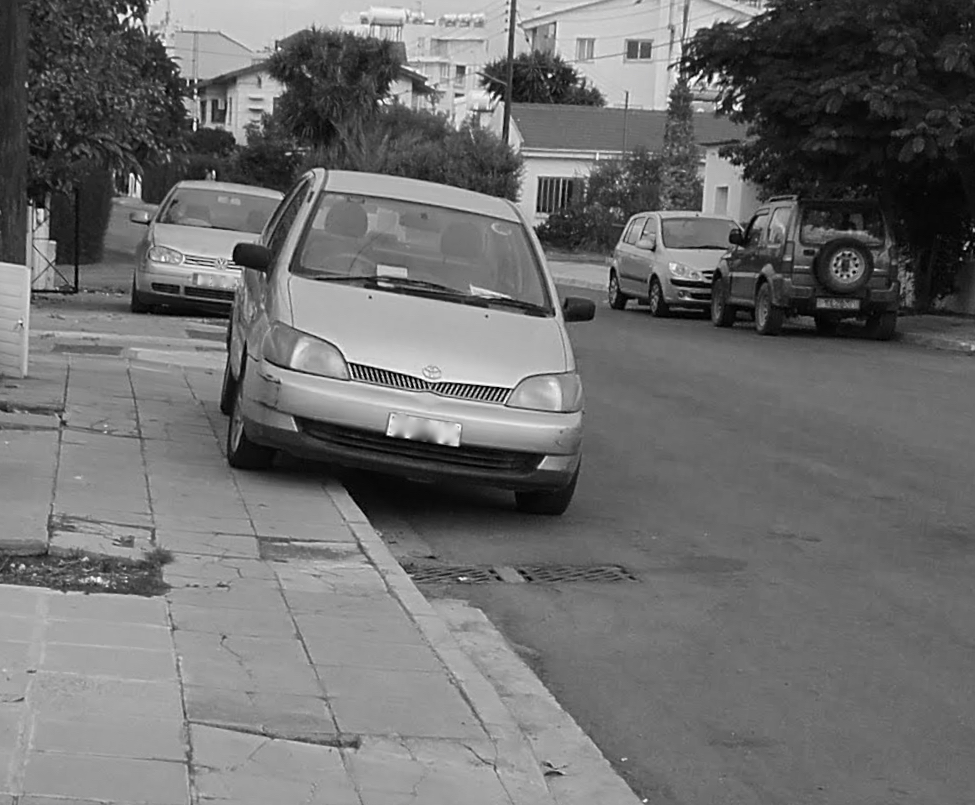
I've taken a few photos to illustrate, but as they are examples of thousands of others, I've blocked out the number-plates, turned the photos into black-and-white, and cropped so that it shouldn't be too obvious where they were taken. I don't want anyone to get into trouble on my behalf - and compared to some of the other offences on the list, illegal parking, particularly in residential areas, isn't so dangerous. 

Here, for instance, are two cars on the pavement. One facing the right way, the other not:


Here's a different view of the same cars, showing how close they are to the corner of the street: 


Another street, another two cars facing the wrong way and partly on the pavement: 


And this one is an example of a car parked on a corner, almost entirely on the pavement, AND facing the wrong way. I assume that the penalties are cumulative.. but they don't seem to be putting people off. 


I am not the only person to be writing about this kind of thing - just a week ago there was an article in the Cyprus Mail about 'pavement bandits' - making the same point, but illustrated with cars in colour (though, again, with no visible number-plates). 

Given that there are so many trees growing in the middle of pavements, and some areas with no real pavement at all, I'm not convinced that, in a residential area, it makes that much difference if cars park on the pavement - indeed, it gives more space for cars to pass each other on the road. However that article does point out that for people in wheelchairs, or parents pushing children in buggies, illegally parked cars can force them into the street, which can cause accidents.

It will be interesting to see if driving and parking starts to improve, but there's no sign as yet. 

PS If anyone who has read this lives in a country where 'pavement' means 'the paved area of a road', please substitute the word 'sidewalk' for 'pavement'.  

Sunday, August 12, 2018

Out of Cyprus, Summer 2018: Coronado Playa, Panama

After the frustrations of our first couple of days of family holiday, we settled down to a - mostly - relaxing break together. It's the first time all seven of us have been together for about a year, so it's been wonderful spending lots of time with our grandchildren.

Today we check out and return to the area close to Panama City. Tim is going to spend a week on the Logos Hope; Richard and I will stay in a much smaller guesthouse nearby for a few days, then begin our journey home (including a brief stay in Costa Rica).

To get the negatives out of the day first: Tim's luggage still hasn't appeared, which has meant he's had to spend at least half an hour each day on the phone to American Airlines, and at least a couple of hours trying to find suitable clothes (which should eventually be refunded by his insurance). Esther hasn't been sleeping well, meaning that Daniel and Becky have had very broken nights, and in the past couple of days Daniel has had a bad sinus-ish cold.

However, overall it's been an excellent break. When looking for a suitable place to say, Richard had several criteria: he wanted it to be in a safe place, child-friendly with at least four bedrooms. he hoped for some outdoor space for the children to run around, and - if possible - a beach nearby. He found all those things in our Air BnB villa in Coronado Playa.


The whole village is in a closed area; to get in, we have to stop at a booth and explain where we're going. It's not particularly secure - usually Richard just says we're going to a friend's house, which he was told to say - but is protection against some danger. Not that it's a particularly dangerous country, but petty theft is fairly common, and this is quite a wealthy area. The owner of this villa lives in one of the cities, and this is her family holiday home. This appears to be the case for many of the owners of properties in the neighbourhood; they're mostly empty at present, although the weekend saw quite an increase in people locally.

The villa itself has a high fence around, with padlocked gates at the front. There's a caretaker who lives in a little house on site, and three large (though extremely friendly) dogs which live outside and bark at any hint of activity nearby during the night.


For me, one of the best things about a holiday is not having to cook or even think too much about food. Becky and Tim both enjoy cooking and planning meals, but we had decided to eat out a few times anyway, to save time and to experience some of the local cuisine. Not that we managed the latter. While there are some inexpensive 'fonda' restaurants (roughly what we would call tavernas in Cyprus) they're not child-friendly, and mostly only have outside eating areas near the street. Many only offer breakfast and lunch.

We've eaten twice at the closest child-friendly restaurant, an Italian one.


There are plenty of vegetarian options, although rather limited in dairy-free items at first glance. But they were happy to make a cheese-free pizza for Tim and were excellent with the children. There was a high chair for Esther, pictures and crayons offered almost immediately to both, and their food was ready before ours.

One lunch-time, after finding a department store that sold clothes suitable for Tim, we decided to have lunch at what looked like a fast-food non-chain place. There wasn't much that was dairy-free, but I had an excellent vegetarian lasagne, and once again there were pizzas, though not as high quality as at the Italian restaurant.


Mostly we've eaten at the villa: Becky organised fajitas for the first evening that Tim was with us, after picking up ingredients at a large supermarket in the afternoon. One evening Tim made some curries, which we ate with Arabic bread (available here, though naan doesn't seem to be). One evening we had a barbecue:


We ate outside, and asked the caretaker to join us. But there were a lot of mosquitoes around, and this rather high-class barbecue didn't produce any smoke to drive them away. So the rest of the time we ate indoors.  We had cold lunches - or evening meals, when we ate out at lunch-time - with bread and cheese and eggs and salad, and whatever random bits were left from other meals.

Yesterday we ate out again, this time at a Tex-Mex place called CBC which seems to be an international chain.


We weren't sure what to expect, but it turned out to be excellent as well as very reasonably priced. There were tortilla chips with dips 'on the house' as a starter, and cinnamon fried tortilla chips with a caramel sauce as an extra dessert.


Becky managed very well communicating in Spanish as we tried to make our order, but when it was done, hoping it was correct, a friendly American guy (apparently the owner) appeared and ensured everything was correct, as well as chatting to us all and being extremely helpful.

So much for meals... though I mustn't forget the excellent ice creams, to which Tim treated us all on a couple of afternoons. The closest place, not far from the CBC restaurant, was called 'gelarto'. We found the spelling rather odd, as if it were a nod to British pronounciation. But hardly a problem.


There were many choices, including some sorbets which Richard and Tim could eat. I tried a Belgian chocolate cone the first time, and it was so good I had the same the second time.

David did very well with his cones (chocolate brownie the first time, mint choc chip the second) but Esther, who tends to eat quite slowly, had to have some help. Here's a standard toddler-eating-ice-cream photo...


There was the added bonus of a shoe shop next door, where I was able to find some very comfortable flip-flops for indoor wear, and also some soft, light walking shoes. Esther, who likes shoes very much, thought it a wonderful shop.

Shopping inevitably took up more time than we had hoped, as we had to try and explore various supermarkets to find such essentials as bread, fruit, toilet paper and so on. We had to buy containers of drinking water too, as the tap water isn't good for drinking (though fine for brushing teeth and washing fruit). And Tim had to find suitable shirts and underwear, as his luggage continues to be missing.

The beach is about 500 metres from where we are staying, an easy walk down a country-type lane and a short alleyway. The sand is black in places, something new to us, and rather messy when walking on it! We've been a couple of times when the tide was quite high, and yesterday Richard and Tim took David to make a castle when the tide was much lower. There's no shade, so it's not a place to stay for more than a hour or so, and I haven't been other than in the early evening.

When we (or some of us) have been, one of the dogs usually accompanies us.


One late morning, when Daniel, Becky and Tim took the children to the beach, Esther's hat blew away and was swallowed in the sea; the waves were quite strong and there was no sign of it. On the off-chance that it appeared at high tide, we went for a walk the following day, and found some rocks to sit on a little way down the beach, while David hunted for shells.


The hat didn't turn up, however.

We had thought about making some day trips a bit further afield, but none of us really wanted to spend an hour or more in the car, and then another hour or more back. The only real attraction locally other than the beach is a golf course, and as none of us play golf, we haven't explored that.

But it hasn't been a problem. The children have played outside for at least half an hour or so each day (other than one day when it rained). It's been hot and quite humid, so it hasn't been possible to spend as much time outdoors as we had hoped. But David and Esther have had fun in the tree house, or on the trampoline, or running around with the dogs. Esther was very nervous of the dogs at first; as Daniel commented, she's seen more crocodiles than dogs in the past year. But now she's much happier around them.


We've read lots of stories to them; Esther immediately accepted Tim as one of the family, and David loves the way he reads, so he's been a popular choice:


and we've played some games with David....


He has reached the age where he likes simple board games, and is also beginning to be able to play games intended for slightly older children, such as Uno.

Becky brought a selection of toy cars/trains, and building blocks, and activity books and it's been great just to hang out and enjoy spending time together, rather than rushing around doing things or seeing places of interest (which probably wouldn't interest the children).

Both children are usually in bed and asleep by around 7.30pm, sometimes earlier. So we(or some of us) have played board games every evening. Becky brought Above and Below (confusingly in a Settlers expansion box), Ticket to Ride (even more confusingly, in a Carcasonne box) [with the game boards separately], and, most importantly, Settlers of Catan. We've played that four times in all; it's still our default favourite game, one we never really tire of.

Last night, our final night in the villa, all five of us played.


Daniel won in the end but it was a high-scoring game where any of us could have won. Almost all the cities were built and we used up just about every building spot.

This morning we're tidying up and packing in preparation for leaving about noon. As we have no idea what wi-fi access we'll get in the next week, I've hurried to finish this so I can post it before we leave.


Saturday, February 18, 2017

Time and Trust in Cyprus

A couple of weeks ago, I wrote a lengthy post bewailing modern technology as it gradually takes over life in Cyprus. Things are no longer as simple as they used to be.

To summarise the post: I couldn't pay our van tax because it needed an MOT, and when the MOT was done I couldn't pay it because my debit card had expired. When I went to collect my new card from the bank, they had returned it because I hadn't collected it in December, despite not knowing it was there. Meanwhile I couldn't pay our PO Box fee because the 'system' wasn't working, so I left the money with the postmistress who assured me she would do it the next day...

There's something about starting a routine, or habit, which makes it become easier as the weeks go by. Those two Fridays in January, I made sure I had things to post to motivate me to walk to the Post Office. It's only a mile away, and it wasn't as cold as it had been some early mornings when I walk with my friend Sheila, but I didn't much want to go out. However, Richard was away, and I don't drive.

I decided to combine the trips to the Post Office with my usual Friday shopping at our local froutaria...

The fruit shop - or froutaria - where we buy all our fruit and vegetables in Cyprus

... and the connected mini-market over the road from the froutaria:

The mini-market, Achna Discount, where we buy general groceries in Cyprus

The Post Office is about a mile from our house, near the sea-front. It's another mile or so in the other direction to the fruitaria, and then a short walk home. Quite a pleasant outing, once I was out in the sunshine, even if it was rather chilly.

So each time I took my Lakeland shopping trolley (one of the best purchases I have ever made):

The trolley that accompanies me on my shopping trips. Wonderful buy from Lakeland UK.

A few days after my foray into the bank, they phoned me to say that my card had arrived.  I could have gone to collect it at once (the bank is perhaps half a mile away) but decided I would leave it until the Friday, and do another round trip.  There was no urgency to pay the road tax, and I didn't need the debit card for anything else; I generally use cash at the froutaria and discount mini-market.

PO Box Rental part 3
So on Friday, just over a week ago, I walked down to the Post Office once again. There was no receipt in my box, so although I didn't have anything to post this time, I went inside.

Once again there was only one postmistress there, not the one to whom I had handed over the cash for the box renewal. She remembered me from the previous week. I asked her if, perhaps, the other lady had done the renewal and forgotten to give me my receipt. She checked the system, and said that no, it wasn't renewed.

However, she told me, I wasn't the only customer in the same situation. Apparently the other postmistress had been off sick, and had put the money for the PO Box renewals in some account which her colleague couldn't access.  She assured me it would be done on Monday, and they would phone to let me know.

Perhaps I should have ensured I was given a receipt for the cash when I paid it; or, even better, kept it and said I would return another time, since I did in fact keep on returning every week. But trust is important in Cyprus, and I couldn't imagine they would try to cheat me, or insist that I hadn't in fact paid anything. So I said it was okay, and I would wait.

New Debit card part 2
I quite like walking along the main shopping streets of Larnaka, occasionally popping into a shop, or looking in the windows, but my next stop was the bank.

I stood in the queue, as usual, and when I got to the front was told I needed to go to one of the desks further inside the bank. I eventually found it, and instead of just handing over my card (in a thick envelope) and asking me to sign for it, the man at the desk had to access my account, and spend several minutes entering things and eventually succeeding in printing a form. Then I not only had to sign it, I had to enter my passport number. I have no idea why, but it's a good thing I carry it with me. It would have been very annoying to have got that far and been unable to collect the card.

The design of the card is different - it's yellow rather than red - and it's equipped with contactless technology, which always slightly scares me. But we keep our contactless cards in little metal-lined folders so they can't accidentally (or maliciously) be triggered.

Car Tax part 4
I got home, and logged into the jccsmart website, and - at last! - succeeded in paying the year's tax for the van.

Success!

Side note
A few months ago, when we realised we had to write off our two old cars, the mechanic agreed to deal with the scrap merchant, and harvest any parts that could be used. They said we might possibly get €200, and that was only because one of the cars had fairly new tyres. They were supposed to let us know when the transaction happened, but we didn't hear anything. Then we went away shortly after Christmas, and hadn't thought much about it.

When Richard got back from his travels, ten days ago, he went to collect the van after its MOT.  They had had to sort out one or two things, and did a full oil change too, and - including the test certificate - the bill came to €70, which seemed quite reasonable. Better still, they said that our old cars had in fact fetched €250, so rather than having to pay anything, he was given €180 in cash as well as the van with its up-to-date MOT.

PO Box Rental part 4
There was no phone call on Monday, but on Wednesday I had a call from the Post Office! They wanted to check the details, then went ahead and renewed our box rental for another two years.

Whew.

The receipt was awaiting me when I walked down to the Post Office yesterday.  So everything is now done. It might take much longer than it should, but I should have trusted that it would work out correctly. 

Saturday, October 22, 2016

Visiting a taverna at Zygi

It had been a busy few weeks, but at last we had bought a comfortable and - we hope - reliable car. Richard wanted to take it on a slightly longer journey than just doing errands around Larnaka, and since we had not been on a 'date' for a long time, suggested we have lunch at the fishing village of Zygi.

My knowledge of Cyprus geography is extremely limited, and I vaguely assumed it was about ten or fifteen kilometres away, so was a bit surprised when it took us nearly half an hour to get there - it was, according to the signposts, nearly 40km away. Still, the journey was very comfortable and smooth; Cyprus roads are really very bumpy, particularly around town, but this Megane seems to smooth them out better than any other car we've previously had.


Richard had heard good things about the main restaurant looking out over Zygi marina, and it was easy enough to spot from the car park. A covered area had lots of tables and chairs, and there were several people eating. There was a big menu on the way in so we paused to take a look.

Just as well that we did. The theme - unsurprisingly, perhaps - was sea-food.  While Richard does quite like shellfish, I can't bear any of them.  Even looking at them makes me queasy. And the prices looked extremely high. So we glanced down... there was a section of the menu that said it was for people who wanted something different, but that was all steaks, at even higher prices. All we wanted was a light lunch... but there were no sandwiches, no baked potatoes with fillings. There was a pasta selection, but it was all related to sea-food.

I expect the food is excellent quality for people who like sea-food, want a large meal, and don't mind paying high prices. But I could not find a single thing on the menu that I could have eaten.

So we decided to walk into the village itself. We rejected one or two rather scruffy looking places, and then we spotted this:


'The Plateia' looked like a pleasant little taverna. There was building work going on at the side:


But it was open, and when we sat down we were brought a menu almost at once. It was exactly what we were looking for: sandwiches, filled pittas, or platters, at very reasonable cost.  We decided on the platters, after being told that they came with both chips and salad.

Richard chose sheftalia, a kind of Cyprus sausage, and I chose halloumi.  It wasn't particularly quick, but that didn't matter; evidently it was freshly cooked, and when it came was nicely presented and delicious:


They brought us a bowl of pitta bread too, but we didn't want extra carbs so we didn't have them, although I'm sure they would have been good too.

We were there for about an hour, and nobody else came to eat there, but it didn't matter. The place was secluded and quiet, and while we couldn't look over the sea, there was greenery and fresh air and sunshine, and our table was pleasantly sheltered.


Tuesday, October 11, 2016

Buying cars in Cyprus

When we moved to Cyprus, almost nineteen years ago, we didn't think we would need a car. None of Richard's colleagues owned one, and the organisation had a few cars which could be borrowed, when necessary; we had to pay a mileage rate, but it wasn't too steep. For shopping trips locally, or even the occasional visit to another town, it was far better value than having to pay running expenses of a car ourselves.

But then we started attending regular meetings of home educators in Limassol, and wanted to explore the island when visitors came. When Richard's official secondment to the organisation here came to an end, we could still use their cars, but the mileage rate was higher. Then we were given a generous gift by a relative... and it seemed like a good idea to look into buying a car of our own. There were few, if any car dealers in Cyprus in the late 1990s, nor much available online. But there was a large classified ads section of the local paper, which we perused regularly.

In September 2000, we finally bought a car. A Lancer Estate, at first known as 'the car', but in recent years referred to as the old white car. It was around ten years old when we bought it, in good condition, and at a good price. I wrote in detail about it at the end of my September 2000 diary page of our family website.


We bought it from someone at the British army base who was leaving the island. In those days, there was a complex system of taxation, and while the vendor assured us that the appropriate duty had been paid, it turned out he was mistaken. Eventually, we were able to register for a duty-free car; and then, when Cyprus went into the EU, the distinction vanished.

It's been an excellent car. We drove it through Europe to the UK back in 2001, and there were no problems at all.  At some point - I forget when - we had a reconditioned engine put in, after some problems... but it kept going. We had a towbar fitted so it could be used for Richard's dinghy:


In May 2005 it started overheating when we took it any distance. Our mechanic fixed that problem, but it kept recurring. We realised that we could no longer trust it for trips further afield than the outskirts of Larnaka.

So in the summer of 2006, shortly after we moved house (and had 'change' from selling our UK house) we bought another ten-year-old car.


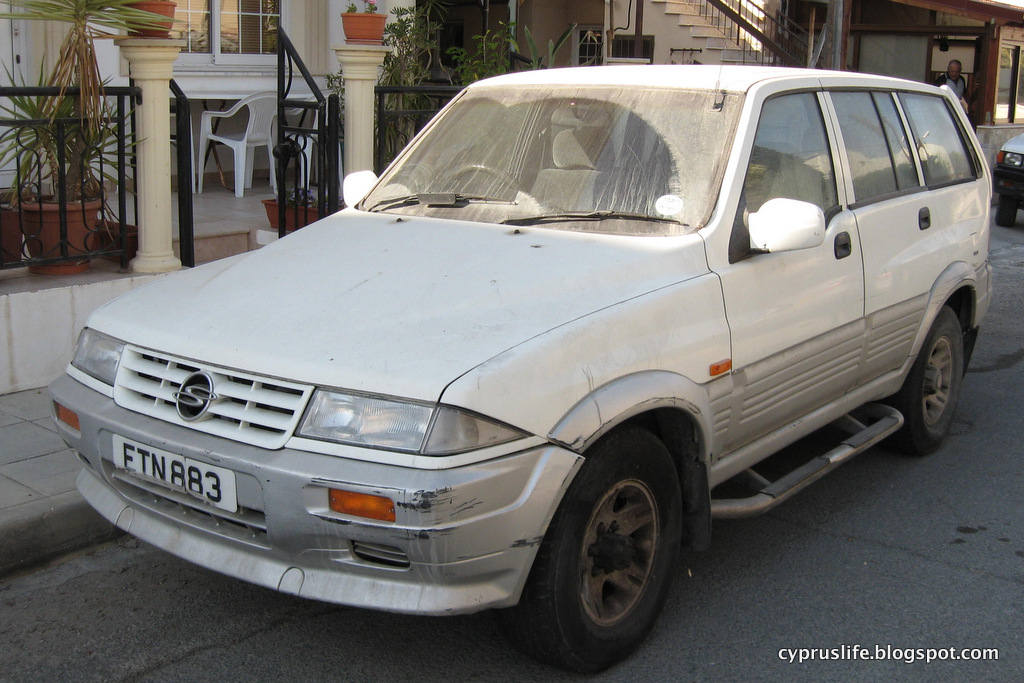
This was a Sang-Yong, a make we had not previously heard of, but at the time there were quite a few of them in Cyprus. We referred to it as the 'big white car'.  Richard bought it from a dealer in Nicosia, and it had a guarantee - of sorts. It was a comfortable and spacious car which had two extra flip-up seats at the back, which was useful when we had more than three visitors.  So, for a couple of years we used this as our 'main' car, and the old white one for the occasional short trip locally. We made the old white one available for guests, too, to get them around Larnaka - to the beach and back on a hot day, for instance.

Unfortunately, the big white car was very expensive to tax and insure. And then the Cyprus dealer for this car closed down, so it became almost impossible to get spare parts when there was a problem. We tried in vain to sell it at the end of 2008, and began using the old white car again, with the occasional car rental if we needed to go anywhere further.  Eventually, over a year later, we sold it for parts.

Then, in the summer of 2009, the car rental guy was selling one of his cars, another Lancer ('the grey car') for a good price. It was newer than our previous cars, but quite high mileage, for a Cyprus car, as it had been used by renters to tour the island.


We were given a good guarantee on the car, and it proved very reliable indeed, although Richard never really enjoyed driving it.

A couple of years ago, when our son Tim was living and working in Cyprus, he realised that a former leg injury meant that he was unlikely to pass his driving test with a manual car, and his instructor suggested using an automatic. So he trawled the local adverts, mostly online now, and looked at several inexpensive automatic cars. He wanted one that would take his keyboard, which narrowed the choice down rather, but eventually he found a small car in a private sale.

They took a friend, who was working as a car mechanic at the time, to look at it, and he said it was sound, and that it wouldn't be too difficult to solve the few problems that we knew about. The make was Toyota Raum, and it was built in 1997.  It became known as the small grey car, or the grey automatic car. Richard didn't much like that one either, but it provided useful driving practice for Tim.

However it seemed ridiculous to run THREE cars. The old white car was still proving useful, with its towbar and spacious boot, and although the seats were falling apart and the air conditioning no longer worked, local friends borrowed it occasionally, and several visitors drove it locally. It was inexpensive to tax and insure, and we felt quite attached to it.

We needed the small grey automatic car for Tim, so the logical thing was for us to use that, until such time as he passed his test and wanted a car himself, and to sell the grey car. Friends took that off our hands almost a year ago, and (to our relief) it has continued working reliably for them.

Unfortunately the grey automatic car (of which we never even thought of taking photos) has not proved very reliable, nor easy to maintain. And a couple of weeks ago, both it and the old white car developed battery problems. Richard took them both to our friendly local mechanic, who told us that they would both cost quite a bit to put right, and even more to get through the MOTs, which are due in the spring.

The time had come to look at another car. Richard wanted one that he would enjoy driving, and started scouring the local adverts and dealers for his favourite kind of car, a VW Golf.

After test-driving several cars a week ago, from a local dealer, he decided that the VW Golf on offer, although very nice to drive, had too high mileage to consider. So - needing a car rather urgently, and not wanting to spend more hours searching and test-driving - we decided to choose his second favourite, a Renault Megane.


It's known, unsurprisingly, as 'the blue car'. It's about twelve years old but has only around 50,000 miles on the clock, and the condition is excellent. There's a year's warranty from the dealer, too.

We're a bit sad to say goodbye to the old white car, which can only be sold for parts/scrap now, but don't really have any attachment to the automatic grey car.

To summarise for those looking at buying used cars in Cyprus: over 17 years, we have bought two cars from private individuals, two from car dealers, and one from a car rental company.  One of the private sales, the old white car, proved excellent value, once the tax problems were solved. The other, the grey automatic, was never great. We don't think the vendor was trying to cheat us, but there's no warranty of any kind with a private sale, and since we're not at all mechanically minded, we'd probably avoid private sales in future.

Buying from the car rental firm worked well; but that's not an option that's available very often, and the choice is non-existent. They're not usually advertised at all.

Buying the big white car from the firm in Nicosia wasn't ideal, as it was a long way to go to get problems sorted, and they weren't great at doing them.  But buying locally, from a company whom our mechanic knows and recommends, with a year's written warranty, seems - at least so far - to be the best option.  We probably paid over the odds for a 12-year-old car, but think it's worth it. The body is in almost perfect condition, the engine as-new, and if any problems crop up in the first year, they should be covered. 

Friday, July 03, 2015

Rules as 'suggestions' in Cyprus...

Last night, around 9.00pm we went for a short walk to deliver some DVDs to a friend. Even at this time of year, it's totally dark by that time, but still warm, now that Summer is well and truly here.

Visitors have regularly commented that crossing main roads in Cyprus (or, at anyrate, in Larnaka) is not an enjoyable experience. We've got used to it now; when traffic is coming in both directions, the secret is to look for a gap on one's own side of the road, and then cross to the middle. It feels very precarious at first, balancing on a white line while cars whizz by both behind and in front. However, the ones in front almost invariably stop when they see someone in the middle of the street, and cheerfully wave them over.

Indeed, it's often safer than crossing at an official pelican or other crossing where there are traffic lights. In most of the world, a red traffic light means 'stop' while amber means 'slow down if you can'. In Cyprus, an amber light apparently means 'speed up', and red means, 'you might be in trouble if you run someone over, or crash into another car, but if you can get through safely, go ahead.'

This is bad enough at major sets of traffic lights, although most cars do, eventually, stop for red lights, which allows careful pedestrians to cross. But at pelican crossings it's far from certain that anyone will stop. Sometimes I have pressed the button, and watched cars continue to whizz past as the lights turn red, then back to green. The little green man flashing to tell me it's safe to cross is not correct.

I haven't crossed at this particular crossing for some time, but I wasn't surprised to see this as we approached:


You might think that photo shows cars driving past, despite the light being red. But further examination will show that there are no lights on in the cars. And most people in Cyprus do, at least, use their headlights after dark, and rear lights too when they're not broken.

No, this is yet another example of the law (and there are official Cyprus rules of the road) being treated more as a suggestion than a serious rule. Policemen are unlikely to be about at night, so cars park almost anywhere, including the sides of the crossing.

But what amused us was what happened after we pressed the button and the traffic light turned red. A green man started flashing... but the red 'stop' man was still showing too, directly above:


It was a useful reminder that, even though it was theoretically safe to cross the road, it was a good idea to check first, and remain 'stopped' unless we were quite certain. And, indeed, a couple of cars sped by before we were able to cross.

I suppose this would be a good point to link to a post I thoroughly enjoyed writing, nearly nine years ago, about the vagaries of the Cyprus rules of the road. 

On a somewhat unrelated note, we were also amused to see this labelling and contents in our local small grocery shop earlier today:


Surely, in any other country, the Trades Description Act would have something to say?!

Monday, September 26, 2011

Calls from the Cyprus Traffic Police

Richard has just returned from attending a conference in Scandanavia. He flew in the early hours of last Wednesday morning. Since our street was blocked off, due to ongoing construction work, he could not park in our driveway, or even in front of our house.

So, as he has done for the past few weeks, he found a place to park in a nearby street, in front of someone else's house. Cypriots can be a bit possessive about the road space in front of their homes, but with so many road works going on everyone locally seems to have been fairly flexible recently. It was a street where construction work had finished, so we hoped it would be all right for five days.

Mid-morning Wednesday, the phone rang. I said 'kalimera', in response to the greeting, and the person at the other end launched into some rapid Greek. I was about to say that it must be a wrong number when I caught the words 'Mr Richard', with a query. Yes, I said slowly and in English, Mr Richard lives here, but he is not here now.

More rapid Greek ensued. I apologised (in English) and said that I did not understand. I have learned from experience that trying to apologise in Greek just leads to a response in Greek which I still won't understand.

So the person who had been speaking to me found someone who spoke English, at least somewhat. 'This is the traffic police', he announced. Then he read out the number plate of our car and asked if it belonged to Mr Richard. I acknowledged that it did, but that Mr Richard was currently out of Cyprus.

'You must move the car, it is blocking,' I was told. I did not, at that stage, know exactly where the car was, but was pretty sure it would not be blocking anywhere. More to the point, I don't drive. So I told the man.

'You have a key?' he asked. I said that we did.

'Then you must ask a friend to move the car. It is blocking.'

I said I would see what I could do. I knew that at least one other person was on the insurance, possibly more. I wrote a note on Facebook (to local friends only) explaining the dilemma. And saw one friend online, whose husband - I thought - was on the insurance. It turned out that he was, and he would be able to come over late morning, and would happily move the car to somewhere safe behind the building where he lives.

So far, so good.

I went for a brief walk to check exactly where our car was, and it wasn't far at all. Nor was it blocking anything. It was parked in front of a fairly wide house, with plenty of space, nowhere near the driveway.

I discovered that I could even see it from one of our bedrooms:


At lunch-time, our friend arrived. He started the car with the spare key... it turned over... and nothing happened. He repeated it. And again. Each time, the car sounded lively - the battery was evidently fine, and the petrol gauge showed plenty of fuel - but it simply would not go.

After several more attempts, our friend said that we must have some kind of immobiliser chip in our key, which rendered the spare one rather pointless (unless the main keys had been locked in, I suppose). So he walked home. There was evidently no way to move the car until Richard returned. I did find an email address for the police, and wrote to explain, but had little expectation of anyone reading it.

Having heard stories of cars being towed away and even crushed when they could not be moved for a few days, I felt quite anxious for the rest of the day.

On Thursday, late morning, I had another call from the traffic police. This time it was from a man who spoke excellent English. I explained about the apparently immobilised car, and he understood immediately. I gather it's quite common although it's not something we've had on any of our other cars. Probably they were all too old.

He sounded very worried until I said, 'So, I'm afraid there's really nothing we can do until Monday. I don't see the problem since the car is NOT blocking anyone in...'

.. and he said, 'Monday? Your husband returns then?'

'Yes,' I replied. 'Early Monday morning. He is only away for five days. '

He sighed with relief. 'Oh well, in that case, we can wait. There is no problem at all.'

So that was that. I still don't know why we were phoned. Did the people really complain that they were blocked in, or is there some further construction work to be done in that street? We will probably never know.... this is Cyprus!

Thursday, August 25, 2011

Text messages instead of parking meters in Cyprus

Yesterday, when we went to get my passport photos taken, we had to park in one of the side-streets near the town. It's many months since I have been there, so I started looking for change in my purse, expecting to have to pay for a parking meter.

I was a little startled to see this, which at first glance just looked like an advert:


But Richard explained that parking meters in Cyprus are being superseded by parking-by-phone. Not being very technologically minded this was a little beyond my comprehension. Apparently he had to send a text message (SMS) to a certain number, giving the parking slot, the car number plate, and the amount of time we wanted to park. Since half an hour cost 30c and an hour 60c, we thought half an hour would be sufficient.

How, I wondered, did we actually PAY for the parking?

It seems that just making the call effectively deducts money from the phone contract or credit.

So, I asked, how does a traffic warden know that we've paid? Assuming they still have something a old-fashioned as traffic wardens, that is...

Apparently the call puts details on a database somewhere. The traffic warden would have access to it. And the phone had a reply text, confirming the slot.

It all seemed rather like a conjuring trick to me, but Richard said he'd done it before and that it was a good idea. I could see that it would stop the problem of vandalised parking meters, and would also stop people from 'giving' their unused time to other people since the car registration is noted.

Anyway, we went to get my photos done, and had pretty much forgotten about the parking meter, when a text message arrived on Richard's phone, reminding him that his parking slot expired in ten minutes. We were still waiting for the prints at that stage. I wondered if he would have to go and move the car...

But no. He simply sent another text message, booking another 30 minutes. No need to return to the car, no worries about running out of time. And the cost is exactly the same as it would have been if we had booked an hour in the first place. Suddenly I could understand that it's rather a good system.

The only obvious drawback appears to be that some drivers do not own mobile phones.. although this would be very unusual in Cyprus.

I wonder if this system is now in place in the rest of the world...?


Saturday, September 25, 2010

Sunset in Larnaka

Richard was in Italy for most of the week. He arrived home around 6.25 last night, just the right time to set out on foot for the cell group we attend which meets at our friends' home nearby.

To get there, we have to cross the main Fanoroumeni Street which is sometimes extremely busy. It was particularly so last night... but it didn't matter, because at the far end was one of the most spectacular sunsets I've seen for some time.

A photograph never really does justice to a sunset, but I pulled out my camera anyway...

Monday, October 27, 2008

Chaos at the Fanoroumani/Airport Road crossing in Larnaka

It was shortly after 8am when I set off to walk to the Post Office this morning. When I got to the crossing by Fanoroumani Church, which was pretty busy at that time of the morning, I couldn't - for a moment - work out how on earth I was going to cross.

Why?

The traffic lights were not working.

I suppose the problem is the road works, which are springing up all over Larnaka, as drainage pipes are installed. Perhaps a cable had been cut. Or maybe the power was switched off deliberately, although it's hard to imagine that anyone would do so at such a busy time of day.

There were two uniformed men looking as if they were doing something with a box, which perhaps controls the traffic lights. Or at least the power to the lights. Or rather, one man was doing something, and the other was leaning on the fence watching. Perhaps as a safety precaution. Anyway, whatever it was they were not successful in the time I was there.


Fortunately the drivers were being reasonably courteous, and most of the traffic was moving, albeit rather faster than usual with some near misses. There was a gap in the cars so I was able to cross after a few minutes.

I had already decided that I would probably walk through the town and return by a different route, so that I could pop into the Froutaria (since tomorrow is yet another public holiday). This confirmed the decision for me.

Monday, February 25, 2008

Road tax in Cyprus, once again...

Last November, we paid our car/road tax.

It was not fun. Quite apart from the vast expense, it was a lengthy and convoluted process, as described in the relevant post (linked in the first paragraph).

But, we thought, it would be straightforward from now on. Road tax is valid up to the end of the calendar year, and the new one has to be paid by about March. At least, in theory - it never seems to matter much how late it is (which is just as well, considering how very late we were last year).

The department of road transport usually sends out letters at about the end of February, saying how much is due (it varies, depending on the type of car, and this year everything's in euros), with printed certificates that need to be stamped. So, we thought, we would wait until those arrived, then take them down to the co-op place as usual, and get it all sorted out.

But it seems that the system has changed this year.

Last week, two letters arrived in our PO Box, informing us that our car tax discs were about to expire. Fair enough, you might think. BUT... one of them was addressed to me, and the other - even more bizarrely - to Daniel. Neither of us drive. Both cars are registered in Richard's name. But no letter arrived for him.

Ah well, this is Cyprus.

The letters told us there were several ways of paying the road tax. It said we could phone, but we prefer to have printed records of transactions, so we didn't want to do that.

It included a form which we could fill in and fax to the bank. It told us to give the car registration and the last three digits of Richard's passport. The only problem was, it didn't tell us the amount payable.

It said we could go into the bank, which would have been our last resort (they usually charge for paying bills over the counter)... so we decided to opt for paying online at the Bank of Cyprus site.

Clicking the link there took us to the JCC link site. We typed in the car registration details, and the last three digits of Richard's passport... and were told that they didn't match. Same for the other car.

So he found his alien card, and tried the last three digits of that.

It worked!

I then used my debit card - and that worked too!

On screen appeared a picture of our new tax disc. With correct descriptions of the cars. There was a minor problem when the 'print' button produced something much too small, but a regular 'File-print' from the browser produced what we wanted.

All we need now is some of those round clear plastic things so as to affix the tax discs to the car windscreen.

I can't believe how easy it was, in the end.

Thursday, November 29, 2007

Paying car tax in Cyprus

In August last year, we bought a 'new' car. New to us, that is. It was about ten years old at the time.


In the UK, when one buys a car from a garage, its tax and MOT are up-to-date. It didn't occur to Richard to ask about either; we assumed documentation would come through when either was needed. The tax disc actually showing on the windscreen was dated June 2005, but we didn't really think anything of it - people often seem to show outdated tax discs in Cyprus. Sometimes because they're behind on payments, sometimes because they've forgotten to put the new disc on the window. Not a big deal either way, it seems. Car tax is always paid up to the end of June or December, so we assumed we would have to pay from January 2007.

In about February, paperwork arrived at our new house telling us we needed to pay car tax on our old car (the one that's nearly 20 years old).

However, nothing arrived for the new car.

So Richard asked around, and eventually was given some rather scruffy photocopied paperwork: the application for car tax, when one hasn't paid it before. He also learned that it hadn't been taxed in the latter part of 2006. Oops.

He filled in the paperwork, then realised he had no idea where to take it. So he put it on a shelf, and somehow it got forgotten...

In the summer, we learned that the MOT was due for the newer car. Fair enough, it happens every year. When I went to pay the car tax for the older car (about six months late...) I was told that its MOT had also expired. So that also needed one, before we could pay the tax.

We got them done early in September, as described in this post about some of the oddities of Cyprus life.

I went to pay the tax for the older car, and was successful. Since I had regular renewal paperwork, I just went to the co-op (not a supermarket here - a place to pay bills) and paid. They didn't even comment on the fact that I was now nine months late in doing so.

However Richard still didn't know where to take the paperwork for the newer car, so as we were leaving Cyprus for seven weeks a day later, and nobody was driving it in the meantime, he put the paperwork back on the shelf....

Yesterday I reminded him, and suggested he take it to the co-op. Even if they couldn't deal with it, I thought they might know where he could go. So, armed with all the relevant bits of paper, he went there.

They told him: yes, they could deal with it.

Unfortunately, they refused to take a cheque. Due to their new and efficient car tax collecting system, where it's all online on their computers, they can only take cash. Bizarre.

So he had to go to the bank, draw out the large amount of money necessary for 18 months worth of car tax on a biggish car, and pay it in cash...

We're not entirely sure how that's more efficient than a cheque, though I suppose it saves us the 12c it effectively costs us to write a cheque (free banking is not a concept that Cyprus understands: we are charged £6 per book of 50 cheques)

Thursday, September 06, 2007

This IS Cyprus....!

Cyprus is a great place to live, in many ways. The people are friendly, the lifestyle relaxed, and while I don't do well in heat, the weather is at least reasonably predictable. We love having a lot of space in our home for visitors, and it's been a wonderful place to bring up our sons.

But it's still a strange culture, in some ways. Bizarrely, even the Cypriots are aware of it. They are the ones who will shrug and say, 'This is Cyprus!' at any oddities of life. Such as crossing the road when there's a space, rather than at a pedestrian crossing.

We fly to the UK tomorrow, on the start of our seven weeks away. So here, in the meantime, are a couple of the oddities that we still haven't got used to:

Banks


I wrote last week about some problems with the Cyprus banks. Richard wrote another post about his frustrations with the banks both in Cyprus and in the UK.

Oh, and a friend of ours tried to withdraw a large amount of money to pay his children's school fees, at a branch other than his own, and was told that he couldn't do so. He thought perhaps the amount was too great for his ATM card, so tried to withdraw a smaller amount. It wouldn't let him, saying he didn't have enough money. He went to his own branch and asked what was going on.. and they said the entire amount was 'blocked'. Why? Because he had tried to take it out, but hadn't completed the transaction. And no, his own bank couldn't do anything about it - he had to get the other bank to unblock it.

Eventually the other bank did release the money, but it was very frustrating for a few days. Nobody quite knows what it means for money to be 'blocked' but it's a commonly used word here. When we pay a UK cheque into our Cyprus bank account, the money is 'blocked' for 21 days. It takes about one week to clear... but we don't have access to it for three weeks.

Compared with all that, my latest little snippet is hardly worth mentioning.

Last week, Richard went to close down the business accounts he had been using that were in our personal name, and open up new ones in the organisation name. It had only taken about two years to get that sorted.

In the process, he discovered that £38 had been transferred from our personal account to the old business account. They thought the account was going to go overdrawn by £38, apparently - and rather than letting us know, they do tend to go ahead and make a random transfer from an account that has money in it.

It turned out that the account was actually only going to go overdrawn by £6, because of a cheque book which he didn't need (yes, we even have to pay for cheque books here). So he gave them some cash to cover it, and asked that the money be transferred back.

A few days later I was working on our accounts, and checked our online statement. It showed a transaction of £35 out of our personal account, but no corresponding transaction into it. I thought maybe it would take a few days, but today I had another look and still there was no repayment. And it wasn't even the amount they said they had transferred.

Then I saw that our savings account had an extra £38 in it. That, too, turned out to be a bank transfer.

But why take it out of one account, and then pay it into another? And even more oddly, why did we apparently gain £3 from it???

This is Cyprus!

Hairdressers

For over two years now, I've been going to a pleasant girl who runs her own business on her own, very close to where we used to live. She doesn't talk too much, she does exactly what I want, and she only charges £4 despite usually working for nearly an hour on my hair, even when it's just a trim.

It's a bit of a walk from our new house, but I've been going back there because she's so good. I last went in early June, as far as I recall. I asked then if she would be closed at all during the summer. She said yes, she would have to close for a week in August as it was the law. But that was all.

I was going to go in July, but it was hot and humid, and I wasn't in that neighbourhood, and anyway my hair looked OK. So I didn't.

I thought about it in August, but realised I didn't know which week she would be closed. Then I realised that, as we'll be away for seven weeks, it would be best to wait till the first week of September anyway.

On Tuesday this week, the mothers-and-toddlers group (where I help out) started again after a two-month break. It's quite close to the hairdresser, so I walked back past the shop, intending to pop in and either book a trim or - if she wasn't busy - have it at the time.

But it was closed. There was a note on the door saying that it was going to be closed from August 15th-19th, so I just assumed she had gone to lunch or something.

On Wednesday, we had to do a few errands and drove through the same area. So I thought I'd pop in. Once again, it was closed. The same note was still on the door. And then it occurred to me that the hairdresser is very tidy and organised, and would surely take down her holiday notice when she went back. So it looks as though she has not returned to work. Either she's sick, or she's decided it's not worth running the business - she never seemed to draw a huge amount of traffic.

But that means I have no idea where to get my hair cut.

However, I remembered a place in the town that some friends have recommended, and I also knew there was a hairdresser just five minutes walk from our home. Today I wanted to go into the town to check our PO Box, so I thought I'd go this afternoon and then call in at the hairdresser there, and see what they were like. I've been told that appointments aren't usually necessary.

Trouble is - it was closed.

So was the hairdresser near our house. And so was another one I saw on the way back.

Then I remembered that while Wednesday is the regular early closing day for shops, Thursday is the early closing day for hairdressers. It does make sense, I guess... shopkeepers can get their hair cut on a Wednesday afternoon, and hairdressers can do their shopping on a Thursday afternoon.

It's just that, despite having lived here for nearly ten years, I had totally forgotten.

MOT

Cyprus has, at last, got the MOT theory sorted out. All cars have to have this test ever two years, and there has to be a valid MOT certificate before we can apply for car tax.

Of course, it's quite possible to pay the car tax up to a year (or more) late - that doesn't seem to worry anyone.

Anyway, the tax on our newer car (the one that's only ten years old) is well overdue, so - nothing like leaving things to the last minute before we go away - Richard took it for its MOT test today. It had a thorough service not long ago, and the mechanic said it was up to MOT standard, so he thought it would be fairly straightforward and quick.

Not so.

The car has tinted windows at the back and sides. Very pleasant in the summer as it cuts down the glare of the sun, and also means the car doesn't get too hot.

Unfortunately, new MOT regulations mean that tinted windows are not allowed. At least... they're allowed if the glass itself is tinted. But if there's a thin tinted film painted on it, that's not OK. Unfortunately, our car has the latter type. Why that should be 'worse' than tinted glass, I've no idea.

Richard did not think it possible to remove the tinted film. But then one of the junior mechanics produced a small double-sided razor blade, and demonstrated that it is possible. In about five minutes, he managed to remove about a square centimetre.

Labour is very cheap in Cyprus, so the garage owner said he would employ someone for a day to remove all the tinting, so that our car can pass the MOT tomorrow, so that we can pay the tax. Would they really go to that much trouble in other countries??

What's even more bizarre, though, is that our old car (the one that's 20 years old) had its MOT on Tuesday. It has a tow-bar which Richard had fitted a couple of years ago, when he bought his first dinghy. Apparently the new regulations say that a tow-bar should not stick out quite as much as ours does.

So, the mechanic told us, if we get asked about the tow-bar, we have to say that we fitted it after the MOT was done....

So let's hope nobody asks about it, since we're not going to tell lies about it, but also don't want the mechanic or the MOT folk to get into trouble!

Yes, this is Cyprus...

Wednesday, March 14, 2007

Road works in Limassol

Some friends - whom we hadn't seen for years - are on a Mediterranean cruise, following the footsteps of St Paul. Yesterday they came to Cyprus, and - not really wanting a lengthy coach tour via Paphos and elsewhere - came to see our new house, and took us out to lunch. Which was very pleasant.

In the afternoon Richard drove them back to their ship. We think of Limassol as a long way away, but it's only an hour (if the roads are clear) from our house to the port, which isn't really a long way although it seems it, living on such a small island.

I hadn't been to Limassol for at least a year. I knew there were plans to build a huge bypass to go over (or, in one case, under) the six or seven roundabouts that can get very slow in peak traffic hours ('rush' hour seems like an odd phrase when all the cars are crawling along). But I was still a bit shocked to see all the roundabouts churned up - no nice grass and flowers any more, just dry earth, concrete, and blocks.

The first roundabout approaching Limassol is the Germasogia one (pronounced something like 'yerma-soya') which doesn't yet have a flyover built. I don't think I've ever seen so many trucks and diggers, and various constructions in one location.

This is what it looked like from the back seat as we approached the roundabout:


I caught this one as we went around it:


Then on the way back, as it was starting to get dark, I took this one as we approached the same roundabout from Limassol:


One section of the flyover was open, but another longer section was closed for the day, and some parts, such as this bit, are not yet built.

Tuesday, September 26, 2006

Cyprus road rules?

Since Tim is now 18, and wants to learn to drive, the first step is to learn the rules of the road (what we call the 'highway code' in the UK) and take a theory test. So he paid £2 for a copy of the Cyprus 'road traffic act' in English. Not particularly good quality printing, but never mind, so long as it contains what he wanted...

It starts out fine. A little formal and convoluted in places, but that's often the way with translations from Greek. Pedestrians are told how to cross roads, and drivers are warned to be careful of pedestrians. Interspersed in the text are the kinds of questions that might be asked: for instance,

When you see a ball rolling in the road what should you do?
You should stop because children are probably playing with the ball and a child may run after the ball in order to catch it.

That shows rather nicely, we thought, the way that pedestrians and children really are (mostly) treated courteously and considerately by drivers.

Some of the instructions seem a little obvious - such as making sure there is room to open the door before doing so, but then some people do take the law literally. The first indication that perhaps the translator was getting bored (and thus a little careless) is on page 10, when we read:

What must you remember before leaving your vehicle?
- You must be sure that you have pulled up the hand brake, stopped the egging and locked the doors.

Most people don't bother to lock their doors around here, but we really don't know whether they stop the egging....

Then we were a little puzzled (on page 13) by this question and answer:

What are the safety discs and where to we find them?
- These are small stones (reflectors) and are found upon small pillars on the left and right of the road, on corners or turns and where there are obstacles in the road. 'Those placed on the left are red and those on the right white).

Small stones on small pillars sounds like some strange religious rite, but we think they're just talking about reflectors that show up after dark.

There are then a few pages about hand signals (are those used any more?), traffic lights, and the standard triangular, circular and other international road signs. Including, oddly, a whole page about those for level crossings, controlled or otherwise, despite there being no trains in Cyprus, and thus no level crossings!

By page 29 we're getting to motorway and area signs (some of which are called 'sings' in this booklet) - then out of the blue is this question:

When you come face to face with another vehicle what must you do?
- Do not insist that the other vehicle goes off the asphalt.

Well, that's a relief!

It does go on to say which should give priority on hills, and that heavier vehicles should give way to lighter ones.

This is followed by this rather bizarre set of instructions, which we're quite sure nobody obeys:

When less than six vehicles are moving together in the same direction what distance must there be between each vehicle?
- There should be a distance between each vehicle of at least 120ft. When the vehicles moving together are more than six they should be separated into two groups, each group should include less than six vehicle and there should be a distance between these gruops of at least 300ft.

Quite apart from the fact that very few people can remember the pre-decimal 'feet' measurement, and that cars generally drive a great deal closer than 120ft, we've no idea how they would divide, as if in a dance, to form two groups as soon as a seventh car joins them!

On page 34, I think somebody more mathematically inclined must have taken over the translation. I'm not entirely sure what this means, but it's right beneath a diagram of a T-junction:

Horizontal marking: What does it means and what must the driver do?
- The sign STOP is complemented with a white line vertical to the axis of the road and with another white line in the middle of the road and lengthwise. It indicates the position at which the driver must stop his vehicle before entering the main road....

Then, right after more complicated lessons on road markings, is this unrelated question:

Which is the main cause of fatal accidents?
- High speed is, in most cases, the main cause of fatal accidents. Start for your destination early, in order not to find yourself in the necessity of speeding.

Up to this point, the guide was wordy, complex and muddled, but we could at least make sense of it. Then we got to page 40, which I had to photograph for the full effect. Click the small image to see a full-screen version:

bizarre diagram in Cyprus road rules booklet


If anyone can interpret this, please do let me know...

That does seem to be the only page in total gobbledegook, but there follow instructions - a page each - on how to turn left or right, and how to make a three-point turn, complete with diagrams. Then this slightly strange instruction:

How to make the left reverse move
As soon as you pass the sideboard on your left, stop on the left side of the main road and drive backwards on the left side of the side-road.

... so, if we see a sideboard on the street, we must go back and collect it.

Right.

Underneath is an even stranger instruction which sounds excessively dangerous:


How to make the right reverse move
As soon as you pass the side-road on your right stop on the right side of the main road. Look over your shoulder outside the window and drive backwards, stopping on the left side of the side-road.
This is a country where people drive on the left (or are supposed to, anyway). So they're saying that if you're on a main road, driving on the left, and see a turning on the right which you should have taken, you should drive onto the WRONG side of the main road, then reverse into the side street.

What's really worrying is that this one doesn't appear to have a typing or comprehension error. The accompanying diagram suggests that this is exactly what they do mean! Sure enough, it's something we've seen several times. No hint that they should drive ahead until there's a safe place to turn, and then drive back on the other side of the road so as to make a left turn!

After this, we barely blinked at such instructions as:
The examines [we think this refers to the student taking the test] must know:
- How to dive carefully....

And felt quite moved by this:
Look upon the motorcyclists with sympathy and protect them. The dangers they face are many more, because they rely only on two wheels, the chassis of the motorcycle doesnot offer them any protection and they are exposed to the weather conditions.

But I did feel a little perturbed by this question on the final page:


When we notice from the indicator panel that the motor is overhead, what are the usual causes?

Um... wouldn't we notice if the car was upside-down without having to check the indicator panel??

Fortunately we realised from the answers (such as 'not enough water in the radiator') that 'overhead' was simply a typing mistake for 'overheated'.

So... all Tim needs to do is learn the contents of this book so he can take the written exam and get his 'learner's licence'.

Our visitor, meanwhile, enjoyed the booklet so much that she's going to buy several of them to take home for family Christmas gifts!