Showing posts with label parking. Show all posts

Monday, November 16, 2020

Parking violations in Cyprus

Some years ago, we were 'warned' by a police officer that we were parked too close to a corner. We weren't parked for long, and we were not obstructing anyone's view; since other cars around were parked a lot closer to the corner than we were, it was slightly surprising. The officer took our car registration, and warned that if it happened again within the next year we would be fined.

I mention this in passing because, at the start of October, there were some new penalties introduced in Cyprus. Road accidents used to be one of the highest causes of people dying on the island, and there are still far more than there should be. So it was hoped that, by introducing these strict fines, to be enforced immediately, drivers might be more careful. I don't drive myself - I never have done - but even I notice regular, dangerous driving - in particular people chatting on their phones while they drive, or speeding up rather than slowing down as they approach an orange/amber traffic light that's about to change to red. 

I was particularly amused - if that's the right word - by the new fines for parking: 

Parking illegally on a pavement will be subject to a €100 fine, parking at spots reserved for the disabled will be subject to a €300 fine, drivers parking on the opposite side of the road will face a €100 fine, while parking on a double yellow line will be subject to a €100 fine.

No mention of parking on corners, which seems to be the most dangerous of all, particularly if it's on a junction with a main road. And while Richard is usually very careful to park on the correct side of the road, I didn't realise it was even a legal requirement on the island, let alone a fineable offence not to do so. 

I gather there were a few fines issued during the weeks following these new penalties, but we haven't noticed any change in the way people drive or park. When I'm walking in the morning, it often seems that there are more cars parked in one or more of the above illegal ways than there are cars parked correctly. 

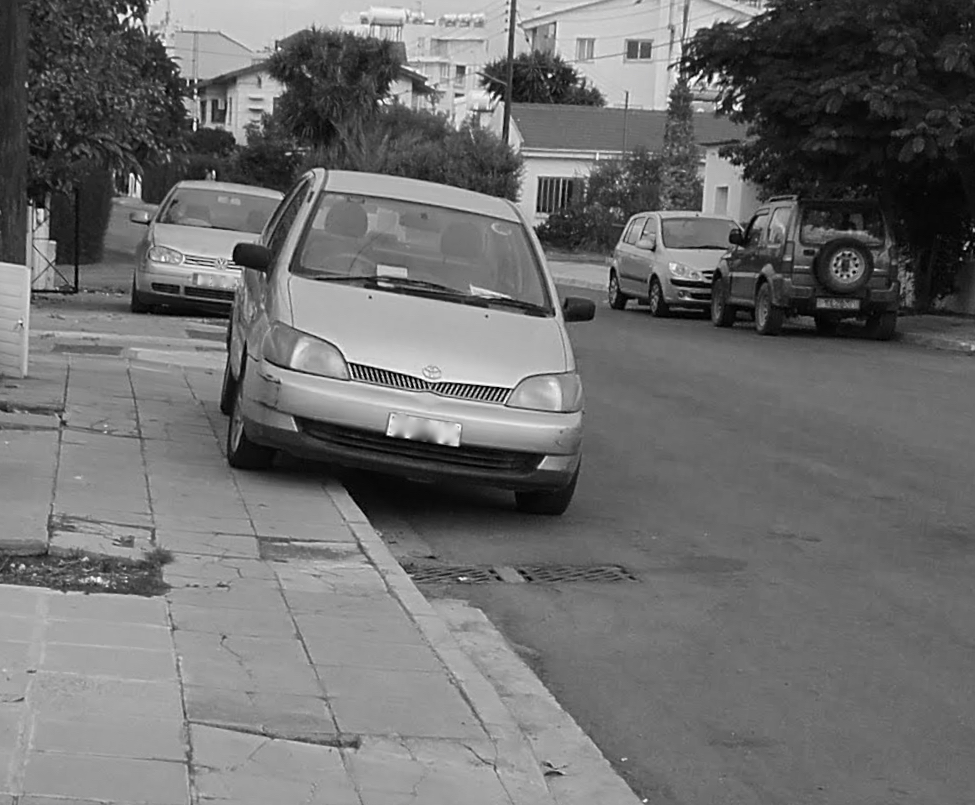
I've taken a few photos to illustrate, but as they are examples of thousands of others, I've blocked out the number-plates, turned the photos into black-and-white, and cropped so that it shouldn't be too obvious where they were taken. I don't want anyone to get into trouble on my behalf - and compared to some of the other offences on the list, illegal parking, particularly in residential areas, isn't so dangerous. 

Here, for instance, are two cars on the pavement. One facing the right way, the other not:


Here's a different view of the same cars, showing how close they are to the corner of the street: 


Another street, another two cars facing the wrong way and partly on the pavement: 


And this one is an example of a car parked on a corner, almost entirely on the pavement, AND facing the wrong way. I assume that the penalties are cumulative.. but they don't seem to be putting people off. 


I am not the only person to be writing about this kind of thing - just a week ago there was an article in the Cyprus Mail about 'pavement bandits' - making the same point, but illustrated with cars in colour (though, again, with no visible number-plates). 

Given that there are so many trees growing in the middle of pavements, and some areas with no real pavement at all, I'm not convinced that, in a residential area, it makes that much difference if cars park on the pavement - indeed, it gives more space for cars to pass each other on the road. However that article does point out that for people in wheelchairs, or parents pushing children in buggies, illegally parked cars can force them into the street, which can cause accidents.

It will be interesting to see if driving and parking starts to improve, but there's no sign as yet. 

PS If anyone who has read this lives in a country where 'pavement' means 'the paved area of a road', please substitute the word 'sidewalk' for 'pavement'.  

Saturday, December 30, 2017

A few more Cyprus quirks...

Although we've lived in Cyprus for twenty years now, there are still occasions when we smile, or roll our eyes, and mutter, 'This is Cyprus!' It's a phrase used by Cypriots as well as ex-pats, often with a sense of pride in the way the island functions. Below are three recent examples:

1.  Central heating pump

Our main floor and the upstairs have separate pumps in our central heating system. About a year ago, we weren't getting any heat on our main floor. Not such a problem in Cyprus as it would be in, for instance, the UK; but some days are decidedly chilly. Our builder recommended a central heating engineer who came to have a look. He said we needed a new pump, so we asked him to fit one. However, instead of buying a new one, he found one that was being discarded by a school, and fitted that. The heating worked - mostly - for the rest of the winter.

But by the time it got cold again a few weeks ago, it was obvious we needed another replacement. Richard decided we would buy one ourselves, and then just ask a plumber to fit it, rather than risk another poor quality one. We went to a suitable local shop, where we were told that yes, they could sell us the exact same pump as our original one but that they recommended another which worked the same and was half the price. We would have bought the most expensive one if they hadn't been so insistent that their own brand was as good (and guaranteed). It was a positive 'This is Cyprus!' moment.

So we asked the shop if they had a recommended engineer who could fit it; preferably one who speaks English.  Yes, they told us, we should speak to George.  I don't know how many scraps of paper we've seen over the years with a phone number and the name 'George'.  Richard phoned him, and he said he would come later that day, or the following morning.

We waited, but nobody appeared. So Richard called, and he said yes, he would come later in the day.  He didn't.  He had many good reasons for not coming when he said he did, but after about the fifth day we were starting to feel rather frustrated. It was a not so good 'This is Cyprus!' experience that is all too familiar.

However, he did eventually come, fitted the pump efficiently and quickly, and even told us why the gas-powered part of our water heating has never worked.  He looked at a drip on the roof and said that one of our water tanks was faulty.  He then looked at a toilet which was very difficult to flush, and made a quick adjustment.  He was competent, quick (once he got here) and charged us just €30 for his time.

2. Curtain track 

Most of the curtains in our house have pull-cords.  And for about ten years or so, they worked just fine to open them in the morning, and close them at night.


Perhaps it's not obvious from that photo, so here's a close-up of the bit we pull:


In the past few months, however, first one curtain and then a couple of others started to jam. They wouldn't open - or wouldn't close - using the pull-cord.  We thought perhaps the cord needed to be replaced, as it looked a little frayed in places, so we bought some new cord. But quickly realised, when we took one down to try and replace the cord, that the problem is in fact with the mechanism at the end of the track that guides the cords:


There are two little wheels at each end, in a metal enclosure, and they were stuck. One of them broke off completely. We realised that the pelmets with the curtain rails have probably been here for thirty years or so... and the little wheel mechanism things needed to be replaced.

So Richard took the track off, and we went to a local shop that sells curtains and fittings.  The person on duty shook her head, and said it was a 'very old' fitting, one that could not be replaced. She said we would have to replace the entire metal track with a new fitting, and that each one would cost at least €25.  Since we have ten of them in all, which will need to be replaced eventually, this seemed a bit steep.  Moreover, the new track which the shop assistant showed us was exactly the same size as the one we have already. "Couldn't we buy just the new mechanism and fit it in the track?" we asked.  No, they insisted, it was too old.

Another oddity of Cyprus is that similar shops tend to congregate in the same area. So we thanked the shop assistant, and went to the next curtain shop, a couple of doors down the same street. We asked the same question.  They, too, said that our mechanisms were too old to be replaced, and that we would need a new track.

But they said it would only be €10 for the replacement.

We were startled at such a price difference, but thought we might as well pop into the third curtain shop that was in the same street, just another couple of doors down.

This time, however, the assistant assured us that yes, 'of course' we could replace the old mechanisms. They don't have them in stock right now, she said, but they could get some in. No, we don't need to make an order, just come back next Friday.  The cost?  €5 for two.

Yes, 'This is Cyprus!'

So, we'll go back there next week and see if they really can provide an exact replacement.

3.  Airport parking

Larnaka's old airport was replaced many years ago with a new, improved and mostly pretty efficient airport.

Unfortunately,  they have never really sorted out how the parking works.

At first, when dropping someone off or meeting a flight, there was twenty minutes of free parking in the short-term car park. If one parked for longer, there was a parking cost, but it wasn't too excessive. Of course, we, like many of our friends, would sometimes go back to the car after fifteen minutes, drive it out of the car park and then park somewhere else, so as to avoid paying - but in most cases, twenty minutes was plenty.

Then they started charging for all parking.  So people started not using the car park; instead they (and we..) would drive around while waiting for a call, or have one person get out to meet arriving guests, while the driver would find somewhere to stay temporarily, until a phone call alerted them of the arrival. But more and more people did this, and the roads around the airport became clogged, and then the authorities started putting up barriers, or cones, to stop even temporary parking.  They blocked off some of the car parks completely... but the main short-stay car park really isn't big enough.  So at times when we do want to park, sometimes Richard drives around for five minutes or more, just looking for a space.

On Wednesday morning we took Tim to the airport.  We decided to go in with him for half an hour or so, and were there in plenty of time. As usual, the car park looked absolutely packed. So Richard dropped Tim and me near the entrance while he went to look for a parking space.  We thought the airport would be heaving with people, as it often is, given the number of cars that were parked.

To our surprise, it was extremely quiet. There was no queue at all, so Tim checked his luggage in immediately.  Apparently the flight was almost empty.  We sat down and chatted for a while, and during that time saw very few people. Evidently December 27th is not a popular time for flying out of Cyprus. There didn't seem to be many arrivals, either.

So we were not just saying, 'This is Cyprus' in a frustrated way about the lack of parking spaces at the airport, we were genuinely puzzled:  why, with so few people in the airport, was the car park as full as ever...?

We wondered if it was long-term parking, for people who had gone away for a week or two over Christmas, but thought that was unlikely, as there's a separate covered long-term car park.  Could it be for staff?  No, they too have their own separate car park.

Then I discovered that instead of the long-term car park being better value than the short-term one for more than 24 hours of parking, it's more expensive. Indeed, the airport site actually suggests that people consider long-term parking in the short-term car park.

No wonder there's such a problem.  But... 'This is Cyprus!'

Monday, September 26, 2011

Calls from the Cyprus Traffic Police

Richard has just returned from attending a conference in Scandanavia. He flew in the early hours of last Wednesday morning. Since our street was blocked off, due to ongoing construction work, he could not park in our driveway, or even in front of our house.

So, as he has done for the past few weeks, he found a place to park in a nearby street, in front of someone else's house. Cypriots can be a bit possessive about the road space in front of their homes, but with so many road works going on everyone locally seems to have been fairly flexible recently. It was a street where construction work had finished, so we hoped it would be all right for five days.

Mid-morning Wednesday, the phone rang. I said 'kalimera', in response to the greeting, and the person at the other end launched into some rapid Greek. I was about to say that it must be a wrong number when I caught the words 'Mr Richard', with a query. Yes, I said slowly and in English, Mr Richard lives here, but he is not here now.

More rapid Greek ensued. I apologised (in English) and said that I did not understand. I have learned from experience that trying to apologise in Greek just leads to a response in Greek which I still won't understand.

So the person who had been speaking to me found someone who spoke English, at least somewhat. 'This is the traffic police', he announced. Then he read out the number plate of our car and asked if it belonged to Mr Richard. I acknowledged that it did, but that Mr Richard was currently out of Cyprus.

'You must move the car, it is blocking,' I was told. I did not, at that stage, know exactly where the car was, but was pretty sure it would not be blocking anywhere. More to the point, I don't drive. So I told the man.

'You have a key?' he asked. I said that we did.

'Then you must ask a friend to move the car. It is blocking.'

I said I would see what I could do. I knew that at least one other person was on the insurance, possibly more. I wrote a note on Facebook (to local friends only) explaining the dilemma. And saw one friend online, whose husband - I thought - was on the insurance. It turned out that he was, and he would be able to come over late morning, and would happily move the car to somewhere safe behind the building where he lives.

So far, so good.

I went for a brief walk to check exactly where our car was, and it wasn't far at all. Nor was it blocking anything. It was parked in front of a fairly wide house, with plenty of space, nowhere near the driveway.

I discovered that I could even see it from one of our bedrooms:


At lunch-time, our friend arrived. He started the car with the spare key... it turned over... and nothing happened. He repeated it. And again. Each time, the car sounded lively - the battery was evidently fine, and the petrol gauge showed plenty of fuel - but it simply would not go.

After several more attempts, our friend said that we must have some kind of immobiliser chip in our key, which rendered the spare one rather pointless (unless the main keys had been locked in, I suppose). So he walked home. There was evidently no way to move the car until Richard returned. I did find an email address for the police, and wrote to explain, but had little expectation of anyone reading it.

Having heard stories of cars being towed away and even crushed when they could not be moved for a few days, I felt quite anxious for the rest of the day.

On Thursday, late morning, I had another call from the traffic police. This time it was from a man who spoke excellent English. I explained about the apparently immobilised car, and he understood immediately. I gather it's quite common although it's not something we've had on any of our other cars. Probably they were all too old.

He sounded very worried until I said, 'So, I'm afraid there's really nothing we can do until Monday. I don't see the problem since the car is NOT blocking anyone in...'

.. and he said, 'Monday? Your husband returns then?'

'Yes,' I replied. 'Early Monday morning. He is only away for five days. '

He sighed with relief. 'Oh well, in that case, we can wait. There is no problem at all.'

So that was that. I still don't know why we were phoned. Did the people really complain that they were blocked in, or is there some further construction work to be done in that street? We will probably never know.... this is Cyprus!

Thursday, August 25, 2011

Text messages instead of parking meters in Cyprus

Yesterday, when we went to get my passport photos taken, we had to park in one of the side-streets near the town. It's many months since I have been there, so I started looking for change in my purse, expecting to have to pay for a parking meter.

I was a little startled to see this, which at first glance just looked like an advert:


But Richard explained that parking meters in Cyprus are being superseded by parking-by-phone. Not being very technologically minded this was a little beyond my comprehension. Apparently he had to send a text message (SMS) to a certain number, giving the parking slot, the car number plate, and the amount of time we wanted to park. Since half an hour cost 30c and an hour 60c, we thought half an hour would be sufficient.

How, I wondered, did we actually PAY for the parking?

It seems that just making the call effectively deducts money from the phone contract or credit.

So, I asked, how does a traffic warden know that we've paid? Assuming they still have something a old-fashioned as traffic wardens, that is...

Apparently the call puts details on a database somewhere. The traffic warden would have access to it. And the phone had a reply text, confirming the slot.

It all seemed rather like a conjuring trick to me, but Richard said he'd done it before and that it was a good idea. I could see that it would stop the problem of vandalised parking meters, and would also stop people from 'giving' their unused time to other people since the car registration is noted.

Anyway, we went to get my photos done, and had pretty much forgotten about the parking meter, when a text message arrived on Richard's phone, reminding him that his parking slot expired in ten minutes. We were still waiting for the prints at that stage. I wondered if he would have to go and move the car...

But no. He simply sent another text message, booking another 30 minutes. No need to return to the car, no worries about running out of time. And the cost is exactly the same as it would have been if we had booked an hour in the first place. Suddenly I could understand that it's rather a good system.

The only obvious drawback appears to be that some drivers do not own mobile phones.. although this would be very unusual in Cyprus.

I wonder if this system is now in place in the rest of the world...?