Showing posts with label coronavirus. Show all posts

Monday, January 24, 2022

Isolating in Cyprus, recovering, and trying to get into the system...

Continuing the post I wrote ten days ago, about being ill, confusing test results and voluntary self-isolation. 

I was reassured by comments telling me I was doing the right thing, and suggestions that I should continue isolating until a home test proved negative, whatever the official rules might be.

The day after writing the email I mentioned, on the morning of Wednesday 12th January, I had a phone call in response. A helpful man with limited English told me I should go to the New Hospital for a PCR test at 7.30pm that evening. I had to turn left at the parking, he told me, and wait at the old container.

At around 3.30pm he called again and said that if I wanted to, I could go immediately. 

Of course it meant Richard and I had to be in the car together rather than isolating from each other, but we both wore masks. Since he hadn't caught it on the two days when I had symptoms but was testing negative with the home test, I didn't think there was a huge risk by this stage, when I no longer had any symptoms. Perhaps the PCR would prove negative, and I wouldn't be in the system at all...

The test wasn't too uncomfortable, and I assumed I would hear the result by the following morning. No, the doctor told  me, this wasn't  a quick PCR. This was a slow one, so I would hear in three or four days.  

I was not impressed! It was six days, already, after having had the first symptoms. But I knew I needed to keep isolating. So I didn't leave the house. We continued sleeping in different rooms, spending most of our days in other different rooms, and I wore a mask when I went into the kitchen or living room.

On Saturday, January 15th, I thought I was improving. The cold symptoms seemed to have gone, and I really wanted to get the house clean and aired, the bedding changed, and life beginning to be back to normal. So, feeling hopeful, I did another home test. 

It proved positive.

I wasn't happy. I stayed in my study, venturing out into the rest of the house in a mask to do as little as I could, and gradually realised I was still extremely tired. Perhaps it was as well that I wasn't trying to clean the entire house. We postponed our usual get-together with friends for Sunday and I knew I wouldn't be going to church. 

Then there was an update in the papers, about isolation periods, due to be implemented on 17th January. While some other countries were reducing the isolation period to seven or even five days (with negative home test to release them), Cyprus was making it longer. Instead of ten days from onset of symptoms, it became ten days after the first positive test. The only good thing was that no longer do doctors have to be involved - the article states that, 'The citizens will be automatically informed on the mobile phone with an SMS the night before their release.'

On Sunday 16th, I finally received a text message from the Ministry of Health with my PCR result. Actually, it was four text messages: two in Greek, two saying the same things in English. 

The first one said, in capital letters, 'Your Covid19 test is positive. Please self-isolate, inform your contacts and contact your general practitioner. You can find the official guidelines at https://bit.ly/2ZZEbtd". 

I had, of course, already informed my contacts, such as they were, and they had done tests to ensure they were Covid-free. I hadn't seen anyone other than Richard for over a week, and had kept my distance from him. 

The second text message told me that in order to submit contact tracing data, and to get a certificate of recovery, I had to fill in an online form. It gave me a code to enable me to do that, so I did. It felt rather like the cliché of shutting the stable door after the horse had bolted but I wanted to show willing. So I filled in all my information again, made up a Greek spelling of my name (which was required in addition to the English spelling), and listed Richard and the friend I had seen most recently (eight days beforehand) as two contacts. Both are fully vaccinated and boosted so would not be required to isolate or have tests... but I assumed they would both get a message from the ministry of health.

But, over a week later, neither of them had heard anything. 

On Monday morning last week, I felt considerably better. By then it was two weeks after my likely exposure to Covid, ten full days after my first symptoms. It was eight days after my first positive test. By the regulations of most other countries, I would be free to go out and about, considered non-infectious. 

But I wanted to be sure, so I did another home test. And, hallelujah, it was negative!


They don't have QR codes here, and there was no way to inform anyone official, but we reckoned that meant I was no longer in danger to anyone. So I spent Monday airing and cleaning the house, doing extra laundry, and no longer wearing a mask. It felt as if I were no longer 'unclean', and it was awesome to be able to hug my husband again. 

Possibly I did too much as I was exhausted by about 6pm, but I was very relieved to think that life was getting back to normal again, and that I had escaped reasonably lightly. 

On Tuesday I emailed an address I found, for queries about release from isolation. I had no response, not even an automated one. Since I had decided I wanted to be in the system,  I thought I had better stick to the rules of not going out, even though friends came over, satisfied that I wasn't going to infect them. 

By Friday. I still hadn't heard anything. By Friday, it was two weeks after my first positive home test. I didn't go to the shops; my 'safepass', according to the local press, would not work (although when Richard scanned it with his CovScan application, it showed as fine). In the evening, we went to our friends' house but I was more tired than I had realised, and we left early. I really hoped I might get a 'release' text on Friday evening, ten days after my second positive home test. But nothing came.

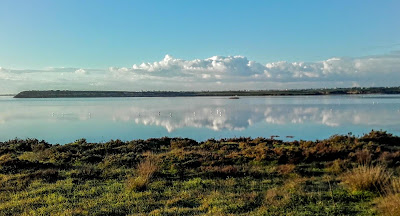
On Saturday, I went out for an early morning walk with my friend, for the first time in a couple of weeks. I couldn't walk very fast, and felt that we had to turn back before we reached our usual destination. It was good to be out, although it's been very cold recently. Even the flamingoes seem to have got the message about distancing, although in this photo they just look like tiny white blobs:

flamingoes distancing in the Salt Lake

I know, I really shouldn't have left the house at all until I'd had my release text. But if my lab antigen test on Monday10th had been positive (as I'm sure it would have been if they had done it correctly) I'd have been released, at least in theory, a couple of days beforehand. And it wasn't as if I were seeing lots of people. 

Much as I enjoyed the walk, I was very tired by the time I got home. There's a cough, too; not as frequent as it was a week earlier, but quite hacking and unpleasant when it hits. Usually when I get cold, or when I'm talking. Hot drinks help, as does staying warm. And I do want to get a bit fitter again, but walking even a couple of kilometres appears to be as much as I can manage so far. 

I felt wiped out for the rest of Saturday and had another early night... but just as I was about to go to sleep, I heard two messages on my phone in quick succession.

At last!  My official release text, in both English and Greek. 

But that's not the end of the saga. 

My second vaccination (Astra Zeneca) was on July 7th 2021. In Cyprus, we were told to wait six months before booking a booster, so I had planned to have it as soon as possible after 7th January.  That guidance did in fact change mid-December to allow a five-and-a-half month gap. But it didn't seem like a great idea to have a booster right before Christmas. Besides, I didn't suppose I was at much risk... so I had booked it for January 11th. Obviously, I had to cancel since by that stage I was isolating. Even that wasn't straightforward, but Richard eventually found the right phone number and succeeded in doing so. 

While opinion is divided about how soon after having Covid one should have a booster, most of the advice I found recommends at least a month. In Cyprus 'safe passes' for vaccinations expire seven months after the second dose, if no booster has been given. That would mean that from February 7th my vaccination pass would no longer be valid for shopping or church or anywhere else I might want to go, unless I had the booster before that date, and I wanted to wait. 

No problem... or so I thought. Instead of continuing to use my vaccination safe pass, I could get a new one based on my having had Covid. That would be valid for at least three months, so I could wait a bit longer before booking the booster.

So on Sunday morning Richard used his phone app to try to get a new safe pass for me. But when he selected 'recovery from Covid', it told him that the system couldn't find a release certificate for me. He tried a couple of times, and I tried on my computer - nothing worked.

Perhaps, we thought optimistically, it would take 24 hours to update. 

So we tried again this morning, and it still didn't work. 

At the bottom of the page was a hotline number for questions, so Richard called that. And a helpful guy said, 'Oh, yes, it's wrong. I will update it. Try again in twenty minutes'. 

We rolled our eyes a little - surely the system should have automated it...? - and he tried again twenty minutes later.

This time it found the certificate. It produced a safe pass. 

But my name was spelled wrongly.  Not just one spelling error (which, in Cyprus, really wouldn't matter as spelling does tend to be variable for proper nouns) but THREE mistakes.  One in each of my three names. Since places checking safe passes are also supposed to check IDs, I thought it should really be more accurate than that. And where had it picked up the wrong spelling anyway...? We will probably never know. 

So Richard called the hotline AGAIN and someone else said that she would correct it. It's a tad concerning that all it takes is a phone call to have something like that edited... but 'this is Cyprus'. 

Sure enough, it worked. 

Well, almost. 

My middle name is given as part of my surname rather than as part of my first name, but at least the spelling is correct.

I now have a safe pass valid until July 7th. That's six months away. I don't plan to wait that long before my booster, unless Omicron proves to be the end of the pandemic (as some hopeful experts have suggested might possibly be the case) in which case I might not have one at all. But assuming it continues, I really don't want to risk another infection. I know my case was mild; I don't have any underlying conditions and I'm reasonably healthy. And I've had two vaccinations. But it wasn't pleasant, the lingering cough is nasty, and I'm still not back to my usual energy levels. 

Tuesday, January 11, 2022

Isolation and Testing Confusion

On Monday January 3rd, we went to look for a new small upright freezer for our guest flat. There are several people booked to stay there over the next few months, including some families. Our old guest flat freezer was very inefficient to run by today's standards, and likely to stop working at some point due to its age (close to 24 years). 

One of the shops we went into was in the Metropolis Mall. I was aware, while there, that people were not really distancing from each other, and many were rather casual about mask wearing. There were a few coughs and sneezes, too. We didn't end up buying the freezer there, but we did find one at our favourite white goods' shop, George Theodorou, where health protocols were correctly observed.

On Tuesday I walked first thing with my friend Sheila as usual. Later, she and her daughters came over to help me put the Christmas decorations away, and to play some games. In the afternoon I finished cleaning the guest flat and made up the beds.

On Wednesday I did some shopping first thing for the first guests, due to arrive in the evening, since Thursday was a public holiday. Later in the day, we put away Tim's bed, turning his room temporarily into a kind of sitting room, soon to be occupied by Richard's electronics projects and repairs. 

bedroom turned into sitting room

On Thursday morning, I woke about 4am for no obvious reason, and couldn't get back to sleep. I was a bit headachey, and felt as if I were starting a cold. I didn't worry about it particularly; Sheila's daughters have all had colds recently and since they have twice-weekly antigen tests for their 'safe passes', I knew they were 'just' colds. So assumed I had finally caught one of them. I took extra Vitamin C and manuka honey, dozed for a while, and hoped it would be short-lived. At 6.15 or so I went out to walk with Sheila as usual. 

Gradually, as the day progressed, I started sneezing and coughing more and more. The headache got worse, and I felt incredibly tired. Waking up at 4am would have contributed to being tired, of course. But in the current pandemic crisis, my mind was, unsurprisingly, on the possibility of Covid. 

In the UK, most people we know test themselves at home a couple of times per week. We haven't had that possibility in Cyprus (possibly because the rather more authoritarian government here doesn't trust the rather less obedient public...) until mid-December. But as Christmas approached, each adult was allowed to collect one set of five lateral flow self-tests, intended for use over the festive season. It was a good idea, so that people could make sure they were Covid-free before spending time with elderly or vulnerable relatives.

We hadn't used any of ours, so I thought it would make sense do so. I knew that cold symptoms and headache could be a sign of the latest Omicron variant. The instructions were lengthy and confused, but Richard worked it out, and I did my test.

Negative.

negative Covid test

I was slightly surprised but highly relieved. However I was so tired that instead of playing a game with our friends in the evening, I went to read in bed with a warm wheat bag for company.  

On Friday morning I woke at 4am again, this time with an absolutely raging headache, right across the front of my head. There was no way I could get back to sleep. I got up, and took some Solpadeine (after eating an apple to ensure my stomach wasn't empty). It helped somewhat, but not nearly as much as I would expect. A few hours later I took some aspirin and it did get a bit better.

But I felt quite grim; so before we headed out to do our weekly shopping, I did another home lateral flow test. 

That, too, was negative.

So we shopped, and went through the day although I felt washed out, and in the evening we went to our friends' home as we usually do for a shared meal, though I could barely stay awake and we left well before 9pm. 

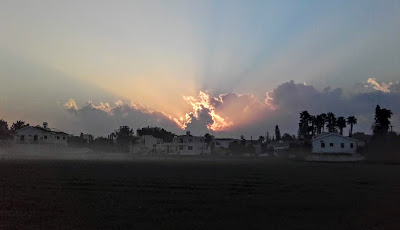
On Saturday, another raging headache woke me up at 4am. I did not appreciate what seemed to be turning into a new daily routine. This time I just took paracetamol and dozed in my study. It very slowly got better, so that by 6am I was able to walk with Sheila. And for the first time in ages there was rather an attractive sky, though as ever a photo can't really do it justice: 

sunrise near the Salt Lake in Larnaka

As I said to Sheila, I thought a good walk would either make me feel better, or wipe me out for the rest of the day. It seemed that the former was the case. Though very tired by the end of the walk, through the morning I did start to feel more myself again. I put clean sheets on the bed, and cleaned the bathrooms, and put away Friday's laundry, and mopped the floors... I took breaks in between each burst of activity, but I felt less much less washed out than before. 

I still didn't feel up to playing a game in the evening, so when our friends came over, I went up for another evening with a book and a wheat bag. I was tired, but I also had a hunch that I really shouldn't be sitting close to folk and breathing on them. Even though my cold, as I thought, was almost entirely better.

On Sunday morning I woke early yet again... but only a slight headache this time, and getting out of bed eased it. I had a bit of a sore throat too, but more a tickle than anything. A glass of water helped that.

I went downstairs and since I felt quite wide awake for a change, I decided to finish a baby blanket I've been knitting off and on for the past six weeks or so.  I not only finished the knitting, I sewed it all together - much easier while the cats were still asleep in the dining room.  

80cm square baby blanket for refugees

Then I squeezed orange juice and made our breakfasts, and turned the water heater on. I planned to go to church at 9.30 so couldn't wait for the sun to warm the water. 

And then... being, basically, quite a responsible person (I hope), I thought that it would probably be a good idea to do one more home lateral flow test, before going out, just to be sure. There are some vulnerable folk at the church, after all, even though we are masked and distance. I had a busy day planned on Monday, too, with two different groups of people, and some of them are also vulnerable. 

I want to say I was surprised that this test proved positive, but I had a strong hunch that it might.  


Richard took one too, and his was negative, so he was able to go and set up the livestream at church. Vaccinated close contacts don't need to isolate here though tests are recommended.

Chatting online with my son later, I learned that with the Omicron variant it's not uncommon for lateral flow tests not to pick up an infection in the first few days. That's because it mainly replicates in the throat rather than the nose. This is why it's less likely to lead to lung problems, which is good; but it means that the home tests are less helpful in ensuring that someone is safe to visit vulnerable relatives.

Instructions are (we thought) clear: On receiving a positive home test result, we are supposed to contact our personal doctor who will arrange for a PCR test. And, indeed,  this article is a clarification that was published a couple of days ago, including: 

As soon as they test positive, the confirmed cases must:

  • Go in self-isolation
  • Inform their personal physician
  • Inform their closed contacts, employer, school, military camp, and so forth
  • Will get out of self-isolation only after the days, provided by the protocol, have passed

(There's also a rather mystifying comment that confirmed cases cannot use any mass media... I suspect this is a mistranslation of something, as I see no possible reason why I shouldn't watch television or read a newspaper if I wished to.)

However, as it was Sunday, we couldn't reach our personal doctor by phone. I sent a text to her mobile number, but had no response.

So I called the official hotline and a helpful man asked if I were vaccinated (yes, but not yet boosted), and if I had any symptoms (not really, I said, other than a slight sore throat and explained that I had symptoms the previous few days). 

Okay, the guy said, the best thing was to isolate for the day, and contact the doctor on Monday morning.  She would then give me a code to authorise an official PCR test, he told me. And then I would have to isolate for ten days, although possibly I could count Sunday as the first. 

I stayed in my study all day. Richard cooked, and did the washing up, and re-made Tim's room back into a bedroom so he could sleep there while I isolate, even from him. I had already contacted our friends - we had only seen members of this one family all week - and they went for tests, which were negative.  I let folk know I wouldn't be at any meetings on Monday. 

I read a book, and wrote emails and Facebook messages on the computer, and did a few bits and pieces... and then slept pretty well Sunday night. I don't like having to isolate from my husband but we're fortunate to have a big enough house that it's possible without my being stuck in just one room. When I go into the kitchen, or other shared space, I wear my mask. Also when I am with the cats, who totally refuse to isolate from me. 

On Monday morning Richard called our personal doctor. The receptionist said that since I didn't have any serious symptoms, I didn't need a PCR test. Instead, she said, I should just go for a rapid test, and if it was positive the result would get recorded in the system and my official isolation could start. When Richard queried this, the receptionist checked with the doctor who said that yes, that was correct. 

We drove to the underground carpark at the mall where the official free testing happens, but there was quite a long queue. So we decided to go to the lab we went to in the summer and pay five euros rather than waiting around for half an hour or more. 

And.... the lab test came back negative. 

But by this stage I was feeling as if I had a slight cold - and my intuition still told me that I probably did have Covid, even if so mildly that it couldn't be detected by an antigen test two days later. My intuition can, of course, be wrong. But I don't think I'm a hypochondriac, and besides, it's better to be over-cautious as far as Covid is concerned than to risk other people's health.

So we agreed that I would continue isolating for the rest of the day, and Tuesday too, as minimum. On Tuesday morning I would do another self-test, and - if negative - I would be careful for a couple of days until the slight cold was gone, and then go back into circulation.

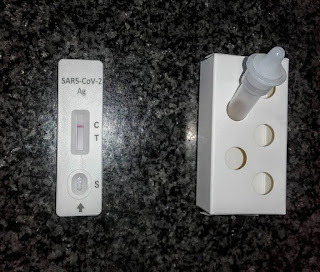
But this morning's test was not negative. It looked even more strongly positive than the one on Sunday: 


What to do? There didn't seem to be any point contacting the doctor again, since the negative lab test yesterday effectively released me - I only took the one today to be certain. I would probably be told to ignore the home tests. I don't want to have to pay for a PCR test, which could take a few days to come through anyway, and I would then have to isolate for ten days further. 

A bit of research turned up this page relating to the home tests. The instructions on that, right at the bottom, are rather different from those quoted above: 

In case of a positive result, citizens must contact the Coordination of Public Health Clinics via email... by sending their identification details... as well as a photo of their positive self-test.

Okay.

So I composed a lengthy email (no, not as long as this blog post!) describing my symptoms and the tests, attaching the photo of the second positive home test as above. I said I have no more symptoms other than a mild cold; I haven't had a fever since Thursday, and then only a mild one (if at all). I mentioned the official negative test. I told them I have been isolating since Sunday.

I asked them what I am supposed to do. 

About half an hour later, I received a response. It said:

Your request has been received.

Should we require further information we will contact you.

I have done my duty. Indeed, I feel I have gone above and beyond, by taking the tests on Sunday and today, neither of which were required after the negative tests. I will continue to isolate for at least another couple of days but am not sure what else I can do. 

If anyone has any words of wisdom, please comment... 

(Continuation, official recovery and release in the next post: https://cypruslife.blogspot.com/2022/01/isolating-in-cyprus-recovering-and.html

Thursday, September 02, 2021

Preparing to Travel from Cyprus to the UK

We usually - in the pre-pandemic days - travelled to the UK at least once per year, sometimes twice. All our immediate family members live in England now, scattered around the country. Last year we had to cancel the week we had booked with our sons and grandchildren in Scotland, as travel was impossible. I kept hoping to be able to visit, all through the Autumn of 2020, but it wasn't to be. Our younger son didn't even manage to come out to Cyprus for Christmas, for the first time in over a decade. 

I say this not as a complaint, but to give some context. Many are much worse off than we are from the family visit point of view; some, sadly, have lost loved ones during the past eighteen months. 

Cyprus has done fairly well as far as vaccination rate goes, though it was awhile before we were eligible to be jabbed. I had my first Astra-Zeneca dose in May, the second in July. Back in May when I booked it, I was somehow hoping that it might be possible to travel in August, and that being fully vaccinated might help. 

By the end of June, I was beginning to think we might have to wait another year without seeing any of the family, and that vaccination status was irrelevant. But in early July, realising that my passport would expire in November, I applied for a new one anyway. I knew that if any chance of travelling did come up, I would need at least six months' worth of validity... so I thought I might as well apply rather than potentially leaving it to the last moment if a travel opportunity came up.  

The site for applying online was surprisingly easy to navigate, clear in its instructions, and even allowed a digital photo taken on a phone. I had to send my old passport to the UK via recorded delivery, but was pleasantly surprised that, rather than it taking 11 weeks, as the site suggested, I had my new passport back before the end of July.

But the Covid case numbers in Cyprus were very high, and it was in 'Amber' status as far as the UK went. That meant that in addition to having to do a pre-flight antigen test, visitors to the UK had to book two PCR tests after arrival, and self-isolate for ten days. An annoyance for Brits returning home, but really not an option for tourists, nor for visiting the family, unless the family lives somewhere isolated already and one is not trying to see a large number of different people.

Then it was announced that, from August 2nd, fully vaccinated tourists from 'Amber' countries would NOT need to isolate on arrival in the UK.  My heart beat a little faster. Maybe we would be able to see the family after all..

We started putting out feelers, wondering whether to fly at the end of the first week of August, Richard staying for ten days or so, while I might stay longer.  But nothing quite came together, and I never felt 'right' about it. 

Then, gradually, another plan evolved. I wouldn't stay longer than Richard- I wasn't entirely happy about using public transport - and we would play to stay at Travelodges or AirBnBs instead of with family members. That would reduce contact time at night and breakfast and would be less hassle for those we wanted to see.

This time, our suggested dates worked for everyone. Flight prices were surprisingly low (although car rental wasn't!) and we were able to find suitable accommodation in all our planned locations. 

Of course it's not that simple, this year. We had to book pre-flight tests. The UK government website makes it clear that they don't have to be PCR tests, they can be the rapid antigen tests, but must have paperwork saying they meet certain criteria. We also had to book PCR tests - just one each - to use on Day Two in the UK.  That was quite complicated to arrange, and a tad pricey, but the AirBnB host for that day was happy to receive them on our behalf. 

On August 11th, the day before we were due to fly, we went out to get our antigen tests. The first two pharmacies we went to were closed for most of August. We looked at a suitable lab, but there was a long queue in the hot sun. We eventually found a pharmacy with rapid tests being done outside, with no queue. The people involved in the testing looked at our printed list of UK government requirements, and said, 'Yes, yes, we do that'.  

'Is it okay for flights to the UK?' we asked. 

'Yes, no problem,' they said. We would have a printed form, they told us, and a text message on our phones. Eight euros each, which seemed reasonable. And while we were there, we bought some high quality masks to wear on the flights.

It was the first time either of us had had a Covid test, and it felt like a slight tickle in the nose. I was surprised they got anything at all. The results (negative, thankfully) appeared in about two minutes. Then we were given our forms, which looked very scrappy, and were mostly in Greek:


We were assured that everything was fine, that there were no other forms or paperwork they could do, and that the government would send us a text message with more information. 

A while later we did indeed receive text messages from the government, confirming that we were negative. This would be fine if we were just wanting a 'safe pass' to go to a big shop or church service. But since we're both fully vaccinated, we don't need those.  I didn't feel entirely happy about it, but hoped it would be all right. 

After that, we had to fill in the UK passenger locator forms, which must be done online. I don't know what people do if they don't have access to a computer.  It was reasonably straightforward, with options to check and edit every field if necessary, but a lot of information was required. We printed them out... more paperwork. 

In the evening we discussed our pharmacy antigen tests with a friend, who pointed out that the pharmacy hadn't even put our dates of birth on - and that's a requirement. Nor did they have any phone number to contact them. Perhaps, our friend suggested, we could go back and ask them to add this information, and give us a contact card. 

But on Friday morning, the day we were due to fly, we decided that, rather than get into a possible argument/debate with the pharmacy, and - more importantly - risk being turned away from the flight in the evening, we would go to a lab, even if we did need to queue for half an hour or more. Thankfully we didn't need to wait more than a few minutes, and it all seemed much more professional. And they only cost five euros each. 

Best of all, they gave us printed forms that included all the necessary information (I have, of course, cropped parts with personal details from this photo - but it shows how much more professional it looks than the first one)

Rapid Antigen test results for flying to UK

Having said that, there was a slight glitch when Richard saw that they had spelled his name wrong, and they initially gave me someone else's form. So they had to re-check and find mine, and edit his name to print another. But at last we had what, we hoped, we needed. 

When we got back, we sorted out clothes to take, and worked out that we wouldn't need to book an extra bag, as Richard had feared. So we wondered if we would be able to check in online. Most people we know of who have flown in the past couple of months have said it was impossible - the airport staff want to check every document. It's not unreasonable, since they have to check certificates etc, and apparently doesn't take much longer.

But he tried anyway, and to our surprise we succeeded in checking in. Boarding cards appeared, not to be printed but for our phones. Just as well I have a smartphone now. We were only flying with hand luggage - on a slightly upgraded kind of ticket that allows two full-size cabin bags, and two smaller under-seat ones. 

So the boarding pass was paper-free, but the amount of paperwork we had to print was considerable: 


That included information about all the locations where we were staying, the rapid test results, details of the ordered PCR tests, car rental... and details of the flights too, although we knew we probably wouldn't need those. 

When we arrived at the airport, we went straight through security with our phone boarding passes, and the various checks - passport, luggage scans etc - were much quicker than usual. The airport looked almost empty - we had never seen it so quiet. We had quite a wait, and were wondering if we'd have to show the antigen test paperwork to anyone - but we did, at the boarding gate. A man there asked to see our vaccination certificates, and also the negative test results. Thankfully everything was fine, and we finally boarded the emptiest flight I can remember.

At last, I allowed myself to hope that we really would soon be seeing our family!

Friday, January 15, 2021

Half-way through January

It's only three weeks since Christmas. That's easy enough to calculate, of course, but it feels like much, much longer. December - when we were still able to have up to ten people meeting at a time - seems like a distant dream.

Christmas Day was pleasant despite being unable to see any of our family. We were able to go to a church service in the morning, albeit in a masked and distanced way, and it was good to see people. Our closest friends came over for lunch, and games in the afternoon, followed by a high tea where none of us felt hungry, but all of us ate plenty.  

lots of food for Christmas high tea

On Boxing Day we didn't do much; on the Sunday we had some other friends to lunch and mainly ate leftovers. 

It almost felt like normality. 

But the Covid numbers were climbing. On December 28th, there were 751 new cases announced in Cyprus.  That's equivalent to around 50,000 in the larger countries of Western Europe, or the UK. This is a small country, and while the hospitals weren't yet full, the authorities were getting worried. The restrictions - such as they were - from mid-December were due to end on January 11th. Schools were closed until then, and only two people were supposed to meet outside, although - bizarrely - we could still be with up to eight other people indoors.

On 29th December, after an emergency meeting, the government announced that people could no longer visit anyone else's home. That was in place until December 10th, we were told, but on New Year's Eve there was a relaxation of the rules. We could invite one other family to our home, and the curfew would not start until 1am on New Year's Day rather than 9.00pm as it had been the rest of the time. 

So Richard took the opportunity of inviting some friends to sail on New Year's Eve; it seemed reasonable to be able to count his boat as part of our home, and was safer (from the virus perspective) since it's outside rather than indoors.  And as the wind was light, and the weather not too hot, I went too. For my first time on his boat Liza. 

sailing in Cyprus on New Year's Eve

It was an enjoyable day, and I said I might even go again at the end of 2021. 

In the evening we were the one household invited to our other friends for an evening meal and games; I just about managed to stay awake. I really wanted to make sure 2020 had gone... even though it took me a few days to catch up on the lost sleep. I don't do well with late nights!

So from January 1st we were back to virtual meetings only, with the exception that two people from different households are still allowed to meet outside for exercise. So I continued walking first thing with my friend Sheila. Sadly, although daily Covid case numbers dropped a bit, they were still in the four hundred range, so we knew the restrictions were not going to be relaxed on January 11th. Indeed, it was fairly certain that we'd be subject to another lockdown. 

That has proved to be the case; it was announced last week that from January 10th until the end of the month we must stay at home, other than 'essential' outings, for which we must send an SMS request to the government. But it's not as strict as the lockdown last spring.  For one thing, we're allowed two daily requests rather than being limited to one. Somehow that makes an enormous difference.

We're also allowed to walk in parks or on beaches, as exercise is one of the permitted reasons for going out. And two unrelated people can still meet for exercise, though no more than two (unless one of them has under-age children with them). 

The weather has been very mild, with no rain at all until Wednesday when there were several heavy showers. That meant that on Thursday morning, the flamingoes were much closer to the shores of the Salt Lake than usual. I didn't have my camera with me, of course, but was able to take a slightly better photo of a few of them with my phone: 


And I took a video, albeit not great quality, showing flamingoes walking, and some of them flying.  (If you decide to watch it, it looks better if you either use the full-screen option or click the YouTube option to see it there).


Walking first thing is not just good exercise, and a chance to spend time with a friend, it's a great start to the day, which gives me more energy and focus.  At least, in theory. It's not easy to get things done in this continued uncertainty. And while we had plans to do various things in the house, we didn't manage to get organised enough to buy what we needed before the current lockdown. All shops deemed non-essential are closed, although many more now offer online ordering. 

So the first week has almost ended, and it hasn't been too bad. Perhaps it's easier because we've done it before. Maybe it's less stressful because we're no longer worried that the virus might leap up at us from the supermarket. We all wear masks, and of course we do wash our hands when we arrive home, as it's a good idea in general. But I often forget to sanitise my hands on the way in and out of shops, and it's not enforced. Nor is anyone wearing those horrible disposable plastic gloves that were required back in the spring last year. 

And perhaps it's less worrying because, although the scope of Covid has been far, far worse than anyone imagined, the vaccinations offer hope, at last, that the elderly and the most vulnerable will be safe. Of course it's very difficult for many businesses, hard hit by last year's lockdown, suddenly having to close again. Some may never recover. 

The positive case numbers have been a bit better - around 250-350 the last few days, reflecting the fact that we haven't been able to meet in other people's houses since the start of the year. We don't know what will be announced for February; perhaps 'non-essential' businesses will be able to open again, if the numbers stabilise and the hospitals stop being over-crowded. But I doubt if we'll be allowed to get together with friends inside for some time to come. 

Friday, November 27, 2020

Restrictions for the first half of December, island-wide

A couple of weeks ago, I wrote about the latest restrictions on travel, shopping, meetings etc in Cyprus. These were introduced in the hope of curbing the sudden increase in Covid numbers. Limassol and Paphos had stricter regulations than the rest of the island, but the only new thing that affected us was not being able to do any shopping before 10am. Which, in the scheme of things, is no more than a minor inconvenience.

Unfortunately, the number of new cases testing positive each day has remained in triple figures, mostly between 180 and 260. That's a lot when the population is only around one million. Equivalent to around 14,000-20.000 in the larger Western European countries, and they've had much stricter restrictions over the past month. 

Here's how the overall case number chart is looking for Cyprus now, in bar chart form: 

Covid case-rate in Cyprus, November 2020
It's not good. 

Part of the reason for the increase in positive cases is that testing has been increased quite significantly over the past couple of weeks.  But if the cases weren't there, they wouldn't be found. Many are asymptomatic, of course, which makes it harder to find them, particularly when people are casual about isolating, and reluctant or even unable to divulge all their contacts. 

On a global scale, Cyprus hasn't done so badly:

Covid figures for Cyprus, at the end of November 2020

Compare, for instance, to three of the worst-hit countries in the European areas:

Covid figures for Spain, Italy and the UK, November 2020

(To read the statistics, you probably need to click the images to see them rather larger)

The significant figures are the total cases and deaths per million. The worst European country is Belgium, with nearly 1400 deaths per million. Of course different countries calculate statistics somewhat differently, and one has to take into account the age and general health levels of the populations. But those are unlikely to be significantly different in countries such as these. 

Still, despite having done reasonably well overall, the recent increase in numbers in Cyprus is very concerning, and all the more so because the health system is beginning to struggle, as more and more people are having to be treated in hospitals each day.  A bar chart of the deaths doesn't look too bad - most days it's just one or two people, the majority with underlying health conditions. But each death is a tragedy for the family concerned. And the trend is not encouraging:

Covid death rate in Cyprus, November 2020
So, on Wednesday the health experts met with government advisors, and various scenarios were discussed, though no details were released at the time. Today there was another meeting, and the new regulations were announced shortly after 1.00pm. 

Road restrictions to Limassol and Paphos have been lifted. The case numbers in Paphos have apparently improved, and limiting traffic to and from the cities was causing major traffic jams as well as a logistical nightmare, with everyone eligible to go to these towns needing to be tested for Covid first. 

However, the entire island has a new, stricter set of regulations from November 30th-December 13th, in the hope of reducing numbers significantly. One that is going to affect us and our friends is:
Curfew from 21:00 until 05:00
That stops people having long drawn-out evening meals together (particularly Cypriots, who often don't eat until eight or even nine o'clock), and it will prevent us from our regular evening get-togethers for board games with friends, usually twice per week. But it's another minor inconvenience in the cause of preventing spread of the disease. 

A slightly surprising new restriction is: 
Restaurants to be open until 19:00 with the exception of take away and delivery.
Many restaurants don't even open in the evening until seven o'clock anyway. And even if one goes to an all-day restaurant at six o'clock for an early evening meal, it would be quite rushed to finish and be out within an hour. So this essentially stops people eating out in the evenings. 

We were also surprised to see this:
One person for every 10 s.m. for shops.
It had been one person every 3 sq m, as far as I remember. This is going to make it more difficult to do any shopping - and we didn't think there had been any cases of people being infected via shopping. Hand sanitisation and mask-wearing have become 'normal' in shops, and people are pretty good at moving out the way of other customers, and keeping a couple of metres apart most of the time. 

Other restrictions - the closure of gyms and casinos, public transport to operate at 50% capacity, and so on - don't affect us personally.  And, again, they're irritating to those involved, but in the scheme of things not a huge problem, particularly if it's only for two weeks.

We had expected a reduction of the number of people allowed in private gatherings in houses, but that's still set at ten. It doesn't even have to be the same ten people: there's no 'bubble' system operating here. We could theoretically invite eight people over one day, a different eight people the next day, and so on, leading to nearly fifty close contacts in a week. 

We don't do that, of course. We normally see our closest friends a few times each week, and a limited number of other people.  But we were expecting some reduction in the numbers allowed for private gatherings, as those are where the transmission of the virus is most likely. Masks and distancing are not required or even expected in private gatherings, possibly because it simply wouldn't happen here. 

As for what will happen from December 14th onwards, that will depend in part on the epidemiological situation. But according to this article on the Kathemerini site (right-click to translate, if necessary) they hope to return the curfew to 11pm rather than 9pm, and to allow restaurants to open until 10.30pm again.  Between December 23rd and January 1st, they plan to allow 15 people in private gatherings rather than 10.

Christmas is inevitably going to be very subdued this year. Maybe things will start to get back to normal in the spring: there's been some apparently encouraging news published about vaccine trials. But according to the Lancet, the results haven't yet been peer reviewed.  There's a concerning phrase in that article:
"How well the vaccines work in older people or those with underlying conditions and their efficacy in preventing severe disease are still unclear."

If the vaccines don't make any difference to those most at risk, then it's hard to see how we expect any semblance of normality within the next few months. 

Thursday, November 12, 2020

Further restrictions in Cyprus

It's only a week since I wrote about some new restrictions in Cyprus, until the end of the month.  The only one that affected me was that shops would only serve those who were vulnerable and/or over 65 from opening time until 9.00am. And that masks are required outside as well as in public places, other than when exercising, or in quiet street with nobody else around. 

Sadly, it hasn't made any difference to the number of new cases being diagnosed daily. Here's the Worldometer graph that's now showing:


There was a shocking peak of over 300 one day last week, although thankfully that has not been repeated. But the numbers in hospitals are high, and yesterday four more people died. The hospitals are not able to cope with many more admissions; this is a small country. So on Monday the epidemiologists and other advisors met, and last night there was a meeting to determine exactly what new restrictions would be in place.

We were more-or-less prepared for another lockdown, although we didn't expect it to be as strict as the one that started at the end of March. More is known about the virus, and it was fairly certain that schools would not close. I didn't expect to go back to the SMS system of needing authorisation to leave the house, either.

So last night, around 8.30, I kept checking the various local news sites. I was most hopeful about Kathemerini, a Greek site which seems to get the news more quickly than any of the others. And, indeed, it did. It gave a live stream of the Cypriot President giving a speech asking people to follow the new regulations, and then one of the Health Minister explaining what the new rules are. The Greek was much too rapid for me to understand more than about one word in five, but text was being updated every minute or so as he spoke, and I right-clicked 'Translate to English' to find out what we would be facing.

It turns out that, other than for folk in Limassol and Paphos, not a great deal has changed. The measures from a week ago are still in place, and will remain so until the end of the month. There are some additional rules: no visits to nursing homes or other high-risk areas; the shopping time for the vulnerable and over-65s is extended by an hour. But we can still meet in private homes or outside in groups of up to ten people, which is the most significant thing for us at present. 

However, as the article (and others linked below) points out, Limassol and Paphos have had around 70% of the new cases in the past couple of weeks (compared to 28% in the Spring), and have also had around 70% of hospital admissions currently.  Seven out of eight of the people who have died with Coronavirus in the past week are residents of either Limassol or Paphos. So there are gong to be much stricter measures in those two districts, starting today. 

For one thing, movement is going to be restricted, to ensure that nobody can get in or out of Limassol or Paphos, other than for essential work (health care, mainly) or going to/from an airport. For another, they are having a full curfew from 8pm to 5am (it's 11pm to 5am in the rest of Cyprus). 

Also the universities and lycaeums (schools for age 15-18) in Limassol and Paphos are closing, with online learning only, and various activities are cancelled.  Many businesses are closed too. Shopping malls are shut, and outside groups of more than two are not allowed. However, surprisingly, up to ten people at a time are still allowed to meet in homes in those towns too. 

I was mildly amused at the auto-translation of the notification that churches are closed in Limassol and Paphos: 
"Ecclesiastical and other forms of religious worship in religious places are performed without the presence of believers."

Today there was a summary (in English) on the Cyprus Mail website although I don't think it's particularly helpful to use the word 'Draconian' in the description of the not-quite-lockdown for Limassol and Paphos. It is, after all, nowhere near as severe as the restrictions during April.  

However the best place to look for all the details is the press release on the PIO site.  I checked, out of interest, and the phrase about church services in Limassol and Paphos states:

"Church services and other forms of religious worship in religious places take place without a congregation present."

Which is how we had understood the odd auto-translation above. While this still sounds a bit strange to those of us of Protestant backgrounds, it's important, as I understand it, for the Greek Orthodox priests to say/sing their liturgy in their church buildings on Sundays and other special occasions, but it doesn't matter so much whether anyone else is there. The Protestant churches will have to return to live-streaming, probably from their homes. Or maybe from their church buildings, if they are able to do so without any congregation present. 

So Cyprus has essentially introduced a 'tier' system, a little like those which the UK and various other countries have adopted, although it hasn't been officially described as such. But I assume that, if cases start to get worse in Larnaka, we too are likely to have these stricter measures implemented. 

We just hope and pray that numbers will reduce, here and elsewhere, and that the hospitals will cope. There are more effective treatments now available, as the virus is better understood, but all over Europe and the United States people are still dying, more than did back in the spring when some of the treatment was guesswork. 

Thursday, November 05, 2020

New restrictions in Cyprus for November

Yesterday I refreshed various news sites on my browser several times. Partly, out of mild curiosity, to see if anything had progressed on the other site of the Atlantic. It hadn't.

But also in part because we knew that the government here was meeting to discuss new measures to restrict the spread of Covid-19.  Cyprus was doing pretty well earlier in the year, with a very strict lockdown in the spring, and gradual return to - almost - normal life during the summer. 

However, we were aware that countries in the Western part of Europe were seeing seriously high numbers of new cases again, from about mid-September onwards. So it wasn't really a surprise when it started happening in Cyprus too.  Here's how the graph from the Worldometer site looks at present: 


daily covid cases in Cyprus, February to November 2020

In many of the other European countries, the big numbers currently were partly due to increased testing. Or, rather, then lower numbers shown in the spring were due to lack of extensive testing.  But in Cyprus they implemented a track-and-trace system pretty quickly. They determined where the first cases came into the country, and in every case, at least during March, they knew exactly where the virus had come from, and were able to test and isolate known contacts. 

The small spike in August wasn't considered too serious; it wasn't due to tourists, who began coming to the island again when the airports opened to visitors again in mid-August, but in many cases due to residents returning from seeing family and friends elsewhere - mostly Greece, but some in the UK and other countries. 

But since the middle of October, there have been far more cases than there were in the spring. In the past couple of weeks, between 100 and 200 cases have been reported every day; some from contact tracing, but mostly from 'private initiative' - people with symptoms going to get tested.  There are still very few discovered at airports. It's clear that the virus has a hold in the community, and can no longer be suppressed by individuals self-isolating.  

If you think 100-200 still sounds like very small numbers, remember that this is an island with a population (in the south) of less than a million.  Many of the bigger European countries have populations of between 60 and 70 million.  So it's equivalent to between 6000 and 14000 cases in a country with 60 or 70 times the population. 

Part of the problem is that some people have violated quarantine rules; part of the problem is that people, often younger ones, but not exclusively, assume they are not vulnerable, and continue meeting.  Not everyone knows or understands what is and isn't allowed, and even in this little country there are people who believe Covid-19 doesn't exist, or that it's no worse than an ordinary cold. 

Not many people here have died of Covid in Cyprus; the rate here is much lower than many other places, but the number of folk in hospital is increasing, and there aren't all that many allocated beds. So it was clear that new measures had to be taken, and last night the government met with the health advisors, and came up with new regulations.

It's not another lockdown, as we had feared, though perhaps it should have been.  Schools are still open, shops and restaurants are still open, though with some restrictions. Churches can still meet, albeit with masks, distancing and limited numbers, as has been the case for the past few weeks. 

Here's the link to the full list of current restrictions, though many of them are not new:  Press Release about the new government regulations

Limassol and Paphos have stricter measures, as they have had the most cases recently.  So after spending most of the day wondering if we'd be able to see our friends within the next month, and go out for walks, there are in fact very few changes as far as we are concerned. Rules about conferences and weddings don't affect us. The curfew from 11pm to 5am is not a problem at all.  We can still have up to ten people (including us) in our house, and we can eat at a restaurant, should we wish to, so long as we're not in a group of more than six. 

It's been a bit complicated working out what to do with the local Christian writing group, which has more than ten members, but we've found compromises - and this month is no different, regulation-wise, from last month. Indeed, there's just ONE thing on that list which affects me personally:

  1. Retail businesses of beverages and foodstuffs (supermarkets, minimarkets, butcheries, etc) and pharmacies, shall only serve persons who are over 65 years old and persons with disabilities, from opening time until 9am and from 1pm until 2pm.

Back in March, this particular regulation related to people of 60 and above.  But back in March, I only shopped once a week, and went in the afternoon, so it wasn't relevant. I turned 60 towards the end of April, and then during the summer months started doing my local shopping between 6.00 and 7.00am as I normally do.  I think the rule was rescinded, but it was introduced again a week or two back. At the froutaria nobody asked me for my ID, and as there were only ever a handful of people in the shop, I guess it didn't matter much anyway. I'm pretty sure there were people there who were considerably younger than I am.

But now the limit is 65.  So I am no longer eligible to shop first thing, when it's peaceful. Just as well that the weather has turned much cooler in the past couple of days, so it shouldn't be a problem to shop later; I'm unlikely to want to go anywhere between 1pm and 2pm, so that bit shouldn't affect us. 

Still, in the scheme of things that's very minor.  We can still have friends over, we can still go to church services, we can still go out and about.  We hope and pray that these restrictions will make a difference - the Cyprus President made a speech, last night, appealing to people to follow the rules so that we can all benefit from more freedom in December, and next year. 

Sunday, November 01, 2020

November already

What a strange year it has been. Time has dragged at times, raced by at others. Here in Cyprus it hasn't rained for six months, although we hope it might do so some time this week. We've had hotter temperatures, each month since April, than ever before. There have been earthquakes, fires, explosions, violence, political unrest... and, of course, the pandemic.  

I just looked back at a post I wrote in March about preparing for lockdown in Cyprus. It all seemed to happen rather quickly. Six weeks earlier we had been in the UK for my nephew's wedding, and were vaguely aware of a virus in the Far East. We were sufficiently aware that we had abandoned any thought of going on a mini-cruise to celebrate my special birthday in April, but had no idea that it was going to dominate the world, nor that it would last so long. 

During the later part of the summer, things were almost back to a new kind of 'normal'.  Tourism was down significantly, even after the borders opened again, due to the need to have a negative Covid certificate before flying. But there were still some brave tourists who came; maybe they were desperate for some sunshine. It wasn't tourists who brought the virus to Cyprus, however, it was locals - Cypriots and residents of the island - returning from family reunions.  But case numbers stayed low, as they did during most of Europe during July and August.  Then in September Spain started seeing a new wave, quickly followed by other countries in Western Europe. 

In the past week, numbers in Cyprus have risen sharply. A week ago masks became compulsory outside as well as inside, unless we're exercising or alone.  We're still allowed to meet in groups of up to ten in our homes and gardens; we're still allowed to gather, with masks and physical distancing, at churches. Theatres and cinemas can operate at 50% capacity, with masks and distancing. Restaurants are open, with tables further apart than previously, no buffets, and no more than six people per table. But everyday life is continuing. We have been able to go out and about as much as we want, so long as we observe the regulations about masks, and are careful not to get too close to strangers. 

The UK has just announced another set of restrictions in the hope of curbing the scary rising numbers there. Many countries in mainland Europe have introduced different measures, some stricter than others.  And with winter approaching, it could be a whole lot worse than it was in the spring. Tomorrow the Cyprus government is having another emergency meeting. We don't know what they will decide. Will we no longer be allowed to meet with friends? Will restaurants close, other than for take-away? Will churches have to stop running services...?  

Yesterday morning I went for a walk with my friend Sheila, first thing. I don't know if that will be allowed any more, although restricting outside exercise doesn't seem like a good idea, now we know more about the virus and the way it works. 

We walked to the aqueduct, and were startled to see a sharp drop-off where there used to be a path.  Perhaps sewers will be installed - hopefully it will be possible, eventually, to walk over to where that low bridge is showing on the left of the photo.

building work in Larnaka

Here's another view of the way the path stops abruptly, looking towards the aqueduct: 

building work by Larnaka aqueduct

It was a pleasant walk, with temperatures a degree or two cooler than they had been first thing. Sometimes when we're walking we chat so much that I don't notice anything around me. But yesterday I realised how many wildflowers were still blooming, despite the six-month drought: 

yellow wildflowers despite drought in Cyprus

These purple ones, too, which I think are a kind of parasitic bindweed, seem to be flourishing in many places: 

purple bindweed in Cyprus

Later in the day, in honour of the slightly cooler temperatures, when I changed the sheets on our bed (as I do every Saturday) I put a duvet cover on top rather than just a flat sheet. And we didn't use the ceiling fan last night. I put out the warm cat beds, too, although they haven't slept in them yet: 

cat bed

This morning we went to St Helena's, and sat outside after Richard had set up the equipment for live-streaming, as usual, and ensured the outside loudspeaker was working. There weren't many in the congregation. Having to wear masks outside is frustrating although it makes sense. It's All Saints' Day, so the inside of the church had white linen:

St Helena's Church, white linen for All Saints Day

One of the hymns was one which, as a child, I was convinced started, 'For all the saints who from their neighbours rest...'  

There's a sense of what I can only describe as negative anticipation right now, in people I talk to here and online. It's almost worse than back in March when we really didn't know what we were facing.  Then, we hoped this thing might end during the summer. Now we know it hasn't gone away; cases are increasing more rapidly than ever.  We haven't seen any of our relatives since the start of February, and are unlikely to do so before at last March or April next year; only then if a vaccine (or much better treatment) is discovered and available.

I know things were much worse a century ago, with the 'Great War', followed by the horrendous Spanish flu pandemic that decimated the world population, including many children. As well as much better medical facilities and research, we have the benefit of technology to communicate with our loved ones. I read stories over Facetime to my grandchildren regularly, and we've even managed to play a board game a couple of times. They're quite accustomed to an online relationship with the extended family, and it means they don't forget us, which is wonderful. We have much to be thankful for.

But still, the outlook is depressingly bleak on many fronts. 

I am thinking of updating this blog every day during this month, although I make no promises. 

Wednesday, August 05, 2020

Half-way through Summer...?

July passed, a day at a time, rather more quickly than I had anticipated. It was apparently the hottest July in Cyprus for nearly four decades. I was very thankful for our new, more efficient air conditioning units. We also bought a new fridge-freezer towards the end of May.  These were justified to some degree by our recent electricity bill. Despite using more air conditioning than we did last year, we used just over half the number of units. 

As I said in my last post, we should have flown to Scotland towards the end of the first week of July.  We were planning to celebrate our fortieth wedding anniversary with our sons, daughter-in-law and grandchildren at an AirBnB in St Andrews, the town where my family went on holiday every year when I was growing up. I was then going to stay with various relatives and stay out of Cyprus as long as possible during the heat and humidity of Summer. 

But the pandemic crisis ensured that didn't happen. We determined to celebrate next year, if at all possible, but in the event we had a very pleasant day.  It started the day before with a lovely basket of flowers sent by my sister:

anniversary flowers

Then on the day itself, several people at church congratulated us. Then we were surprised and delighted with a special cake afterwards (albeit with a minor spelling error - not unusual in Cyprus!) to share in the courtyard after the service:

anniversary cake

We went out for lunch to our old standby Alexander's, as we could park not too far away.  In the afternoon our closest friends in Cyprus were coming over anyway. So in addition to thawing some more apricots and making some more ice cream, I made some tiffin [chocolate biscuit cake], to my grandmother's recipe, since I'm avoiding using the oven during the summer. 

tiffin (chocolate biscuit cake)

We were given two anniversary cards on the day itself, and two more arrived in the post a week later. 

anniversary cards
 
For a non-celebration, it was very enjoyable. Forty years feels like both a long time, and almost no time at all. Will we still be around in another forty...?  It's not impossible. 

Other than that, life has continued in aestivation mode. I've been for a few very short local walks, not even reaching 5,000 steps most days. I've watered the plants and looked after the house, and made a lot of salads. It's been interesting experimenting with different ingredients and combinations for salads, and we haven't yet become bored with cold food. 

Not that it's been entirely cold food. We had been talking about buying an air fryer for some time, having read some enthusiastic reviews. These aren't just a healthy version of a deep fat fryer, but can roast or bake smallish quantities of food too. For just two of us, it sounded ideal. 

We hadn't actually decided on anything, though I was looking at one from Lakeland in the UK.  Then we were in SuperHome Centre looking for something else, and saw that they were selling air fryers. I wanted to know what they looked like out of the box, and a very helpful assistant (masked, of course) showed us in some detail. 

The price was good. And it was ready to take home. And it was a reputable brand, with a two-year warranty - much easier to take back, if necessary, than one ordered from the UK. 

So this was our anniversary present to each other: 

air fryer in Cyprus

I was a little anxious about using it at first, but tried it for re-frying potatoes in slices, and it was excellent.  I've made sweet potato fries in it, and baked potatoes. It's excellent for cooking frozen oven chips.  I've roasted a chicken breast to slice in a curried chicken, mango and cucumber salad, and yesterday cooked a small salmon fillet to flake for a lentil, pepper and salmon salad.  I've roasted peppers and even onions in the air fryer.  It doesn't heat up the kitchen like the oven does, and it's a great deal more efficient to use for just one or two items for two people. 

As for the salads... I've had to cook some ingredients over the hob, but again that's not really a problem. I've made - for instance - tomato/peach/fake feta salad, broccoli/leek/egg salad and avocado/mango/cashew salad.  We bought 500g farfalle pasta, something I wouldn't normally do as we eat very little pasta. A 500g pack of spaghetti usually lasts us around five months. But it's excellent in different salads to provide some carbs; 100g farfalle (cooked) gives us enough for two days' worth of salads. I made one with mushrooms, one with pesto and cherry tomatoes, and another which I've already forgotten.  Most days I make one new salad, and team it with at least one from the previous day, plus perhaps some extra lettuce or coleslaw or chopped cucumber. 

That's it for July, really.  

At least, it was until almost the end of the month, when the Cyprus numbers for Covid-19 positive tests suddenly went up from 0-3 per day to 10, then 13, then 25... big numbers, percentage-wise, for a small island.  

We breathed a sigh of relief when the numbers dropped to 5 over the weekend, but yesterday was another higher number.  Today they have just reported 15 cases.  Here's how the graph looks on the Worldometer site: 

Daily covid cases in Cyprus

It resembles what some countries are calling a second wave, although most of the cases are in Limassol and are being tracked with all contacts traced and tested.  Some are from airport tests of repatriations, too, not all of whom are self-isolating even when they come from 'high risk' countries.  But a few are appearing 'in the wild', which suggests that Cyprus hasn't eliminated the virus at all.

So as of last weekend, we must wear masks in all public indoor crowded spaces. They have spelled out what that means; the ones relevant to us are shops, banks, and churches. It refers to children over the age of six as well as adults. Limassol has had some extra restrictions and closures. 

I find masks unpleasant to wear, particularly in the heat and humidity. For ten minutes or so in a shop it's not a problem. For an hour in a church service last week, I found it increasingly difficult to breathe in properly and began to feel faint with the heat of my breath inside the mask. I will try sitting outside in the courtyard this coming Sunday, so long as we don't have another heatwave. And, of course, the church service will only happen if we're not back in lockdown mode.... 

Every time we see our friends, now, we wonder if it will be the last time for a while. The government had said there would be another lockdown if the cases rise too much. So far the experts seem to think it's under control, and that if everyone wears masks in public indoor spaces, it should gradually ease off again. But we're not taking that for granted.

We also know how well off we are in this country. It might be hot and humid but we have inexpensive and efficient air conditioning, with electricity that works all the time (barring very occasional power cuts).  There's plenty of food in the shops, it's safe to go out and about, albeit with masks on, and we have reliable, fast Internet. Cases of Covid-19 are rising, but they're mostly affecting younger people now so many are asymptomatic. Only four people are in hospital with it, none of them in Intensive Care. 

We have friends in Lebanon where there seems to be crisis after crisis. They aren't doing too well with Covid-19 either, and the whole country has been in financial chaos for weeks, getting increasingly worse.  Their electricity is off more than it's on.  Yesterday we heard - and felt - a loud bang which we quickly learned was from a huge explosion in Beirut, leaving devastation, serious injuries and over 100 people killed.