Showing posts with label reading. Show all posts

Monday, April 24, 2023

Family visiting Cyprus

 It feels like a LONG time since I last wrote. It's only four weeks, but our generally relaxed empty-nest routines were thrown out for a while. The house looked more lived-in than usual, with the coffee table piled high with books. The usual weekly cleaning didn't happen. The Roomba only ran sporadically, and I barely managed half an hour at my computer most days. We didn't watch a single film or even an episode of a DVD series. I usually read at least two books per week; in the past month I've only finished three full-length books, although I read a large number of shorter ones....

It was awesome. 

Our family - son, daughter-in-law and their two children - came to stay over the Easter holidays, with a few extra days each end (authorised by the children's school) so they could find affordable flights.  For just over three weeks they were with us, in Cyprus for the first time since the summer of 2017. 

Life is very different with children in the house.  At eight (nearly nine) and six (and a quarter) our grandchildren are a delight. At times they are noisy, and they rarely sit still, but they're loving, curious, and interested in everything. They love playing games, too - so we played a lot of board games. 

The Lego proved popular... though it only came out a couple of times.

They love books - they can both read fluently, but they like listening to books too, as my own sons did, well into their teens. My grandson discovered Garfield for the first time. We have quite a collection of the books, and I loved hearing his chuckles as he devoured them, one after another. 

In the first week Richard took them out sailing, and we had an afternoon on the beach. I thought we might have had more beach afternoons, but somehow they didn't happen... sometimes it was too windy, or even wet; more often there were simply too many other things to do. 

Cooking was an interesting challenge: my son is vegetarian, which is fine; I have leanings that way myself. But others like to eat meat at least a few times each week. My husband is dairy-free, but eats meat: so normally our house is dairy-free, but we bought cheese and yogurt for the family. Then the grandchildren won't eat any cooked vegetables, though they love raw ones. They also don't like strong flavours such as hot curries, and are reluctant to experiment too much with new foods although they're pretty good about trying things they're not sure about. 

Unusually for us, we ordered takeaways via Foody about once a week, since both of us had discount vouchers. Besides, I needed a break from cooking sometimes, to be able to enjoy an afternoon out.  Sometimes I cheated, too, with ready-made burgers (meat or vegetarian) or breaded fish (or chicken or vegetables). 

But I prefer to eat 'real' food (enchiladas, perhaps, or spanokopita, or chicken pie, or a jalfrezi curry and rice...)  and on the whole it wasn't too difficult to suit everyone's tastes, it just took some planning - and a lot of oven space - if I was making two or even three different main courses, some added form of carbohydrate if needed, and two or three cooked vegetables. 

Before the family came, I made a mental list of places that we could visit. There are local playgrounds and parks, of course, but our first bigger outing was to Cyherbia. We weren't entirely sure what to expect, but the children were thrilled to hear about the famous maze, apparently the only one in Cyprus.

CyHerbia maze

We took a twelve-year-old friend with us, which is a good thing as the children raced around the maze, and our young friend was the only one who could keep up with them. 

Cyherbia also has a walk in the shape of the island of Cyprus, where we could see different landmarks, and there's a beautiful fairy village which we all admired: 

CyHerbia fairy village

We spent a couple of hours walking around (or running, in the case of the children) and would have stayed out longer, but it started to rain. So we went to find our complementary hot herbal tea in the tea room, and the children spotted that there were ice creams. Ice cream was quite a feature of their visit; we lost track of how many they ate when out at various places.

Over the Western Easter weekend, our son and his wife drove part way into the mountains for a couple of days by themselves, and the children moved upstairs to what used to be our younger son's bedroom. It's become an electronics room for Richard, so although he tidied it up prior to their arrival, it's not ideal... however the children liked being with us upstairs so much that they slept there at nighttime for the rest of their holiday. 

While we had the children on our own, we had our second further-away outing, this time to the Camel Park.  It's somewhere else we'd never been, although we'd heard good things about it. We were very impressed with the wide range of activities: a playground for younger children, exercise equipment for slightly older ones, plenty to see including a terrapin pool: 

Camel Park, Mazotos

We bought fairly inexpensive bags of animal feed (carob pods) which were doled out to the many different animals in the park. Perhaps the enclosures were a bit small, but the animals seemed contented and very eager to reach out for their food. 


The highlight was a camel ride, which both the children enjoyed thoroughly: 

camel rides, mazotos

They even went in the swimming pool, although we thought it rather chilly. I felt a bit anxious the whole time, since neither of us are good swimmers and we had no intention of going in. I would, of course, have jumped in fully clothed had either of the children got into difficulties, but thankfully they stayed in the shallow end, splashing about and enjoying themselves until they finally admitted that it really was too cold. 

We'd been at the Camel Park for two hours and it was past noon, so we thought we would go to the restaurant for an early lunch. We had checked the menu in advance: they offered sandwiches of various kinds, and a children's section as well as quite a wide variety of Cypriot foods.

Then we had a disappointment: there was a big party at the Camel Park, so the restaurant wasn't serving meals. They did say that we could have something from the buffet (although it wasn't available for another half hour) but they couldn't tell us what it would consist of - and the cost was quite high for something that we probably wouldn't want, and the children most likely wouldn't eat. We asked if they would at least make sandwiches, and they said no - they weren't providing any other food until 4pm! 

So we bought bags of crisps at the kiosk nearby, as we were all surprisingly hungry; then we left to have our cold lunch back home. We would have stayed another hour or more if we'd been able to eat there. Picnics are not allowed in the Camel Park, so we couldn't have taken our own food. 

As often happens on holiday, the second half of the visit seemed to race past. The children went to local parks several times, and visited the fort in the town. On Greek Good Friday (a week after the Western one) my daughter-in-law organised a hunt for small chocolate eggs for the children around the house and side yard; they took some finding as the hiding places were quite creative. 

hot cross buns

I made hot cross buns (I never can get the flour paste on the top to look right, but they tasted good). In the afternoon, the children went to our friends' house to experiment with dyeing and decorating hard-boiled eggs. It's  something my grandson had read about but they had never previously tried.

Dyeing hard boiled eggs

For the next four days, the family was even more enlarged as our younger son and his wife made a short visit, staying in a local AirBnB, and bringing the warmest weather we'd had all year. Just as well, since my new daughter-in-law is very allergic to cats, so they couldn't come into the house. 

On the Saturday, they all visited an interactive science fair not far from Nicosia, which we'd seen advertised.  I decided to have a day to myself, so I didn't go. The children enjoyed it, but overall the adults felt that it was a bit disappointing. 

The advertising said that visitors would need at least two hours to interact with all the different displays. In the event, about 25% of them were not working - or not working properly - but there were no staff available to assist.  Not that it was crowded - despite being Greek Easter Saturday, there was almost nobody else there.  So they spent as long as they wanted to at all the working exhibits, and still finished in under an hour. 

On the Sunday, we barbecued lunch outside after going to church services to celebrate the Resurrection. Our local friends came over in the afternoon for games followed by a cold evening meal, with 14 of us in all sitting around tables in our side yard. I think it's the most people we've had sitting down to eat out there at one time, and probably the maximum we could accommodate from the point of view of comfort.

On Monday they had a morning of sailing. On Tuesday morning, our friends came over for games, then one of my sons treated us to lunch out in the town. In the afternoon we took a walk by the Salt Lake... and in the evening our younger son and his wife departed to return to the UK overnight. On Wednesday afternoon we took the children to St George's Park, followed by ice creams, and our other son treated us all to food in the Metropolis Mall. And so, time gradually speeded up in our perception as their imminent departure was measured not in days but hours... 

When they left I was sad, but not as devastated as I felt five-and-a-half years ago when they departed after staying all summer.  That's mainly because, in 2017, they were going to join a ship the other side of the world, and we had no idea when we might see them again. Now we see them more often, and video chat fairly regularly so it's not such a wrench. 

I wish we lived closer and could see them more frequently; I certainly hope they come again before another five or six years have passed. But for holidays to be special, they need to have their own everyday lives with their own routines.  And I was quite tired; much as I miss them, it's good to have my own space, with time to relax on my own to recharge my psychological batteries. 

Monday, November 23, 2020

Re-reading and Re-homing of Books

As I wrote in a post nearly two weeks ago, I have a somewhat overcrowded shelf of books which I haven't yet read. I just stopped typing to count, and there are thirty-eight of them. That includes five for the reading group I mentioned in that post, and three or four from my birthday earlier this year, or possibly even last Christmas. 

The rest are almost all from the St Helena's monthly book sales, some of them bought as long ago as November 2018. At fifty cents a book, it's very tempting to pick up all kinds of books I might not otherwise think about. If I decide I don't like them, I can donate them back the following month... or year, or whenever I get around to reading them.

What I didn't mention is that we also have about 3,500 books, most of which I have read at least once, in various locations around the house. And since I have some favourite authors whose works I like to re-read regularly, I try to intersperse around three or four new-to-me books with six or seven old favourites. 

I'm told I started reading books when I was about three or four. My first favourite books were by Enid Blyton (as was the case with most of my generation in the UK). For all her many faults in style and attitudes, she engendered a love of reading in many thousands of young children. By the time I was about ten or eleven, I had a couple of hundred books of my own, and during my teenage years I used to spend most of my birthday or Christmas money on inexpensive Armada paperbacks, which were popular in the 1970s, often on special offer during the January sales.

There wasn't much 'teenage fiction' in those days; I still re-read my older children's fiction (Malcolm Saville, Elinor M Brent-Dyer, Noel Streatfeild, Louisa M Alcott etc) and I also began reading 'grown-up' fiction when I was around twelve or thirteen. At school I discovered Jane Austen and Charlotte Bronte. My father introduced me to PG Wodehouse, my mother introduced me to Gerald Durrell, and my aunt, who worked in a bookshop, introduced me to Georgette Heyer. These are still amongst my favourite writers. 

It wasn't until I was in my mid twenties that I came across authors like Rosamunde Pilcher and Maeve Binchy, and the whole world of so-called 'contemporary women's fiction'. I gradually collected some, many bought second-hand or given to me for a birthday or Christmas if I requested them. When I like an author, I try to collect all their works. 

By the time we had moved all our books to Cyprus, I had around two hundred volumes of 'my' fiction, mostly character-based saga novels, light Regency romances, contemporary fiction, some Christian fiction, and some oddities like Terry Pratchett's 'Discworld' series.  We also had perhaps a hundred biographies, two hundred or so Christian non-fiction books, a hundred or so of Richard's fiction (thrillers, spy fiction, and so on) and around five hundred children's books, mostly from my childhood and teens, and the ones given to our sons. And some general non-fiction, of course: dictionaries, reference books and so on. 

However, I'm not entirely sure how the 1200 or so books we had on our shelves around twenty years ago have managed to multiply to nearly three times as many. But we are finally running out of bookcase space, and - more worrying - of places to put new bookcases. I hate getting rid of books, though I don't mind passing them on to other people who I know will love them. So, until recently, when I need to make space in 'my' bookcases, which are in our dining room, I have moved a few more down to our guest flat. 

I've been keeping track of all my reading on GoodReads, LibraryThing and my book reviews blog for a little over twenty years, and in that time I've apparently read 2171 books.  That's not very many.  Since the boys left home the amount has increased, and I'm aiming to read 120 books this year, though I'm a bit behind schedule at present.  

But I worked out that if I read 120 books per year, and simply re-read all our book collection, without anything new, it would take me 30 years to finish. Now I'm not going to read Richard's books (around 1000, including both sailing and thriller-type fiction and some of his theological and missiological books) and I'm not going to sit down and read reference books, of which we have many. 

Even if I just include 'my' fiction books there are probably well over 1000 of them, and there are some I want to re-read at least once a decade.  I read some non-fiction too, and there are some of my children's/teenage books that I like to re-read regularly. In my planned ten books per month, I usually aim for one Christian non-fiction, two or three new-to-me-books, one or two re-read children's books, and five favourite authors from 'my' fiction whom I'm re-reading. Sixty per year. 600 in a decade...

Thus I don't need to keep more than about 600 of 'my' fiction. And that's about the number I have on our dining room shelves.

So for every new book I read, and want to keep (and probably re-read eventually) I can move a book to the guest flat. Of course it doesn't quite work that way; usually I fit more and more in the gaps until I have no room at all, then select a dozen or so to take downstairs. That's what happened on Saturday, although I was more ruthless, and removed thirty books from the shelves. 

They were so squashed together that I spread them out a little.. I blew off some dust, too, and cleaned the shelves properly.  They do look cleaner, but while there are now one or two slight gaps, it doesn't look as though thirty books have been removed.

Then I looked at the guest flat shelves.  The bookcases are becoming over-full. And since guests usually only stay a week or two, they don't need many hundreds of books, so it finally occurred to me that I could actually pass a few of the guest flat books to the church book sale. A radical thought. There are books down there which I know I will never read again. There are some which I have never read at all. There are some I don't recall ever having seen before... 

I found about thirty books which I plan to give to the book sale. Here's a selection, two of which are duplicates of books we have elsewhere, some of which I read and didn't like, some of which I read and thought were okay, but I won't read them again, and at least one of which I am quite certain I have never seen before. Indeed, when I went to remove these books (and the others I found) from my GoodReads and LibraryThing catalogues, three of the ones I didn't recognise weren't there at all. Maybe books breed when I'm not looking. 


Or maybe a guest bought a book at the airport, read it, decided they wouldn't read it again, and left it behind. If that's the case, I just hope they won't look for the book when - in some futuristic post-pandemic world - they visit us again.

Sunday, November 15, 2020

Lazy Sunday....?

Every other Sunday we have friends over for games, followed by a shared meal. I usually prepare a couple of loaves of bread, a dessert of some kind, and (during the non-summer months) some soup. But on the in-between Sundays, of which today is one, I try to have a day when I don't do anything much. 

So I thought that, today, I would go to the St Helena's church service in the morning, and later I might finish the novel I'm reading. I knew I had to make some cashew milk at some point, but that takes a couple of minutes; the cashews have been soaking in the fridge since Friday. 

Now that it's cooler, I decided I would walk to St Helena's. Since Richard sets up the live-streaming, I've been going with him, which means leaving the house shortly after 8.30am. That's not early, for me, but I like to have some of our lunch prepared in advance, after having breakfast, and then take a shower. As it wasn't sunny this morning, the solar heating hadn't done much so I had to put the water heater on for twenty minutes. But I didn't have to rush since I had an extra half-hour, in which I par-boiled potatoes, took a previously-made couple of portions of a chicken dish out of the freezer, and had my shower. 

As I was about to leave the house, shortly after 9.00am, it started to rain. It wasn't particularly heavy, but I found my waterproof coat, and an umbrella, and actually very much enjoyed my walk in the rain. I'm thankful I arrived when I did, as it got rather heavier within the next hour. There are reports of extensive hail in some parts of Larnaka. I wouldn't like to have been caught in that. 

I like the peacefulness of an Anglican service, and am getting used to chairs being spread out to allow two metres between each person or couple. I still don't like having to wear a mask the whole time, but it's not so bad now the weather is cooler. Up to 22 congregation are allowed under the current regulations (3 square metres per person), as the building isn't all that big, and there has been an outside group up to now. But today the rain put some folk off coming to the service, which is just as well as nobody could sit outside, given the weather. 

A fuzzy photo, unfortunately. 

socially distanced chairs in church

There was a bit of drama in the service when one of the clergy felt faint, but thankfully he was fine later on. 

When we got home, we saw that with the torrential rain the roof over our stairs had leaked, and there was a considerable amount of water on the floor in the living room. Just as well we don't have carpets. So I got out the mop, and got rid of most of the water. 

I did then read for half an hour, but at noon I had to give the cats their wet food, and put the oven on for roasting the potatoes.

At that point I remembered that I was running low on granola, so decided I might as well make some - it's not difficult, and it's quite convenient to toast the oats and walnuts at the same time as cooking the  potatoes, turning the oven down after twenty minutes or so to roast carrots, and re-heat the main dish, and to continue cooking the granola. Then after adding the dried fruit, I leave it in the oven (as it cools down) for the rest of the afternoon.

home-made granola

This is the recipe I used to use for granola, adapted from one given by a friend many years ago.  Nowadays I don't add buckwheat flour, or any grain other than the oats; instead I use chia seeds as well as the other kinds of seed. And I always add some dried cranberries. 

When I opened the fridge to get the carrots and broccoli, I saw a bag filled with tomatoes, which I'd bought at the local fruit stall for a couple of euros on Friday. My plan had been to make some more tomato ketchup, as we'd run out of that too. But I hadn't done it on Friday, nor on Saturday... I decided I might as well do it today. The tomatoes all looked good, but there's no guarantee that they'd last many more days. 

So I washed them and chopped them, and added onions and spices etc, and put them on to stew gently to soften, then continued preparing lunch. 

Just before we sat down to eat, my older son sent a Whatsapp message asking if I'd like to video chat, so I suggested an hour or so later.  We usually have a leisurely lunch on Sundays; it's the only day when I cook at lunch-time rather than in the evening, and Richard usually makes a chocolate mug cake to follow.  By the time we'd finished, and cleared up somewhat, and put the dishwasher on, it was almost two o'clock.  So I turned the computer on and sat down with my coffee, and attempted a video call; the quality wasn't good, so we decided to try again later.

But having sat down at the computer, I checked news sites, and played my Lexulous games that were waiting for me to make a move. I answered a few questions on a forum, and checked Facebook, and followed some links... and about an hour later had a very enjoyable (and much better quality) video chat with my son, daughter-in-law, and two wonderful grandchildren. 


I miss them so much! Still, Facetime allows us to keep in touch, and I usually read a couple of stories to the children. Only picture books - I have to hold them up to the webcam, and read with my head slightly twisted round, so I don't usually read more than two. Just seeing them in their house, talking to them about their week, leave me feeling refreshed, with what a friend, years ago, used to call warm fuzzy feelings. 

Then I continued browsing, and reading online for another hour. At that point I remembered that I needed to blend the tomatoes etc for the ketchup, add the remaining ingredients, and simmer a while longer to reduce it to the right thickness. I have an excellent stick blender which I was given ten years ago.  

simmering tomato ketchup

The simmering doesn't take all that long, and I knew that if I went back to the computer I might lose track of time. So I emptied the dishwasher, and then remembered that I need to make the cashew milk.  Now that we've stopped drinking frappes, I only have to make this about once a week. I have a Lidl blender which works well, so long as I tighten it sufficiently:

blending cashew milk

While it's blending, I put a litre of coconut milk in a large jug.  There's always a lot of coconut cream stuck in the packet, so I add extra water and shake it up, and usually end up adding another half litre of water - which makes a good consistency to add to coffee.

I used to make my own coconut milk out of desiccated coconut, but it was quite a hassle, and sometimes very watery. So we now buy Koko brand coconut milk, which is reasonably inexpensive and readily available, and it has the added bonus of a few extra vitamins. 

home-made cashew milk and shop-bought coconut milk

After those were in the fridge, and I'd turned off the simmering ketchup, I sat down at my computer again to update the St Helena's website with this week's bulletin, and other information. And then realised it was time for another blog post...

Just before I finished, Richard made us a light supper. As he's doing some work this evening I shall now turn off the computer and might even finish the novel I have been reading. 

Tuesday, November 10, 2020

Expanding my Reading Repertoire

 Richard went to the PO Box this morning, and retrieved four parcels - all of them for me. 

parcels in the mail from AwesomeBooks

Each parcel contained one book. I ordered them nearly a month ago from the excellent Awesome Books site. The prices on that site are usually better than those on Amazon UK, with the huge advantage that there's a fixed postage cost of £2.99 per order, throughout Europe and most of the world. (Postage within the UK is free). 

But perhaps more importantly, Awesome Books claims to be the 'no 1 ethical retailer' for books, as well as CDs and DVDs. They donate books to schools all over the world, and they also rescue books from being thrown away. Not that they're poor quality. They sell new books as well as lightly-used second-hand books and the ones they call 'bargain bin' quality: but even those are in good condition. If I can buy something in the bargain bin, I do so.

Those familiar with my preferred reading genres might be a tad surprised to see what was in these four parcels:

great quality second-hand books from AwesomeBooks

They are not the gentle pastel covers of modern character-based novels about families and relationships, which are my favourite reads. Other than the one by Fannie Flagg, they are not by authors I have ever read before. They weren't even recommended to me via Amazon, based on my wishlist and previous purchases.
Instead, they are the books for the first four months of 2021 which will be discussed by the reading group I joined nearly a year ago. One was new, and three were second-hand. They are all, as far as I can tell, in perfect condition. 

I suppose it's rather strange that, in five-and-a-half decades of being an avid reader, I have never before belonged to a reading group. I had heard about them - I was even invited to one, about ten years ago - but they always seemed to me to read a selection of books that did not appeal to me at all.  

But two things came together at the start of this year. Firstly, I decided that it would be a good idea to expand the genres of books I read. I was experimenting with one or two different authors, and had even read a couple of literary fiction books which I thoroughly enjoyed. But I didn't really know how to go about finding suitable books, other than by trial and error. And I wanted to continue reading new books by my favourite authors, as well as re-reading some which I hadn't read for a decade or so. 

Then, looking at books at the St Helena's monthly book sale at the end of February, I was chatting to one of the helpers, and saw a book I had very much liked, though I hadn't expected to. 'Oh, yes,' she said, 'We liked that in the reading group, too.'  

'Reading group?' I queried.

I then learned that there was a local reading group which met once a month, and discussed the book they had agreed to read. And one of the aims of the group was to encourage people to read books they would not otherwise read. I would be very welcome, I was told, and the lady took my email address so she could send me the 2020 list. 

It was serendipity. Or perhaps synchronicity. Or, as I prefer to think of it, a gentle divine prompting to try something new.  

The list was a little daunting; I had never heard of any of the books, and some of them didn't sound very interesting. But I went to the Awesome Books site, where I found two of them inexpensively second-hand, and one in the bargain bin. I also found another book I had been looking for in the bargain bin, so I made my order immediately.  I found a couple of others on Amazon, in the Marketplace, and ordered those too. And I put the rest on my wishlist. Generous family members bought them for me for my birthday a couple of months later.

None of the books had arrived by the first meeting, early in March, so I had only read the 'sample' section of that month's book, downloaded to my Kindle. Yes, I could have bought the entire book for my Kindle, but I prefer to read real books if at all possible. I read a summary online, too, and some reviews. I eventually read the book - 'All We Shall Know' by Donal Ryan - in the summer. I can't say I particularly liked it, but it was well-written and interesting enough that I kept reading. 

By April, Cyprus was in lockdown. The group could not meet. I read the recommended book for April anyway, and was glad I did so, despite not being able to discuss it with anyone. I then started the recommended book for May, but found it a bit heavy-going and repetitive; I still dip into it occasionally - it's a kind of memoir rather than fiction - and if we ever do discuss it, I'll make the effort to finish it. But I didn't at all mind that the group was still unable to meet in May.

In June we were once again able to meet as a group, albeit in a larger room with chairs set over a metre apart from each other, and hand sanitiser on the way in. And since then we've met and discussed books every month other than August, when it would have been too hot and humid, and everyone needed a break. My favourite book so far from the reading group selection is 'The Beekeeper of Aleppo', which was this month's choice. 

I have loved being part of this small, friendly group, and have thoroughly enjoyed discussing the books we have read, some of which have been excellent. They try to introduce books from a variety of cultures and genres, some light-hearted, some heavier; some fairly short, some quite long, most of them highly reviewed. 

And so, when the list for 2021 was agreed, I went straight to the Awesome Books site, and ordered the first four, putting the others on my Amazon wishlist. 

I was delighted to see the books which arrived today, although it seems that my unread-books piles are growing rather than shrinking:

Shelf with as-yet-unread books in piles

And this despite my reading three new-to-me books every month, in addition to re-reading six or seven favourites.

I suppose I could stop buying books at the St Helena's monthly sales... but there's something very reassuring about having a good number of books still to be read. I would hate to get to the end of the pile. 

Monday, October 23, 2017

Fourth set of twenty books read in 2017

Another brief digression from writing about life in Cyprus. With the slight connection that these books are all ones that I have in our collection (well over 3000 in all) and any local Cyprus friends are welcome to come and borrow books from me.

According to GoodReads and LibraryThing (where I upload ratings and brief reviews of everything I read) I have completed another twenty books. So that's eighty this year, so far, and I am on track - just about - to finish a hundred before the end of the year.

Once again, I'll divide the books into categories and begin with the Christian non-fiction. My aim is to read at least two of this category every month; this time I only managed three in all (I finished the fourth this morning, making my 81st book of the year).

Christian books

I began this period with a 1980s classic, 'Freed to Serve' by Michael Green. The author was quite a forward thinker, assessing what he saw as the way forward, if the church was to survive into the 21st century. Although it's not a long book, I found it quite heavy-going and only read a few pages each day. Quite thought-provoking, however.

Next I chose 'Soul Keeping' by John Ortberg. The writing is clear, and well-presented, with interesting, often self-deprecating anecdotes. I don’t know that I found any great new insights, but I found it encouraging and helpful in beginning to get a glimpse of what our souls are. Definitely recommended if you’re interested in this topic.

Then I read 'Above All' by Brennan Manning. The focus of the book is the well-known song of the same title. This was written as a devotional study of the words, and the theology behind them. Inspiring and encouraging, with a few personal anecdotes and much to ponder. A beautifully made book which would make a lovely gift, but very short. Highly recommended.

Novels

I usually aim to read about four novels per month, although it doesn't always work out that way. In addition to the eight listed here from the last couple of months, or so, I also read the teenage fiction listed in a separate section below, interspersed between them.

The first one in this period was 'When I Was Invisible' by Dorothy Koomson. About two girls with similar names, who have been friends since they were eight. A little confusing at first, but the tension builds up as things become clearer. Shocking in places, yet with an underlying theme about the importance of truth and loyalty. Highly recommended.

After such an emotive book, I wanted something light to follow. It was not difficult to choose an Adrian Plass from my books-to-reread-soon shelf, and I thoroughly enjoyed re-acquainting myself with 'The Theatrical Tapes of Leonard Thynn'. This book is third in the series that begins with ‘The Sacred Diary of Adrian Plass, age 37 ¾’. Despite having read it at least twice before, I found myself smiling several times, even chuckling aloud. Very highly recommended.

I next chose 'Laurie and Claire' by Kathleen Rowntree. Unsurprisingly, this is about two close friends of those names, who grow up together. It was sixteen years since I had last read this, and I remembered it as a very enjoyable read. I found it slightly sordid in places this time, and wasn't too keen on Claire. But it was very well-written.

For another light-hearted read, I opted next for 'Jeeves and the Feudal Spirit' by PG Wodehouse. I love Wodehouse's gentle satire. Literary references abound, and Bertie’s general ignorance would be irritating if it weren’t for his generosity and kindness. Very enjoyable.

Next I picked up 'Starting Over' by Robin Pilcher. An unusual setting: a farmer called Liz is trying to decide whether to allow an American firm to take over her land, and turn it into a golf course. The early chapters are a tad confusing with a lot of different characters, and there was maybe too much description in places. But all in all, I liked this very much. I had read it fifteen years ago, but had entirely forgotten what happened.

After that I chose 'Scandalous Risks' by Susan Howatch. I last read this in 2001, and it was probably my least favourite of the excellent Starbridge series about ministers in the Church of England in the 20th century. It's very well written, gripping and believable, but rather sordid and depressing in places, too.

I don't have many unread books on my shelves at present, but there are still a few. One of them was 'Clouds among the Stars' by Victoria Clayton. A brilliant opening sentence followed by some rather depressing and unpleasant chapters, covering issues not usually included in light fiction. It follows the lives of a big and bohemian family, narrated by the 22-year-old middle daughter. However, the writing is good, and it picks up after the first third; so much so that I could barely put it down by the end. I didn't think it was as good as others by this author, but still worth reading.

I followed that with another new book: 'The Secrets of Happiness' by Lucy Diamond. It's about two very different step-sisters who have never been close. But they're thrown together by a dramatic incident in the first chapter. Rather informal writing, with some excellent characterisation, even if some of the minor characters are a tad caricatured. My main grip is the excessive amount of bad language, which I found quite disturbing. Other than that, though, I thought it an excellent read.

Teenage fiction

Interspersed with novels intended for adults, I like to re-visit some of my childhood and teenage favourite. They are ideal for reading over just two or three evenings, when I want something well-written but very light. Along with re-reading my favourite novels, I'm re-reading my collections by favourite children's authors too.

An easy choice was 'Jane and the Chalet School' by Elinor M. Brent-Dyer. This series is some of my most important comfort reading, and this one is the 51st in the original Chalet School series. By the time I reach the end of the series, I will probably be ready to start from the beginning again. Most of this book is standard Chalet School fare with moments of high drama. But it didn't feel 'samey'. I liked it very much, and thought it covered some new ground. Only of interest to fans of mid-20th century schoolgirl fiction, however.
A couple of weeks ago I finished re-reading (for probably the sixth or seven time)'Good Wives' by Louisa May Alcott. It's a wonderful book, written as the direct sequel to 'Little Women'. It begins three years later as Meg March embarks on married life. Some humour, and a very sad, though inevitable chapter towards the end. Some moralising author intrusion, typical for the period, but even that is written a little tongue-in-cheek. Highly recommended for anyone who has read 'Little Women'.

More recently I re-read 'When the Siren Wailed' by Noel Streatfeild. This is an excellent story about some London children who were evacuated just before World War II. Realistic, showing the deprivation and fears of families in the war, and very well written. Highly recommended for anyone interested in this topic, adults or older children.

Younger children's fiction

Once again, I'm including 'chapter' books I read aloud for the first time to my three-year-old grandson, who was here with his family until almost the end of August.

I was a bit surprised when this book arrived in my lap with a request to read it, but my grandson was very taken with Dick King-Smith's 'Mr Ape'. I read it at least three times to him, and others in the family read it aloud as well. It's the story of an elderly man who lives on his own, and gradually starts to keep more and more animals in his large stately home. Good writing, with an enjoyable pace and quite an exciting climax.

We then moved on to 'The Hiccups at No 13' by Gyles Brandreth. I must have picked this up at a charity shop somewhere, and had not previously read it. It's the story of 9-year-old Hamlet Brown, whose family are all actors. And Hamlet gets a bad attack of hiccups... It's quite amusing, and I think I enjoyed it as much as my grandson did, at least the first time I read it aloud.

I then decided we would embark on 'Sophie's Adventures' by Dick King-Smith, the collection containing the first three books in the series: 'Sophie's Snail', 'Sophie's Tom' and 'Sophie Hits Six'. They're about a small but determined girl who wants to be a lady farmer when she grows up. I have read these aloud to other children, though they are usually rather older than three, and I enjoy them every time. Great characterisation and plenty of humour. There's even some low-key educational information about farms. Very highly recommended.

Then I was persuaded to read 'Esio Trot' by Roald Dahl. I had enjoyed the Dahl books I read aloud in the previous period, and this is also intended for younger children. It's the story of an elderly man who lives in a flat and falls in love with the lady on the floor below him. However her passion is tortoises... the plot is ridiculous, in typical Dahl style. There are delightful line drawings by Quentin Blake every few pages, but the story involves deception and the mis-treatment of tortoises. Perhaps I’m over-thinking it, but I really didn’t like this story much, and wouldn’t recommend it.

And just in case it seems odd to be reading books of this kind to a child of three, I should add that we also read him large quantities of pictures books intended for younger children, including most of the ones shown here, among others. Dr Seuss, Shirley Hughes, Beatrix Potter, Mick Inkpen... and many more. I love children's books!


Miscellaneous

I try to read one or two other non-fiction books each month. I didn't manage to complete any writing books in this period, but I did finish a couple of other books that don't fit in any of the above categories.

The first is 'A Slip of the Keyboard' by Terry Pratchett. This is a collection of his speeches, book introductions, and other short non-fiction pieces produced over many years. Inevitably there's a lot of repetition as he didn't say new things every time he gave a speech or wrote an article. It took me ages to get into the book, and I found the final section (after his diagnosis with Alzheimer's Disease) rather depressing. But all in all, I was glad I read it, to gain a few more insights into his life.

I think picked up 'Liberated Parents, Liberated Children', by Adele Faber and Elaine Mazlish, a book I'd bought second-hand at some point. I've read and very much appreciated some of their other books about communicating, particularly with children. This one is written in semi-fictional form, describing family situations and their resolution (or not...) after using some of the techniques the authors espouse. My sons are now adults, but some of the suggestions are appropriate when dealing with any communication breakdown, or apparent deadlock in a disagreement. I finished it in just a few days, and would recommend it very highly.


Tuesday, August 29, 2017

Another twenty books completed

I wrote about my first twenty books of the year early in March. The next set of twenty books was completed late in May. It was at the end of May that my son and his family arrived to stay in our guest flat for three months. During that time, I got very behind on reviewing books. I mostly kept up - with only a few days' lag - until I went away for a couple of weeks in July.  After that, I kept note of when I had finished each one, but I wanted to spend as much time as possible with my grandchildren while they were here, and by the time I had an hours or two myself in the evening, I was too exhausted to do anything constructive.

Moreover, I didn't do much reading for myself, other than ten minutes or so before going to sleep each night. So I thought I was going to be lagging seriously on my 100-books-a-year challenge on Goodreads. Then I realised that I could review the longer books I was reading to David. I didn't want to review shorter picture books - some only take five minutes to read, even though many are delightful - but he likes shorter chapter books too, the kinds with line drawings every couple of pages, so I decided to count them as part of the challenge, if I read them aloud. Which means that my third set of twenty books is rather unbalanced, with an abundance of children's books...

As with the earlier posts, links to my full reviews of each book (on my book reviews blog) are given.

Christian books
Two books read in the last period. Out of the Saltshaker and the Divine Dance
I'm surprised and quite pleased to find that I did manage to complete four Christian books in this period, as I have done previously, even if it was over nearly three months rather than two, and one of them was very short....

The first was on my Kindle, 'The Beloved Disciple' by Beth Moore. It's a lengthy study of the Apostle John, written in devotional style to be read over a couple of months. I liked parts of it, but found it a bit too informal and culturally American for my tastes.

After that, I read 'The Divine Dance' by Richard Rohr, which I had been given for my birthday.  Very readable, interesting, and also reassuring. I had moments of wondering if the author was veering a bit too far into non-orthodox belief, but my gut feeling is that he stayed just inside the line. One I'd like to read again fairly soon.

To contrast with that new, somewhat mystical book I then opted for what is now almost a Christian classic: 'Out of the Saltshaker' by Rebecca Manley Pippert. Written at the end of the 1970s, the contrasting cover style is shown rather clearly in the photo above. The contents are very good, though inevitably somewhat dated.

The fourth Christian book I read over the past three months is a very short one: 'Waking Up' by Ted Dekker, which I read on my Kindle. It's a biographical account of the author's struggles with his faith, and how he moved on to a newer appreciation of life as a believer.

Novels
I read nine novels intended for adults in my first twenty books of the year, nine in my second twenty... and just six in this third batch. I always have a novel of some kind to read before going to sleep at night, but it evidently took me rather longer than usual to read most of these. In addition, they were interspersed with some teenage novels, listed below.  They're all fairly light-weight, as I wasn't awake enough for anything too deep.

'The Christmas Promise' by Sue Moorcroft was the first one I completed in this period. It would have been ideal to read in the Christmas season, but I was given it for my birthday, and couldn't resist. Good characters, interesting plot.

'Belonging' by Alexandra Raife was next. Warm characters, a nice pace, and a hint of mystery that kept me turning the pages.

I then embarked on 'The Holiday' by Erica James. It was with some reluctance, as I hadn't much enjoyed it the first time I read it. But I'm slowly re-reading books by my favourite authors, and thought it only fair to give this another chance. I'm glad I did, as I liked it much more this time.

Wanting a change from contemporary women's fiction, I next read Agatha Christie's 'The Mirror Crack'd from Side to Side', which I enjoyed very much. It features Miss Marple, and an intriguing plot set in a small village.

By the time I'd finished that, I was about to leave for my UK visit, so I picked something from my Kindle: 'The Incomplete Amorist' by E Nesbit. Set over 100 years ago, it was pleasant light reading although I didn't feel it was as good as the author's better-known children's books.

The final book I read that was intended for adults is 'Anna's Return' by Sally Quilford. A novella rather than a novel, it is set in the middle of the 20th century with references to the war, and I liked it very much.

Teenage Fiction
This category involves the books I read interspersed with the novels above, at bedtime; some are for older children (8+) rather than just teenagers, but I enjoyed them anyway.  I read three of this category in my first twenty books, three in my second twenty, four in this batch:

The first one I read in this period was 'Little Women' by Louisa M Alcott, a book I loved when I first read it, probably as a child, and which I've re-read many times over the years. Pure indulgence, and I enjoyed it very much.

I followed that, a week or two later, with 'Meet the Austins' by Madeleine L'Engle. I hadn't read this book before, as far as I recall. Not a whole lot of plot, but a pleasant light read with very well-drawn characters.

Chalet School books are one of my first choices of comfort read, so it's no surprise that I also read Elinor M Brent-Dyer's 'The Chalet School Reunion' during this busy period. Fiftieth in the original series, this is about families and friends connected with the school, rather than being a school story as such. Very enjoyable.

The fourth book in this category was on my Kindle while travelling: 'Of Wheels and Witches' by Stephen Hayes. A very interesting read, set in the apartheid years in South Africa, featuring some children having rather dangerous encounters and adventures.

Children's read-alouds
The first book in this section is one I read to some young friends, over several weeks, and finished just before my grandchildren arrived. 'The Exiles' by Hilary McCay features four girls sent to live with their grandmother for the summer, and I very much liked reading it aloud. My friends enjoyed it too, partly because three of the girls were the same ages as they were.

The first short chapter book I read to my grandson was 'Help!' by Margaret Gordon, a book, along with those below, which I found at the local thrift store. It's about two young pigs who live in a block of flats with their extended family, and who are determined to be helpful... unfortunately it doesn't always work that way. Amusing in places, each chapter complete in itself.

'TJ's Sunflower Race' by Rose Impey is a delightful story intended for early readers, but it works very well as a read-aloud. Lovely line drawings, and if the ending is predictable, it's very nicely done with a bit of humour here and there too. We read this one aloud several times...

'Lollipop Days' by Margaret Nash is about a friendship between a rather mischievous girl and a somewhat more ordinary boy who live near each other.  Not particularly exciting, but quite a nice set of stories, probably intended for about age 5-6 as later chapters involve school.

Roald Dahl's 'The Giraffe and the Pelly and Me', in a large format with colour drawings by Quentin Blake was a wonderful find. The story is (unsurprisingly) bizarre, but not unpleasant, and my grandson loved it. I don't know how many times one or other of us read this thing aloud in its entirety. There are no chapter breaks, so we just kept going...

And finally, at least for this batch of books, another by Roald Dahl. Not as enjoyable as the previous one, my grandson also very much liked 'George's Marvellous Medicine'. It involves a boy concocting a potion to replace his horrible grandmother's medicine, with unexpected results.

As for writing books and 'miscellaneous', I didn't complete any of those in this period. 3e

(I actually finished the last of this batch of books on August 8th and have read another seven books since then, including one of the ones which I mistakenly included in the photo for the final category - but I'll mention it, along with the others, when I've completed my next set of twenty books for this year. )

Tuesday, May 23, 2017

Twenty more books read

Early in March I wrote a post about the first twenty books I'd finished reading in 2017.  A few days ago, I reached my 40th book, a couple ahead of schedule.

So, the next twenty books, with links to my book reviews blog for anyone who might have an interest in knowing more about what I thought about them.

Christian books
The first one I finished was a Kindle book: Beth Moore's devotional study 'To Live is Christ'. It's a series of studies on the life of the apostle Paul. I started reading this in January, and found it worked well to read a chapter (or part of a chapter) each day.

books by Brian McLaren, John Ortberg, Rob Bell and Michael Harper'The Secret Message of Jesus' by Brian McLaren is written in his usual thought-provoking yet very readable style. I thought it contained a lot of good sense, although I found it rather strange that he kept saying that the message of the Kingdom of God was a secret.

For contrast, I next picked up a much older book that was nestling in our bookshelves, 'Spiritual Warfare', by Michael Harper. An interesting author who was an Anglican minister but converted to Orthodoxy later in life. Terse writing on a subject that's often ignored.

Next I decided to re-read one of my favourites: 'The life you've always wanted' by John Ortberg. Very well written, with anecdotes and some humour, and also some immensely helpful points.  I should probably re-read this more often than once every ten years or so.

By this stage I'd had a birthday, when I was given several new books so I embarked on 'How to be here' by Rob Bell. His slightly odd style of writing has grown on me over the last few years, and I found this thought-provoking and encouraging. It was exactly what I needed to read.

Writing Books
Two writing books: Michael Legat's non-fiction books, and Dorothea Brand's Becoming a Writer
I completed two more of these, the classic, 'Becoming a Writer', by Dorothea Brande, and Michael Legat's 'Non-fiction books'.  The latter is about 25 years old, and Dorothea Brande's book, to my surprise, over eighty years old! I bought it online, second-hand, after reading recommendations for it in several places.

Inevitably both books were very dated in the information about typing, editing, presenting documents to publishers and so on. Even 25 years ago computers in the home were rare, and email almost unknown. However, whereas the topic covered a significant part of Michael Legat's book, it was only a tiny part of Brande's, which is one of the most inspiring and helpful writing books I have ever read.

Children's Books
Brent-Dyer Chalet School Triplets, Noel Streatfeild Primrose Lane, Goudge Linnets and Valerians
I included teenage/older children's books with the novels section in my earlier post, but this time there were three I read that were clearly intended for children.

'Linnets and Valerians' by Elizabeth Goudge is a book I liked as a child, and have read at least two or three times over the years. I last read it eighteen years ago, and spent quite a bit of time searching for my copy, in vain. Eventually I went ahead and ordered a second-hand and inexpensive paperback online, and thoroughly enjoyed re-reading it.

'The Chalet School Triplets' by Elinor M Brent-Dyer is one of the later books in the lengthy series, one which I'd almost entirely forgotten. It was about incidents in the lives of the Maynard triplets, Len, Con and Margot, and although I only have the paperback version, I don't think much has been removed.

'The Children of Primrose Lane' is by Noel Streatfeild, one of my favourite children's writers. Many of her books are about extremely talented dancers or musicians, but this one is an exciting adventure story set in the 1940s, involving six fairly ordinary children. Unfortunately no longer in print.

Novels
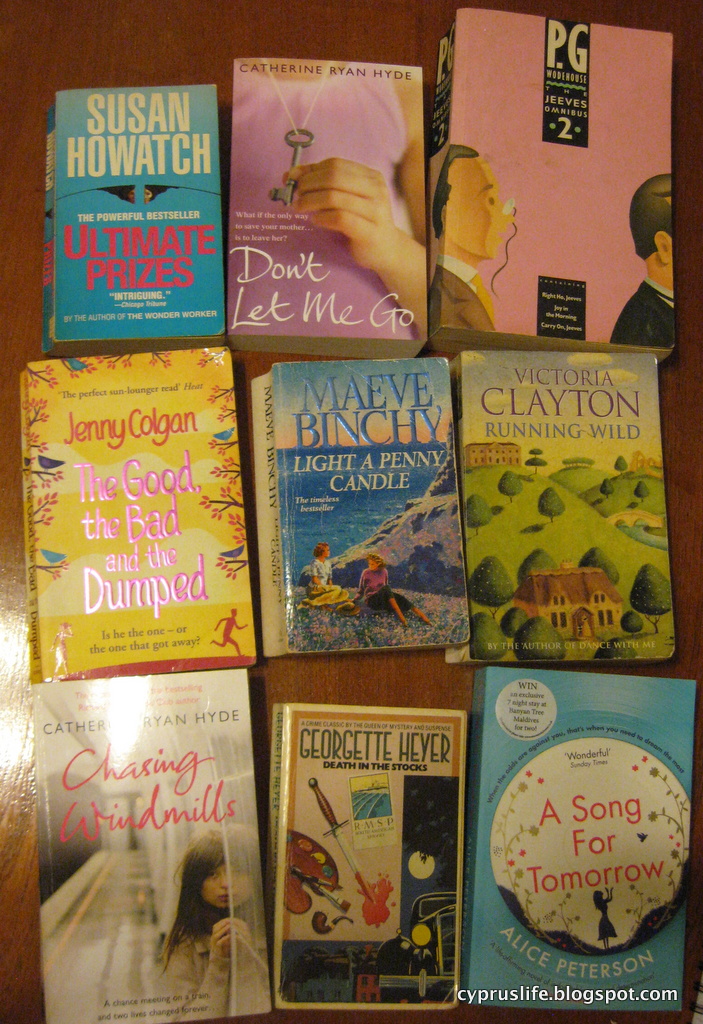
book covers of nine novels
I read nine novels in this period - or eleven, depending on how they're counted!

'Ultimate Prizes' by Susan Howatch is the third in her thought-provoking and often shocking series about the Church of England in the mid-20th century. As with the previous time I re-read it, I hadn't recalled it with much enjoyment, yet found it unputdownable towards the end. Best read after the first two in the series.

Next I decided to read 'Don't Let me Go' by Catherine Hyde Ryan. This was a gift for my birthday a year earlier, which somehow I had not yet read - and I enjoyed it very much. All based around an eclectic mixture of people living in a block of flats, helping a neglected but very likeable ten-year-old girl.

After two novels of such high drama, pulling on the heartstrings and making me think, I decided to indulge myself in some classic Jeeves and Wooster. I hadn't read 'The Jeeves Omnibus 2' (by PG Wodehouse) for a long time. And here's where I don't know whether to count this as one or three; it's one volume, but three individual Wodehouse books: 'Right-Ho Jeeves', 'Joy in the Morning', and a collection of short stories, 'Carry On, Jeeves'. I thought it might be a bit much reading three Wodehouse books in a row, but it wasn't a problem at all. Wonderful writing, great humour, and no political correctness at all.

I try to vary the style of novel I read, so next I chose 'The Good, the Bad and the Dumped' by Jenny Colgan. I bought this a while ago at a thrift store. Colgan writes very light fiction, in the genre sometimes known as 'chick-lit', but I like her style. This one is a rather odd plot, where a newly engaged girl explores her past by visiting all her ex-boyfriends. Pleasant enough holiday reading.

Next I read 'Light a Penny Candle' by Maeve Binchy. This is one of her earlier novels, which I hadn't read since the year 2000. It's very well written, with lovely pictures painted of life growing up in rural Ireland during the second world war, contrasted, later with life for young adults in London. But the ending was, in my view, very depressing.

'Running Wild' by Victoria Clayton is another character-based novel, based in the 1960s. Most of this author's novels are out of print, and I found this second hand. It's a delightful story about a young woman running away to Dorset after deciding that she has to cancel her wedding. Beautifully written, on the whole, with the author's usual sprinkling of literary references.

I've been trying to vary the authors I read, but didn't succeed in another twenty different authors for this period. I embarked on 'Chasing Windmills' by Catherine Hyde Ryan, a recent birthday gift, having temporarily forgotten that I read another of her books only a few weeks earlier. This one is very different, featuring two lonely and stressed young people who meet by chance on the New York subway.

As a deliberate contrast, I followed this with 'Death in the Stocks' by Georgette Heyer, While I like Heyer's historical romance books best, I have enjoyed most of her mid-20th century detective ones too. This is, in my view, one of the better ones plot-wise, although her characterisation is always excellent. I did guess 'whodunit' before the end, but it wasn't obvious until quite a way through.

The last novel I read in this set of twenty books is 'A Song for Tomorrow', by Alice Peterson. This, as I discovered while reading it, is a fictionalised biography of Alice Martineau, a young woman who fought against the odds to become a singer with cystic fibrosis. Very moving in places.

Miscellaneous
And finally... I read just one 'miscellaneous' book that doesn't fit into any of the above categories. This one, 'Survival Games Personalities Play' by Eve Delunas' looks at the subconscious strategies used by people of different temperaments when stressed. It includes an overview of the Keirsey temperament system, and made very interesting reading.

Saturday, March 11, 2017

Twenty books so far this year

After the first hints of spring, this weekend, as so often happens in March, has returned us to chillier weather. It rained yesterday, on and off, and although it wasn't predicted to start raining until eight o'clock this morning, the heavens opened around 7.15 when my friend Sheila and I were almost at the end of our walk. We didn't have umbrellas and weren't wearing raincoats... we were drenched.

As Sheila has decided to write about the books she reads each month, I thought I might take a short break from writing about living in Cyprus, and do something similar. I write reviews of all the books I read on my book reviews blog,  but more people visit this one.  I challenge myself to read a hundred books each year; that doesn't sound like very many, but life gets in the way and some days I read only a page or two.

I've finished twenty books so far this year, so I'm currently on track. Rather than write about them chronologically, I've listed them below in categories.  My aim is to read a couple of Christian non-fiction books each month, four novels, one writing book, and one 'other' - maybe a biography, or a self-help book, or one about personalities, or that catch-all 'miscellaneous'. Most of the novels I read are in the genre of women's fiction (relationship/character-based, primarily) but I also like reading and re-reading some teenage fiction. I try to slot in a few light crime novels too, to make a change now and again.

I usually have about six books that I'm reading at any moment; they're listed in my sidebar if anyone's interested. Likewise, if you're curious to find out more of what I thought about any of them, links given below are to the reviews on my book blog.

Christian books 

At the start of the year we were in the UK visiting relatives, so I was mainly reading on my Kindle.  I wasn't particularly impressed with 'Meeting Rich', which is almost too short to count as a book, but it was quite well written, and passed the time.

Accidental Saints by Nadia Bolz-Weber
I then started reading one of the books I was given for Christmas: 'Accidental Saints' by Nadia Bolz-Weber. I wish this book didn't contain such strong, sometimes crude language, because it's extremely well written otherwise, and very thought-provoking. The author is a Lutheran pastor who runs an alternative and inclusive church, and while some of her ideas are quite controversial, she writes with compassion and humility, and I thought it excellent.

The third Christian book I finished this year, again on my Kindle, was 'The Jesus Training Manual', a title which almost put me off reading it. However, it was well written, if a little repetitive in places: a mixture of biographical account, as the author's faith and theology underwent some significant changes, and some teaching of the kind which we'd first heard in the Vineyard Church we belonged to for a couple of years back in the 1990s when we lived in the United States.

Then I read a book which I found on one of our shelves with a much more appealing title: 'Following Jesus without embarrassing God', by Tony Campolo.

- So I succeeded in my aim of two per month, and hope to finish the two I'm currently reading by the end of March.

Novels 

The first book I finished reading was on my Kindle, one I started on our flight to the UK a couple of days after Christmas. 'Passing Shadows' by Della Galton was ideal holiday reading; it's a romance featuring an artist and a woman who runs an animal centre.

The Shepherd's Crown by Terry Pratchett
I then embarked on 'The Shepherd's Crown' by Terry Pratchett, which I was given for Christmas.  It was a little bittersweet, knowing it was the last book Sir Terry wrote before he died; I love the way it ties up so many loose endings, and that it's the last of his series for older children and teenagers. It was moving as well as having amusing moments, and I was very pleased to have read it at last.

'Summer on the River' by Marcia Willett was the next novel I decided to read. That was another Christmas present, and I started reading it on our return flight to Cyprus... then found I could barely put it down. As with most of this author's stories, it's character-based and about different kinds of relationships. I liked it very much.

I then decided I should finish 'Elsie's Kith and Kin', a book I had been reading on my Kindle, off and on, for quite some time. I was quite pleased when I first discovered the 'Elsie' series free to download, having read about them in the Chalet School books. I worked my way through a couple of them some years ago.  I didn't much like this one, though, and doubt if I'll read any more.

Come Rain or Come Shine by Jan Karon
Back to my Christmas books, and I had immense pleasure reading Jan Karon's latest, 'Come Rain or Come Shine'. I've loved all her Mitford series, featuring the delightful (and now retired) Father Tim and his wife Cynthia. This one features a wedding, and is best read after the rest of the books.

After that I read yet another Christmas book, 'The Great Christmas Knit Off' by Alexandra Brown. It's lighter than the previous books I'd been reading, but moves at a good pace and is surprisingly thought-provoking in places. I hadn't read anything by this author before, but thought that a book about knitting made a nice change from the many similar books about cakes or other baking.

Interspersed with new books I like to re-read books I've enjoyed at least eight years previously, and I tend to work through novels by some of my favourite writers. So the next one I picked up was 'Tell Mrs Poole I'm Sorry' by Kathleen Rowntree, a book I had only read once before, as long ago as 2001. I had only the vaguest recollection of the story, and while it's somewhat shocking, it's very well written.

After that, wanting something different, I decided to re-read Frank Peretti's 'The Visitation', another book which I first read in 2001 but have not picked up since. I had vague memories of it being a book that I found pleasanter than I had expected. I liked the first part very much, when a visitor comes to a small American town and starts doing 'miracles'... but it gradually became more suspenseful and quite violent in places. So I doubt if I'll read that one again.

I followed it with another lighter-looking novel, 'Summer with my Sister' by Lucy Diamond, which I acquired second-hand some time last year.  It's another book about relationships - it features the contrast between a high-flying business woman and a single mother who are sisters, and have almost nothing in common.  I enjoyed it.

After that I picked up 'Many Waters' by Madeleine L'Engle, which I don't think I have ever read before, although it has been on our bookcase of teenage books for many years. Rather different from the others in the 'Time Quintet', the fantasy and science are minimal; the bulk of the story takes place on Earth in the time before Noah.  I was surprised at how much I liked it.

The next novel was another re-read: 'An Ocean Apart' by Robin Pilcher, son of the better-known Rosamunde Pilcher. This was his debut novel, and I read it first in 2001. I'd almost entirely forgotten the story, and once again I loved it.  It's character-based, and in places extremely moving.

I followed that with the much lighter 'Horizontal Epistles of Andromeda Veal' by Adrian Plass, sequel to his first 'Sacred Diary' book. Light-hearted fun with a more serious underlying story; an eight-year-old girl with socialist leanings and highly creative spelling is in traction in hospital with a broken femur, and writes letters to friends, acquaintances, and world leaders.

- So, I finished twelve novels in two months, which is more than my planned one per week. Three are intended for teenagers, and there's inevitably cross-over between the genres as five of them would also be considered Christian books.

Writing books

Writing with Cold Feet by Kathrin Lake
I downloaded on my Kindle 'Back to Creative Writing School' by Bridget Whelan a long time ago, and dipped into it several times before deciding to read it to the end. It takes the format of a creative writing class, so could be studied over the course of several weeks. I liked it very much, and thought it helpful, but didn't do most of the exercises.

I then read 'Writing with Cold Feet' by Kathrin Lake, a slim volume that contains a great deal of wisdom. It doesn't give instruction about writing, or grammar, and doesn't have any exercises as such. Instead it looks at reasons why so many writers feel immense resistance when they sit down at the computer to write. I thought it extremely helpful and inspiring.

Miscellaneous

How it Works: The Mum (A LadyBird Book)
The first 'other' book I read was very short, and almost a cheat to include it in a list of books read, as it took me no more than ten minutes to read it, punctuated by reading bits aloud or chuckling. However, I thought it a wonderful book so wrote about it on my blog - 'How it Works: The Mum', another book which I was given for Christmas.   It's a Ladybird book, in the style of the children's books that were so popular in the 60s and 70s; anyone who has not come across Ladybird books of that era would probably find it bizarre!

And finally... 'The Procrastination Equation' by Dr Piers Steel. It's somewhat of an academic work, by a writer who has done extensive research into what makes people procrastinate, discovering three main styles of procrastination, and outlining what may (or may not) help with working through it. Very interesting information about the way our brains work; a little heavy in places, but overall I thought it excellent.